Cider Tasting with Bill Bradshaw and 9 Washington Cideries at Capitol Cider in Seattle

The Washington Cider Week posts continue!  The previous week brought me to Seattle Cider and the Burgundian (Eden & Alpenfire event ) on Thursday night to kick off Washington Cider Week, and Cider Summit Seattle 2015 on Friday & Saturday (see post 1 for tasting notes and post 2 about the event & photos).  This week brought me to Capitol Cider for a tasting event with Bill Bradshaw and nine Washington cideries (Tues Sept 15 2015, covered here), and to the Schilling Cider House for the 2 Towns tap night (Thurs Sept 17 2015, covered soon).

[Additions after initial post release are in brackets, and incorrect information is struck through.  Thanks Dave from Whitewood for the corrections and extra info!]

I had been to Capitol Cider once before, but it was probably over a year ago.  I really didn’t like that first visit much at all, as nothing really went well, from the food (it was early lunchtime on a weekend but they mostly had brunch items, not lunch), to the service (grumpy bartender), to the cider (didn’t like anything I tried, and the bartender wasn’t too forthcoming with samples; I would have preferred a flight, which they now offer).

Much has changed there since then!  Their service was good this time (I give them some slack as they had to give everyone a few handouts and 9 different ciders! in addition to taking any other orders).  Their bottle list has much improved / expanded.  However, unfortunately it is mostly just a list (they only have the smaller bottles in some fridges literally at floor level near the entry).  As it is a printed list, it easily gets out of date (both times I bought bottles they only had half of what I wanted, although I was requesting more rare & special release selections).  However, Capitol Cider isn’t really my sort of scene.  Getting there & parking is a nightmare for one.  The Schilling Cider House is honestly more my style, plus they have more taps (32) and a larger bottle selection (which you can see and look at the labels).

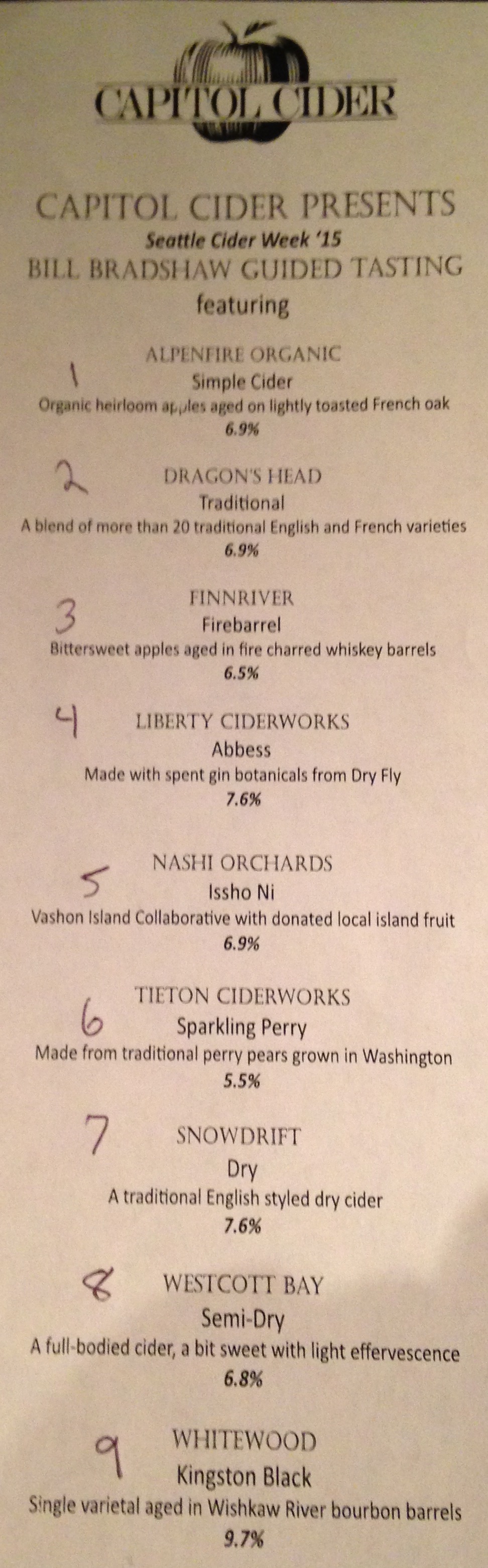
Bill Bradshaw is a cider expert who hails from the UK and has written several books about cider, among other things.  This special event was a guided tasting through ciders from nine Washington cideries.  Dave White from Whitewood Cider apparently helped Bill Bradshaw choose the cideries, although I’m not sure how the ciders got chosen (it didn’t appear Bill, Dave, or the cideries themselves chose the cider selections, so it may have been availability / mostly what they already had on tap).  [The cidermakers chose the ciders poured, although there was some confusion from one of the cideries as far as their selection.]  They are for the most part some of the more traditional cideries in WA.  For $30, I got a flight of nine ciders (probably a 3 or 4 oz pour each), plus a full glass of the cider of my choice.  I unfortunately had to drive, so I made due with my flight (finishing my favorite ciders and leaving the rest) and a couple tastes afterward, but no full glass of cider.  Most of the cideries had one or more cidermakers on hand who came up on the stage and explained about their chosen cider.

They were also selling Bill’s books, he was signing autographs, and many of the cideries brought some bottles which they opened after the event and poured tastes.  During the event there was a slideshow of Bill’s photos.  They also played the teaser for a documentary titled ‘Cider Hunters’ that he and Pete Brown (co-author of World’s Best Ciders) are fundraising for, about the history of cider in the U.S.  Cider is “the drink that built America”.  He described how it disappeared, breweries moved in, the craft beer movement started in the ’80s, and now we are in the age of craft cider, built from the beer explosion.  Throughout the event there was some discussion on whether cider is more similar to wine or beer.  It depends on who you ask.  Bill seemed to lean towards beer, but I’d probably lean more towards wine as scientifically speaking cider is a type of fruit wine, although the ABV of most ciders is more similar to beer than wine.

The event was also unfortunately at 6pm on a weeknight, which is late for me as I go to work at 6am.  So, I didn’t get to stay too long after they were done with the guided tasting a bit after 8pm.  I was surprised there were still some empty seats, as I had expected this to easily sell out (I purchased my ticket a few days in advance over the phone to ensure I wouldn’t get turned away).  Considering that almost all of the 9 cideries were represented and that many brought more than one person, plus the Capitol Cider folks and such, there were almost as many folks that were working the event as attending the event!  They were setting up live music and it looked like the party kept going after I left.  The event was held in Capitol Cider’s basement bar area, which has a small stage, tables, bar height tables, a bar, pool tables & such, and restrooms.

I had an awesome time!  Many of the cidermakers I had been chatting with the previous week were there.  I also hadn’t previously tried 6 out of the 9 ciders they were pouring, which is quite good odds as they are all local.  I tried to take some photos, but the lighting was pretty horrible.  Click to biggify.

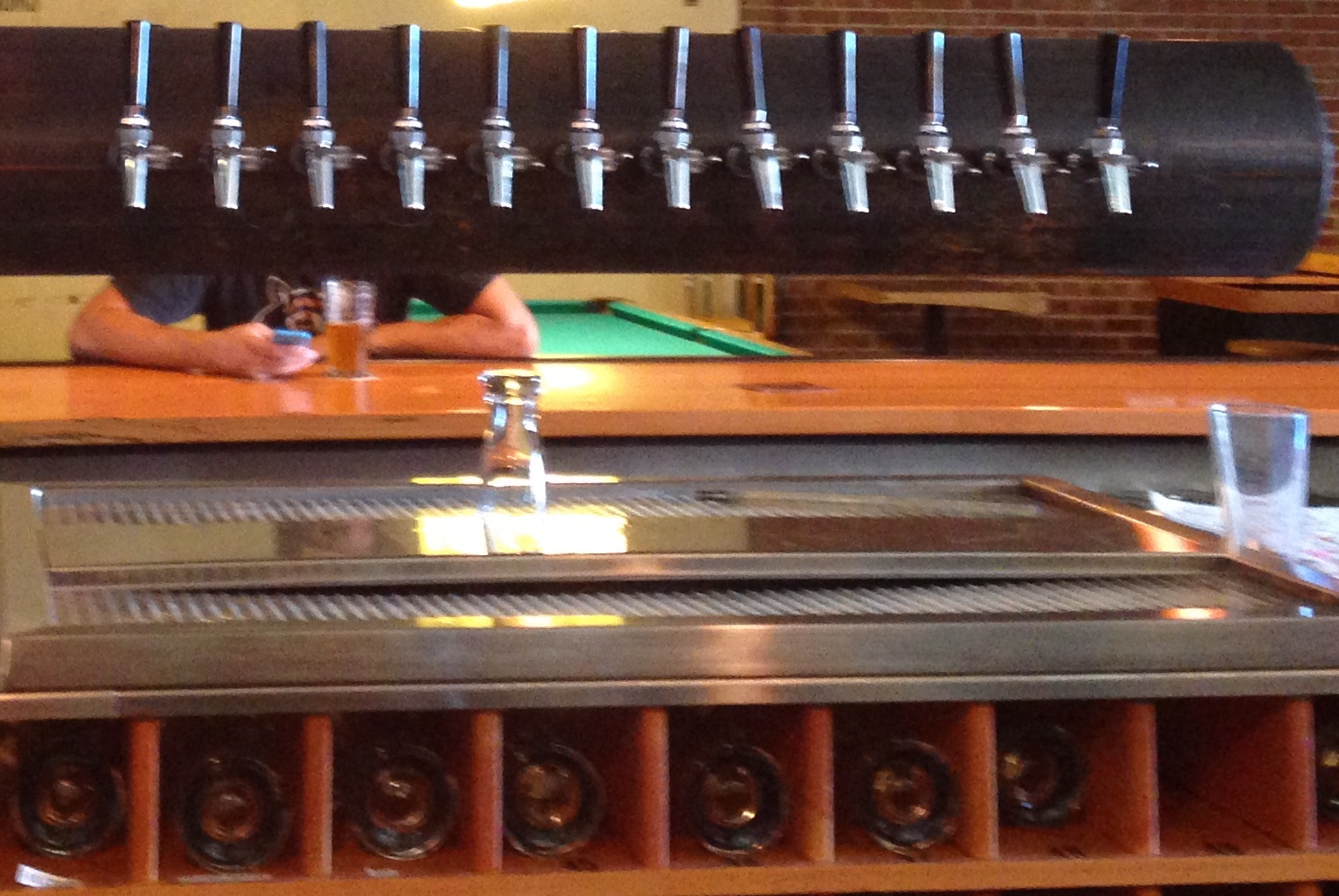
bar
<bar area on the left. tables in the middle, and the stage was to the right>

cider hunters
<Bill Bradshaw himself>

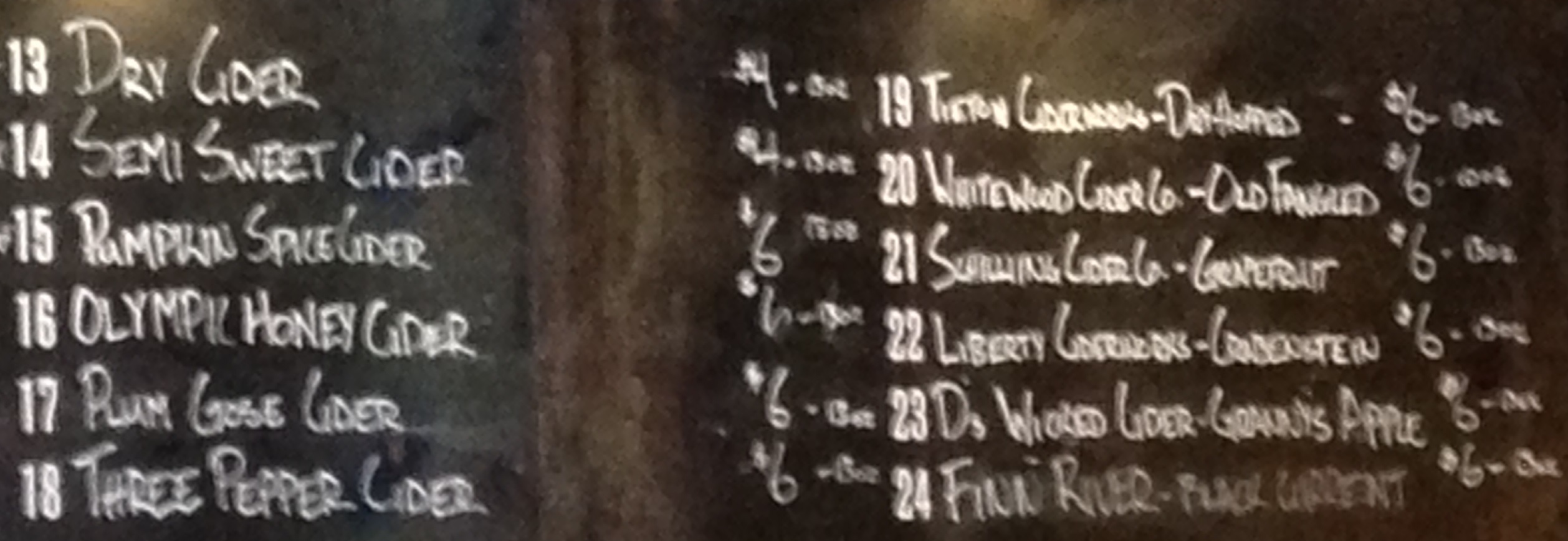
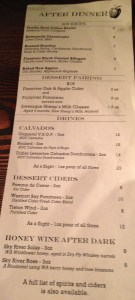
Upon sitting down I spotted a clipboard full of menus.  They had menus for their cider tap list, beer & regular cocktails, cider cocktails, cider flights, food, and a cider bottle list!  I focused on photographing the cider stuff.  Weird angles to avoid glare; sorry.  Their food menu (gluten free restaurant by the way) is on their website.  I ate some pho before the event as I wasn’t sure if it would work well to try to eat dinner during it, and their menu is a bit fru-fru for my liking.  That was a good call as its difficult enough to taste cider and take notes!  I did however order some creme brulee, which was pretty disappointing, as it was almost half fruit, small, and expensive.

tap list desserts

cocktails flights

Now, on to the nine ciders of the night!  They were tasted in an order to try to minimize the effect the last would have on the next, not in the numerical (alphabetical) order.  I believe that all the ciders which were on their tap list were tap pours, and the remaining two (Nashi and Westcott Bay) were bottle pours.  I really enjoyed hearing about the ciders as I was tasting them.  They also took audience questions / comments.
event list 9 pours

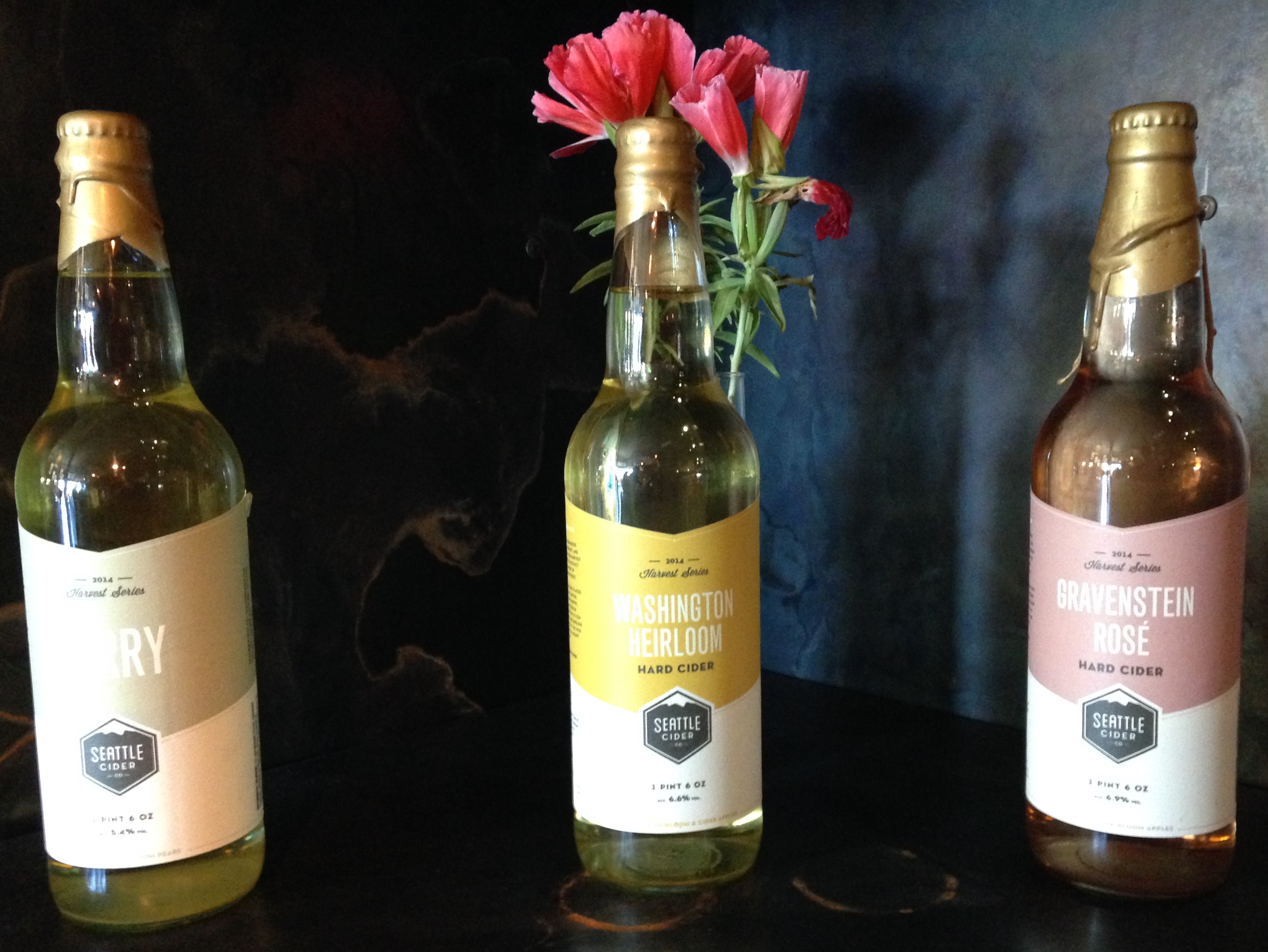
(6) Tieton Ciderworks  Sparkling Perry, 5.5% ABV.  I hadn’t tried this one before, but have tried a number of varieties from Tieton.  Its part of their “top shelf ciders” along with the Cidermaker’s Reserve (which I’ve reviewed), available in pretty 500ml bottles.  Craig Campbell, a grower at Tieton’s orchard (and the one who started Tieton with his wife), was the presenter.  It is made from 11 varieties of perry pears grown in their orchard (which is the largest cider apple & perry pear orchards in Washington, but still small by orchard standards).  Craig noted that pears are much more difficult to grow and press into juice than apples.  This perry was made using a French keeving technique, where it is slow fermented with wild yeast for 5 months.  He said this method can calm some of the tannins of the perry pears.  Craig also noted that this perry was just bottled/kegged in May, and may taste even better after bottle aging for 1-2 years.  On the drier side of semi-sweet.  Mild tartness, bitterness, and tannins.  Medium bodied.  Unique strawberry notes.  I would have liked more carbonation, but I imagine my sample may have sat for a bit / not been able to be poured correctly due to the size.  Pretty tasty!

(5) Nashi Orchards Issho Ni “Together” Cider, 6.9% ABV.  This was my first time trying anything from Nashi Orchards, although I have one of their perries at home.  Jim Gerlach, owner and cidermaker, was there to present.  This is one of the few (two?) ciders that Nashi Orchards makes; they specialize in perry.  Their orchard is full of asian pear varieties and they pride themselves in using traditional cidermaking methods.  This cider was made using apples from the Vashon Island community, which included a lot of crabapples and heirloom apple varieties.  It was dry fermented and not backsweetened.  Smells like English cider, of rich bittersweet apples.  On the drier side of semi-dry.  Moderate to high tannins and bitterness.  Mild tartness.  I liked the bark better than the bite on this one (smelled better than it tasted).  It was a bit too high in tannins & bitterness for my liking, likely from the high crabapple content.  I imagine like most ciders, if I was having a full glass, I would have liked it better (vs. having a tasting glass).

(7) Snowdrift Dry, 7.6% ABV.  I’ve tried a number of Snowdrift cider varieties; my favorites so far are Red (made from red fleshed apples) and Cornice (barrel aged).  This one was presented by someone from Capitol Cider, but Snowdrift sent along some notes.  It was commented that they have a small orchard and cidery which is ideally located in East Wenatchee, with its hot summers and cold winters, ideal for cider apples which thrive with temperature variations.  Their orchard is mostly Yarlington Mill cider apples, but they have over 40 apple varieties.  They noted this cider won an international contest, which is rare for a PNW cider (vs. a UK cider).  Semi-dry.  Clean plain apple scent.  Low in tannins, bitterness, acidity, and tartness.  Some citrus notes, but I otherwise didn’t pick up much.  Smooth.  The alcohol is well hidden.  I found it kinda boring, but a very solid selection.

(2) Dragon’s Head Traditional, 6.9% ABV.  This is the variety I tried at Cider Summit.  I also have a bottle of their Wild Fermented at home.  Wes Cherry (co-owner with his wife) presented.  They are from Vashon Island, where they grow over 70 varieties of cider apples, mostly English and some French.  They moved their cidery from the Seattle area 5 years ago to start the orchard.  This year was their first significant harvest from their own orchard.  This cider underwent malolactic fermentation (which is when malic acid is converted to lactic acid, and can often be considered a fault but some cidermakers desire it) which was arrested to retain some residual sweetness and give some butterscotch notes.  Semi-dry.  Higher acidity.  Citrus and fruity notes.  Low to moderate tannins and bitterness.  Mild tartness.  I really enjoyed this cider.  Probably as it had a little more complexity to it and didn’t go too overboard on tannins and bitterness.

(8) Westcott Bay Semi-Dry, 6.8% ABV.  This was my first time trying any ciders from Westcott Bay.  Presented by Capitol Cider.  Westcott Bay has their own cider orchard in the San Juan Islands which dates back to the 1870s.  They re-planted in the mid 1990s and released their first cider in 1999.  They make more traditional apples using cider apple varieties such as Kingston Black, Yarlington Mill, Dabinett and Sweet Coppin.  Semi-sweet.  Similar to English cider.  Bitter finish, but still only mild to moderate.  Moderate tannins.  Bolder flavor.  I really enjoyed this cider.  I like ciders like this which have a bold flavor profile without being too bitter or too high in tannins.

(1) Alpenfire Simple Cider, 6.9% ABV.  I’ve had a number of ciders from Alpenfire, but hadn’t even heard of this one (it looks like it may be tap only at this time?).  I particularly like their Apocalypso and Spark! ciders.  Presented by Nancy Bishop.  They described themselves as a more traditional cidery whose ciders tend to be higher in tannins.  They planted their cider apple orchard in 2003, then needed to learn how to use it, and get people to buy their ciders!  This variety is their least traditional cider, made from basic heirloom and dessert apples.  It is sweeter and described as having some honeysuckle aromas, and was lightly oak aged.  On the sweeter side of semi-sweet.  Slightly hazy.  I picked up some honey, pear, and mild herbal notes.  No significant tannins, bitterness, acidity, tartness, etc.  I thought it was rather complex for a simple cider!  I really enjoyed it.

(4) Liberty Ciderworks Abbess, 7.6% ABV.  I’ve had a number of ciders from Liberty.  Presented by Rick Hastings.  This is a newer cidery from Spokane, open about a year and a half, and they currently produce 7,500 liters a year.  Unlike many of the cideries featured, they don’t have their own orchard.  However, they have found ways (probably at great expense) to obtain cider apples, primarily from three different orchards, including from Garfield WA.  They also use a lot of crabapples.  They aim to keep the apple centric, and don’t plan to do flavored ciders; their Turncoat Dry Hop cider and this one is as flavored as they get.  I particularly like their Manchurian Crabapple and English Style ciders.  Rick commented the Spokane cider market is growing slower than Seattle, but is still growing.  Liberty was tasting their new Abbess variety, with gin botanicals. Made from Empire, Macintosh, and Manchurian Crabapples.  Its been out for about a month in their tap room and has been popular.  English cider scent with a hint of botanicals.  On the drier side of semi-dry.  Bold flavored.  A hint of botanical flavor.  Significant tartness, bitterness, and tannins.  I’m not a huge fan of this one, but it didn’t have any faults and is a solid selection.

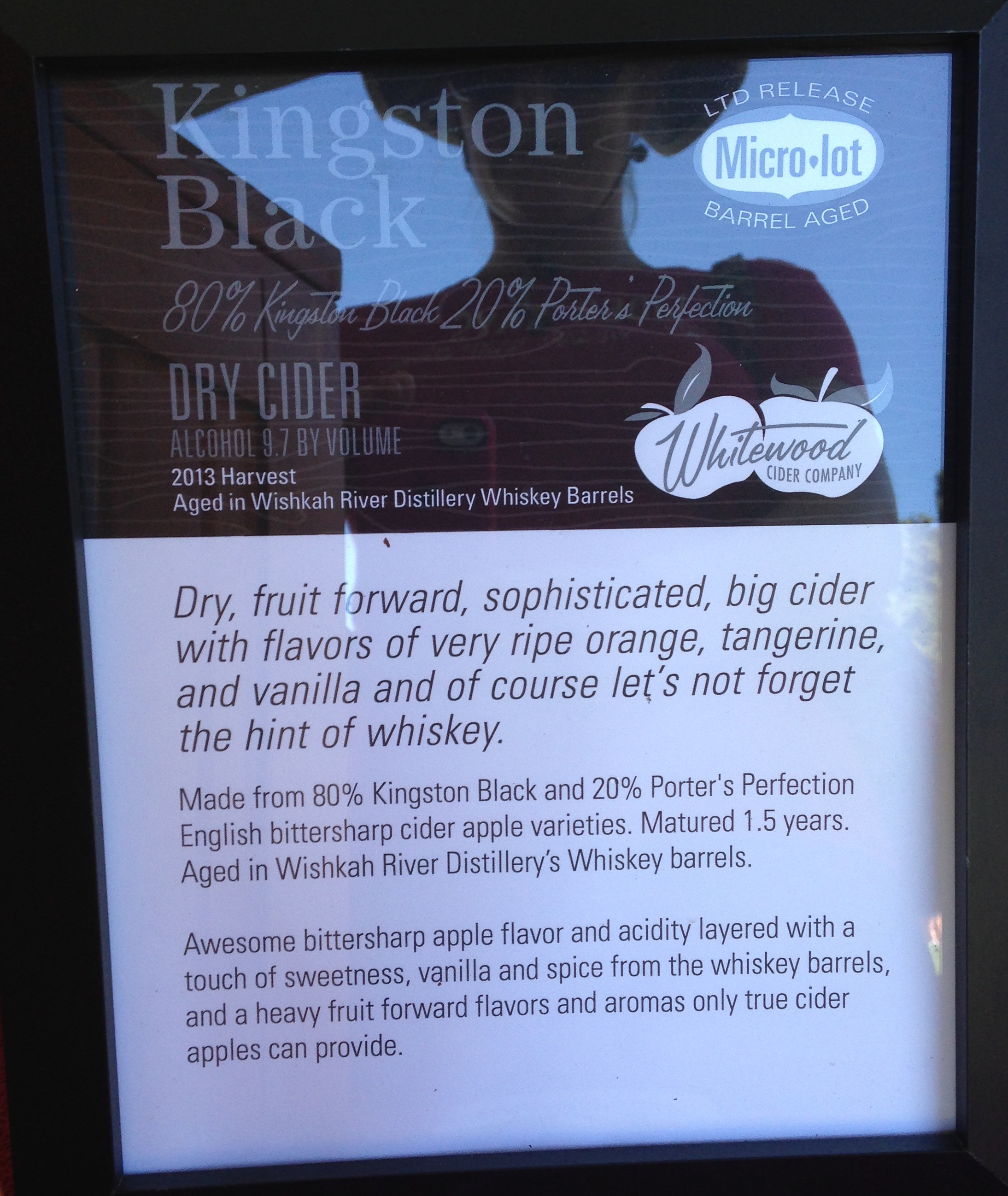
(9) Whitewood Cider Kingston Black, 9.7 ABV.  I had tried this cider at Cider Summit, but didn’t mind having it again in the least, as it was one of my favorites!  I’ve only tried Whitewood’s Summer Switchel and this one, but look forward to trying some others.  Presented by Dave White.  Whitewood released their first ciders in 2013, so this is their third season.  Dave aims to make more traditional ciders, with heirloom & cider apple varieties.  He noted their Southsounder cider is made from apples within 20 miles of Olympia.  This Kingston Black cider was made with champagne yeast, but Dave hopes to eventually make a wild fermented batch.  It is 80% Kingston Black and 20% Cornish [Porter’s] Perfection, much to Dave’s disappointment.  He aimed to make a single varietal, but apparently the Kingston Black apples were sliding around too much during pressing or something, as they were sweated to bring out more flavor.  Doing an almost single varietal Kingston Black cider must have been very expensive, as they are rare.  He noted some Woodinville Whiskey was added to the barrel before aging.  [The barrel was from Wishkah River Distillery in Aberdeen, WA.]  I don’t like aged spirits, but love the flavor in a cider.  This cider was taken out of fermentation in early 2014 and barrel aged until just recently.  Dry.  Whiskey and vanilla notes.  Rich bold flavor.  Very smooth, with hidden ABV.  Low to moderate bitterness.  Yum!

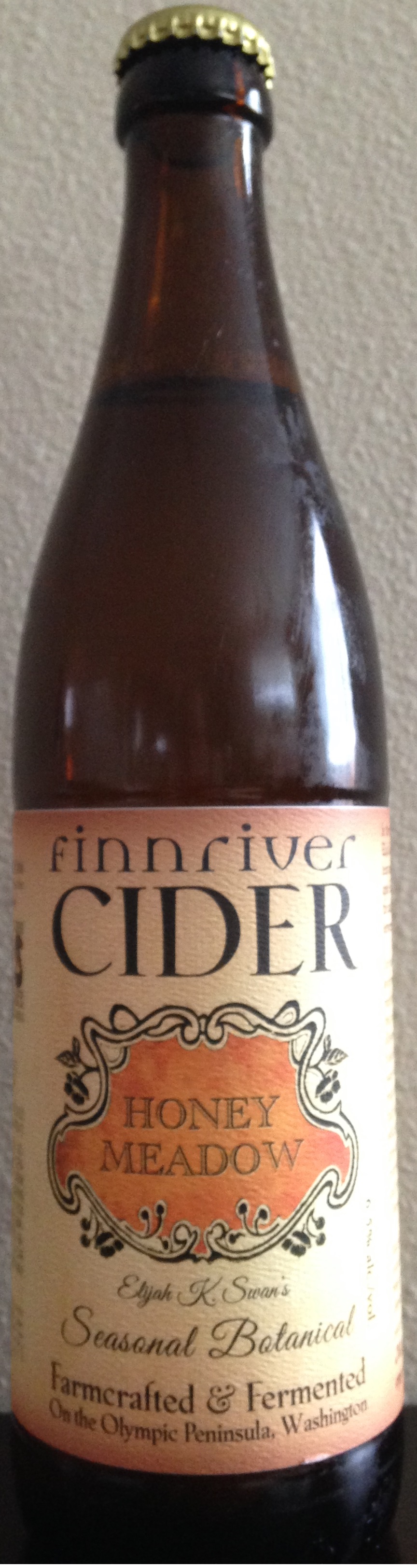
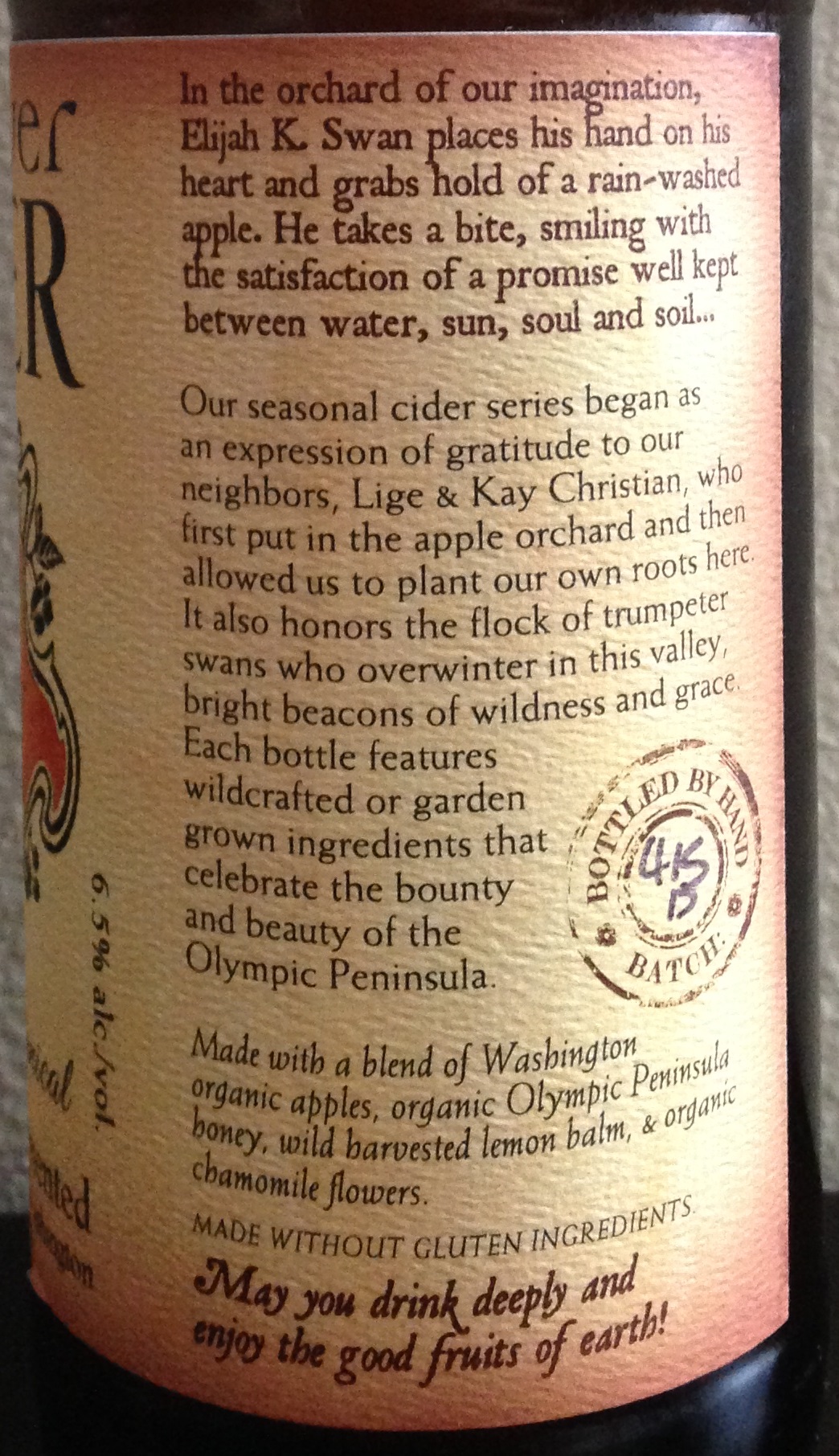
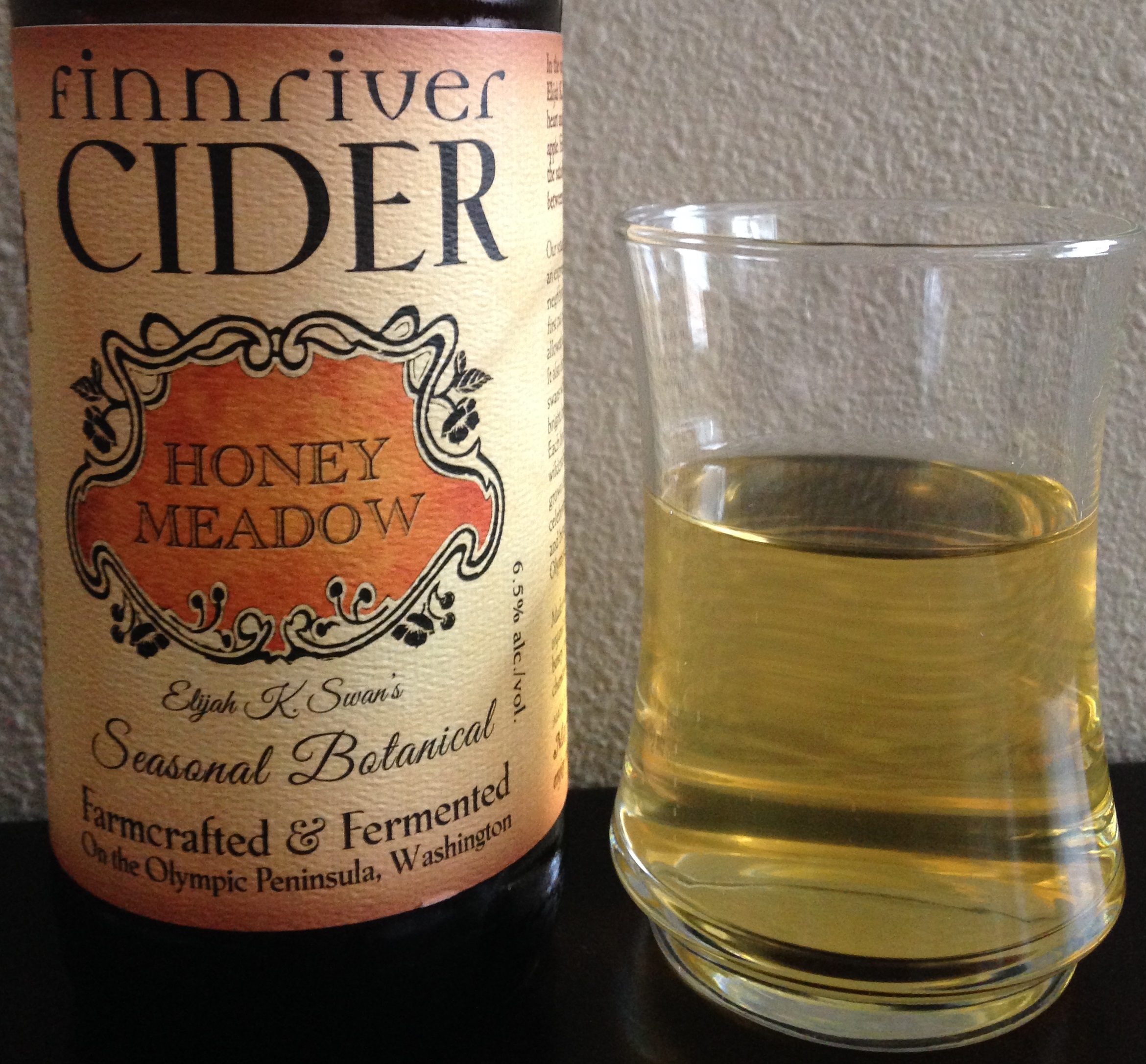
(3) Finnriver Fire Barrel, 6.5% ABV.  I’ve tried a large number of Finnriver ciders, and even tried this variety quite awhile ago.  I remembered really looking forward to it but being disappointed.  I bought another bottle recently as so many folks enjoy this cider, and I wanted to give it another chance, as my palate has changed. So, here will eventually be a full review of it here. Presented by Eric Jorgensen, a co-founder.  They were described as a small organic farm which started selling cider in 2010.  Eric thinks they were the least traditional of the nine cideries present.  However, he described this as their most traditional cider, as it is made from cider apples.  They started a second orchard three years ago and aim to remain sustainable and organic.  This cider recipe was original produced by Drew Zimmerman, who sold the rights when he retired.  It is made from Kingston Black, Yarlington Mill, and Dabinett cider apple varieties.  This cider is no longer aged in Kentucky whiskey barrels though, as they aim to keep it more local, instead using UT or WA barrels.  This cider has inspired Finnriver to take on other barrel aging projects.  They mentioned they are barrel aging a small batch of their Black Currant cider, which sounds awesome, as that is one of my favorites of theirs, along with Honey Meadow.  Very smooth.  On the sweeter side of semi-dry.  Mild barrel notes.  Bold flavor.  Moderate tannins, bitterness, and acidity.  I was surprised with how much I enjoyed this cider, in contrast to my memory from awhile back.  I look forward to drinking the bottle I have at home!

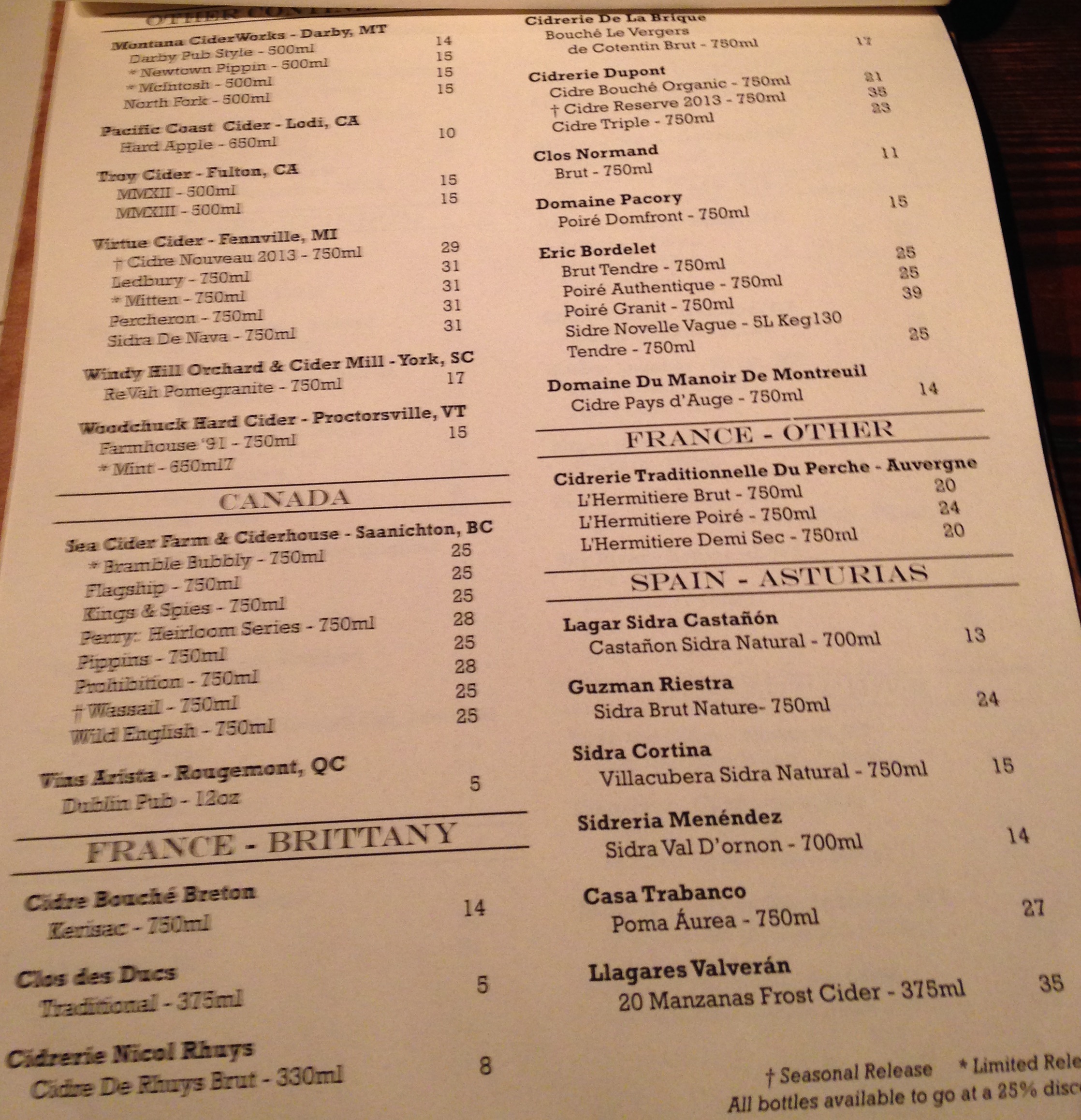
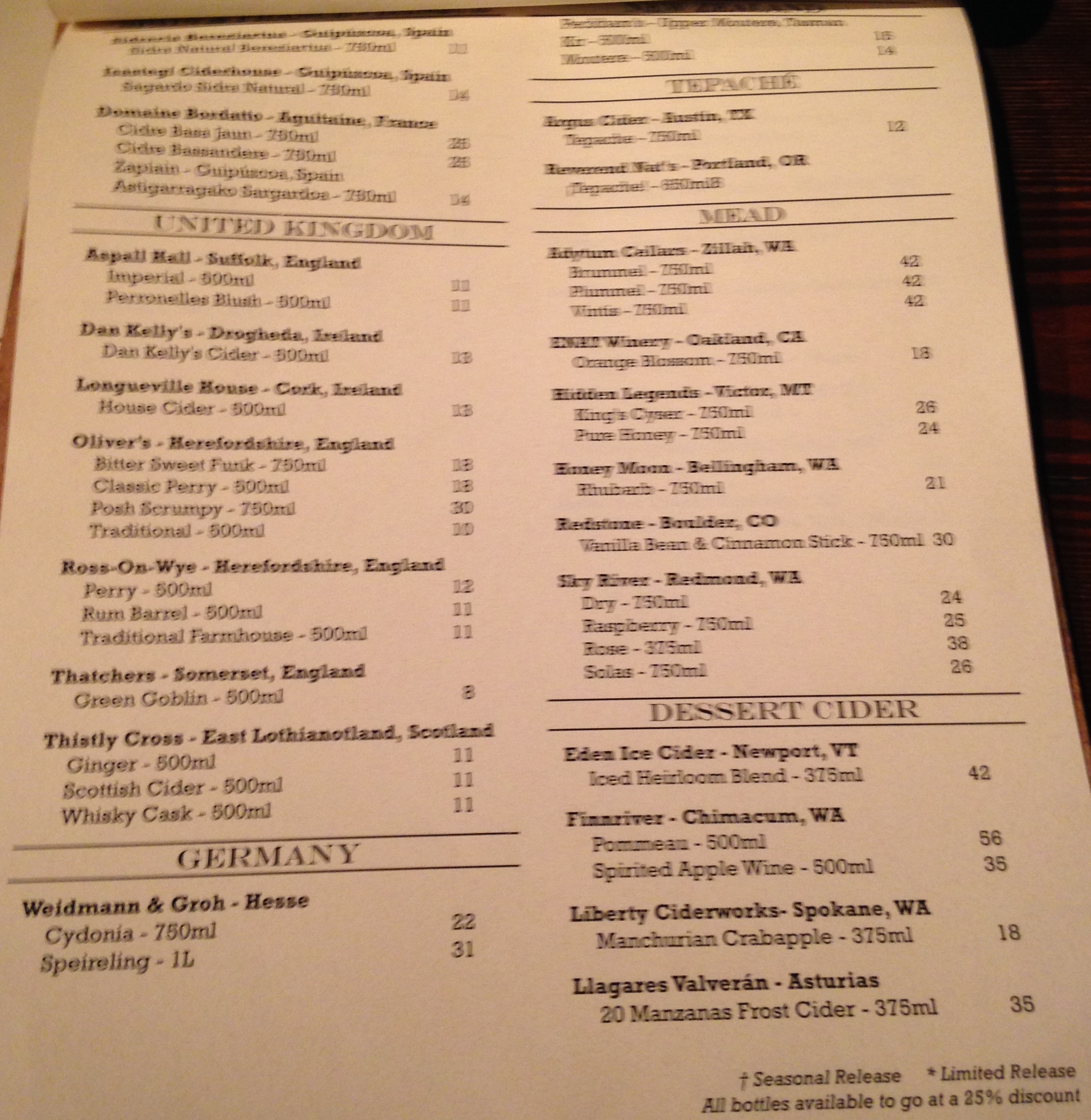
I was interested in buying four bottles to take home from Capitol Cider, but they only had two of the ones I wanted, Virtue The Mitten and AeppelTreow Appely Doux.  I had heard of both but didn’t know they even sold them in WA!  I had been wanting to try The Mitten ever since I got into cider; it often makes top cider lists.  Note that the prices shown on their bottle list below are to drink there, but you get a 25% discount to take home.  That brings their prices just a bit over local bottle shops for most ciders.  The cost to drink a bottle is much less of a markup than most wine lists.  However, with all those ciders on tap, why would you want to?  They initially forgot to apply the 25% discount (they were very busy and I was asked them to go to the back and find specific bottles), so I was very glad I checked my receipt.

bottles

Unfortunately the cider list was stapled at the top, so even taking it off the clipboard I couldn’t get good photos.  The angles are again to avoid glare from overhead lighting.  Impressive bottle list!  However, the win still goes to the Schilling Cider House in Fremont, as you can look at the actual bottles.

list1  list2

list3  list4

list5

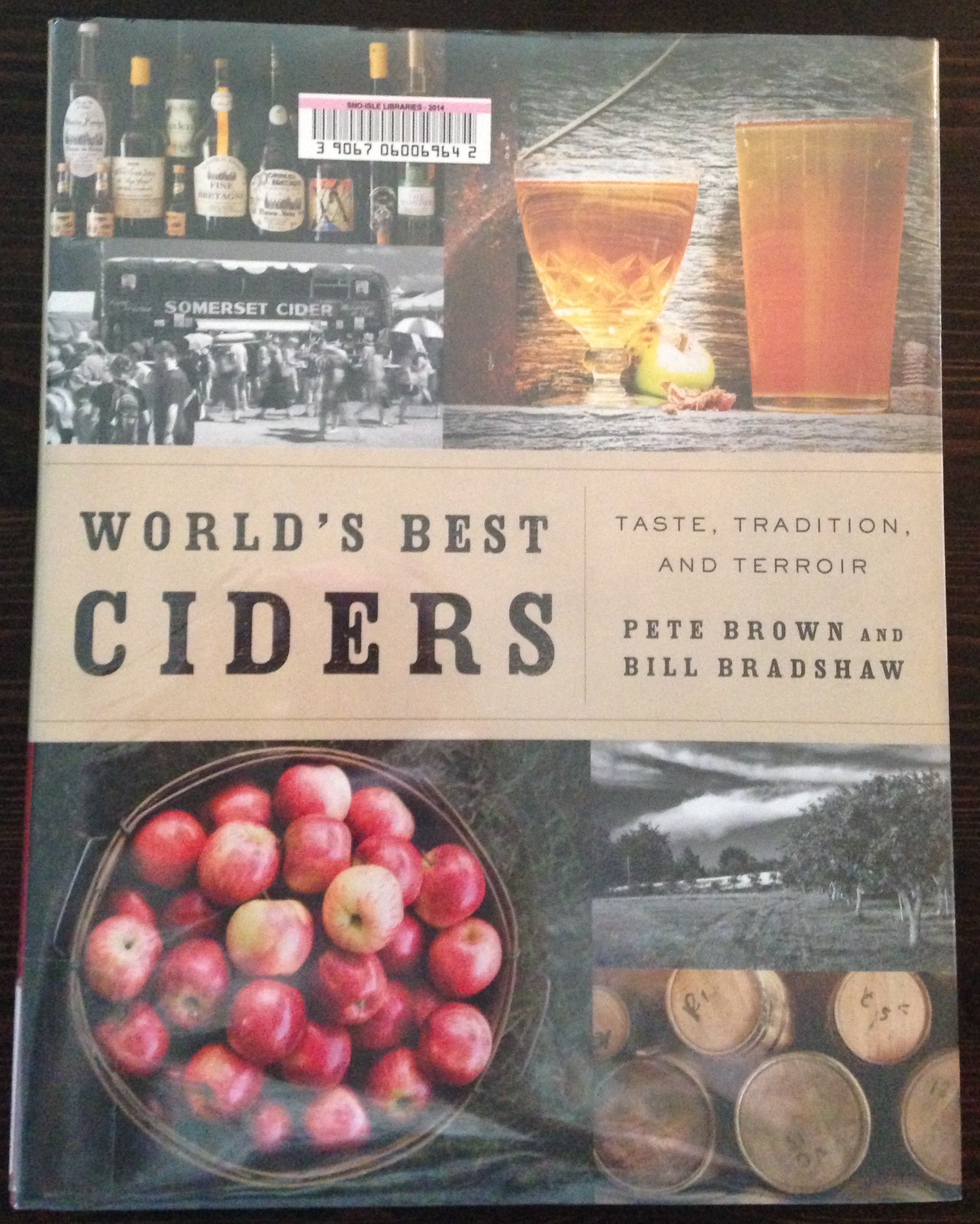
I got my new copy of World’s Best Ciders (which I reviewed here recently) autographed by Bill Bradshaw, and even got to chat with him for a few minutes.

book autograph

Stay tuned for the last but not least Washington Cider Week event post, from the 2 Towns night at the Schilling Cider House!  Like Cider Says on Facebook for the latest info.

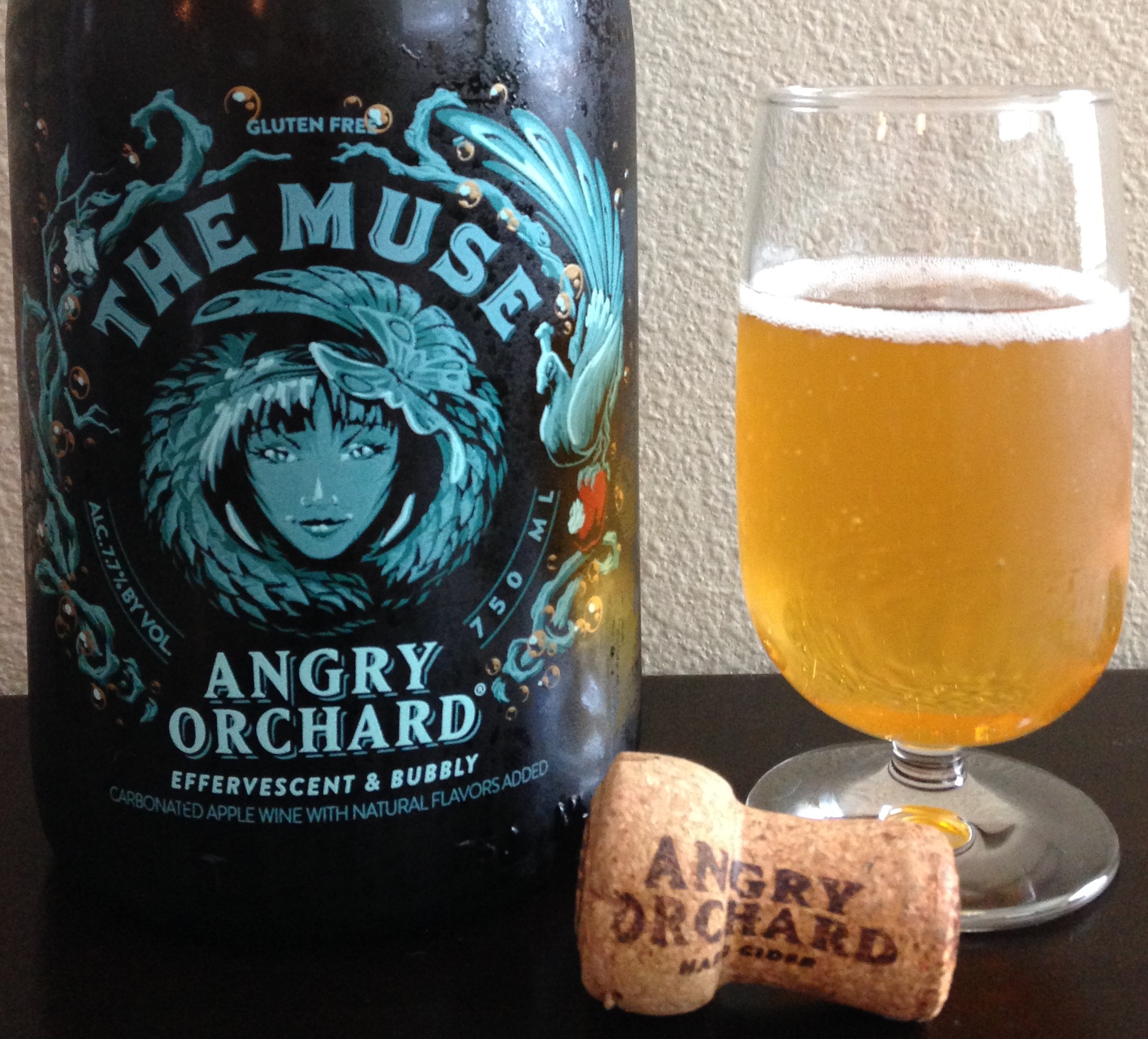
Angry Orchard The Muse

Review of Angry Orchard’s The Muse, part of their Cider House Collection (along with Iceman and Strawman).  I had forgotten about this bottle, as for some reason it was in with our champagne & white wine, instead of with my ciders.  So, especially since I didn’t know how long ago I bought it, I thought I’d better drink this one!

2015-08-30 14.07.17

Cider:  The Muse
Cidery:  Angry Orchard
Cidery Location:  Cincinnati OH
ABV:  7.7%
How Supplied:  750ml corked & caged champagne bottle

2015-08-30 14.07.26 2015-08-30 14.07.45

Availability:  wide release, year round

Description from Angry Orchard:  Our Cider House Collection includes rare and innovative ciders, harvested from our cider makers’ passion and creativity. To bring you these new distinct styles, we experimented with juice blends, wood aging, fermentation techniques, and other traditional processes learned from 15 years of cider making exploration and craftsmanship.

Inspired by the festive nature of slightly sweet demi-sec champagnes and sparkling wines, The Muse is a bubbly, effervescent cider made from traditional culinary and bittersweet apples and aged on French oak. The cider is sweet upfront with a juicy apple aroma and bright acidity, and slightly drying on the finish with a lingering sweet apple note. The French oak adds a subtle wood impression, imparting notes of clove, cinnamon, nutmeg, allspice and hints of vanilla. 7.7% ABV.

Price:  ~$15
Where Bought:  Costco?  Its pretty widely available though, even at the supermarkets near me.
Where Drank:  home
How Found:  Browsing.  I’ve had The Muse and Iceman probably a few times each.

2015-08-30 14.09.53

First Impression:  Darker amber.  High foam & carbonation.  Cooked apple scent.

Opinion:  Sweet to very sweet.  Tastes like a sparkling ice wine.  High carbonation.  Moderate acidity.  Medium bodied.  Effervescent mouthfeel.  No noticeable bitterness, tartness, or astringency.  I don’t pick up any barrel influence or the spices that are mentioned in the description.  I do however pick up some bittersweet apple, cooked apple, and vanilla notes.  There are some poor syrupy and juice-like qualities to this cider.  Longer length finish.  Slightly less sweet than Iceman.  In contrast, Iceman has a higher ABV, some discernible barrel influence, and less carbonation.

Most Similar to:  Angry Orchard’s Iceman.  Check out this post I did with mini reviews of all the Angry Orchard ciders I’ve tried.

Closing Notes:   This cider is pretty good, but I think much better can be had for the money.  Also, I’d really rather support a local craft cidery.  This is however a good introduction to a more craft-like cider product for those with limited cider availability and for those whose palates like a sweet cider.  I have tended towards drier ciders lately and this one is a bit too sweet now for me.

Have you tried Angry Orchard The Muse?  What did you think?

Hard Cider News Edition 3

I think we’re well overdue for a news post here.  These are some recent hard cider news/articles/links/posts I found interesting and have shared on Facebook lately.  To get the latest scoop, like Cider Says on Facebook!

News:

Cider Riot! Signs with Maletis Beverage from Brewbound

A new website to buy cider online launched, ShipCider.com

Woodinville Ciderworks (Woodinville WA) launched at Cider Summit

Rootwood Cider (Chelan WA) launched a few weeks ago

The first LA Cider Fest was last weekend

Craft Cider: How to Turn Apples into Alcohol, a book by Jeff Smith, was released

Cider Made Simple: All About Your New Favorite Drink, a book by Jeff Alworth, was released

“cidery” was added to the Oxford English dictionary

Sicera: Getting Certified in Cider from Cider Craft (cider certification program from United States Association of Cider Makers)

Along came a cider: Milton-Freewater brewer moving up state ranks from East Oregonian

Anheuser-Busch Plans Bud Light Apple from Beer Street Journal

Anheuser-Busch Takes Majority Stake in Michigan’s Virtue Cider from Brew Bound

Also, Cider Guide did a neat cider news recap post lately.

Video/Photos:

Cider Hunters trailer (Bill Bradshaw & Pete Brown are fundraising to do a documentary on cider in America)

Washington Cider Week segment with Alpenfire on Komo in Seattle

New Day Northwest Washington Cider Week segment with Bill Bradshaw

Nashi Orchards on Vashon Island photos from Komo in Seattle

Articles:

Cider & Food Pairings infographic from NW Cider

Your Ultimate Cider Cheat Sheet from Tasting Table

New York City’s Free, Foraged Fruit Makes the Best Cider from Muchies

Everything You Need to Know About Cider (and Why You Should Stop Calling it “Hard”) from SF Gate

The Best Local Ciders This Fall (For When You’re Sick Of Pumpkin Everything) from Brooklyn Magazine

Take a bite out of taxation: the core issues of the CIDER Act from Lexology

Time To Allow Use of Harvest Dates on Cider Labels from Cider Journal

Critical Drinking – Greg Hall of Virtue Cider from Good Beer Hunting

Inherited Heritage: Discovering Perry in the Northwest from Sip Northwest

No Cause for Ferment Over Sale of Virtue Cider to Conglomerate from Cider Journal

Upcoming Events:

Cider Swig, Sept 26, Gig Harbor WA

2 Towns Harvest Party (5th Annual), Oct 3, Corvallis OR

NW Ciderfest, Oct 10 & 11, Pioneer Square in Seattle WA Portland OR

CiderFest North Carolina, Nov 7, Asheville NC

Cider Week NYC, Nov 6-15, New York City NY

Franklin County Cider Days, Nov 7 & 8, Franklin County MA

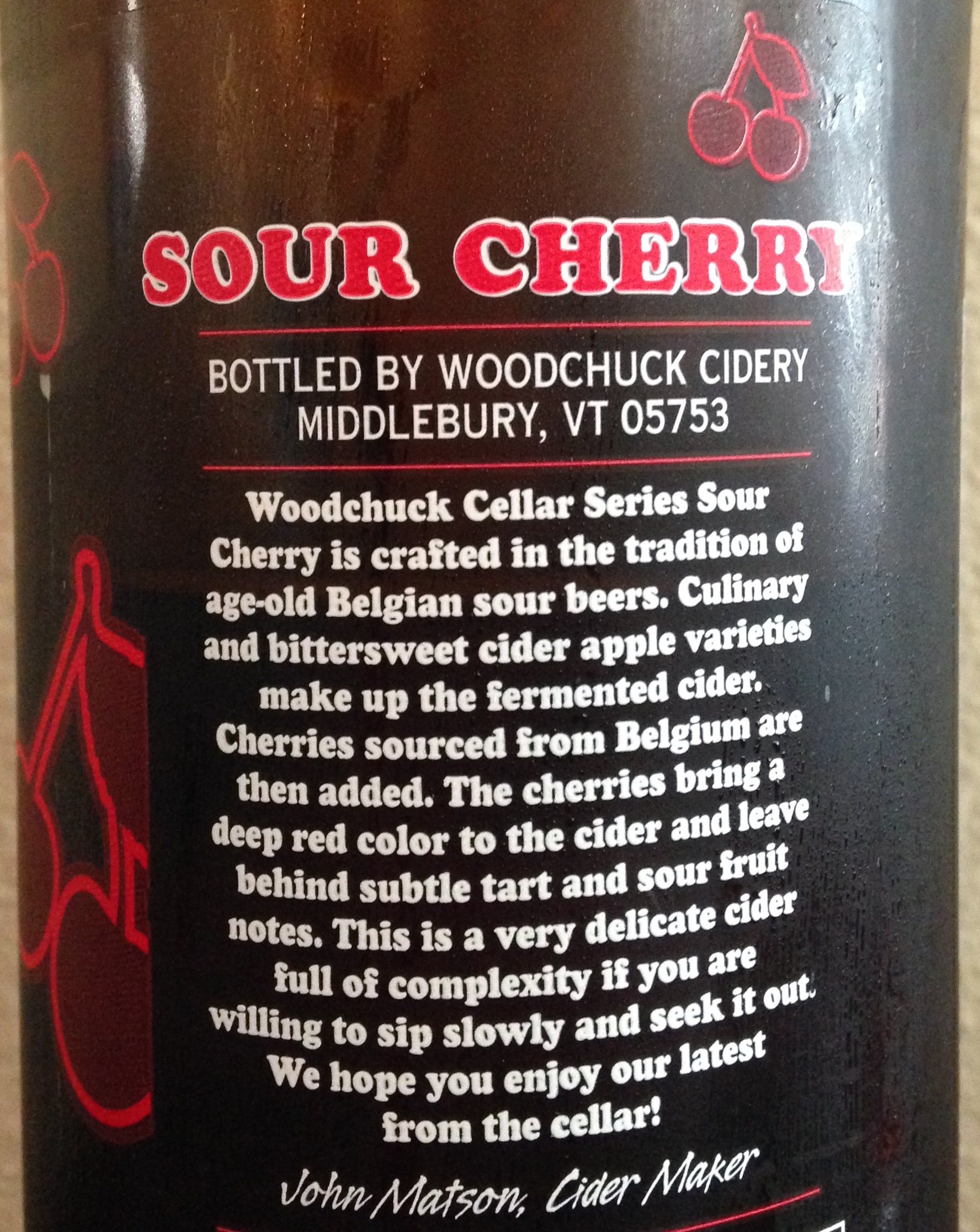
Woodchuck Sour Cherry

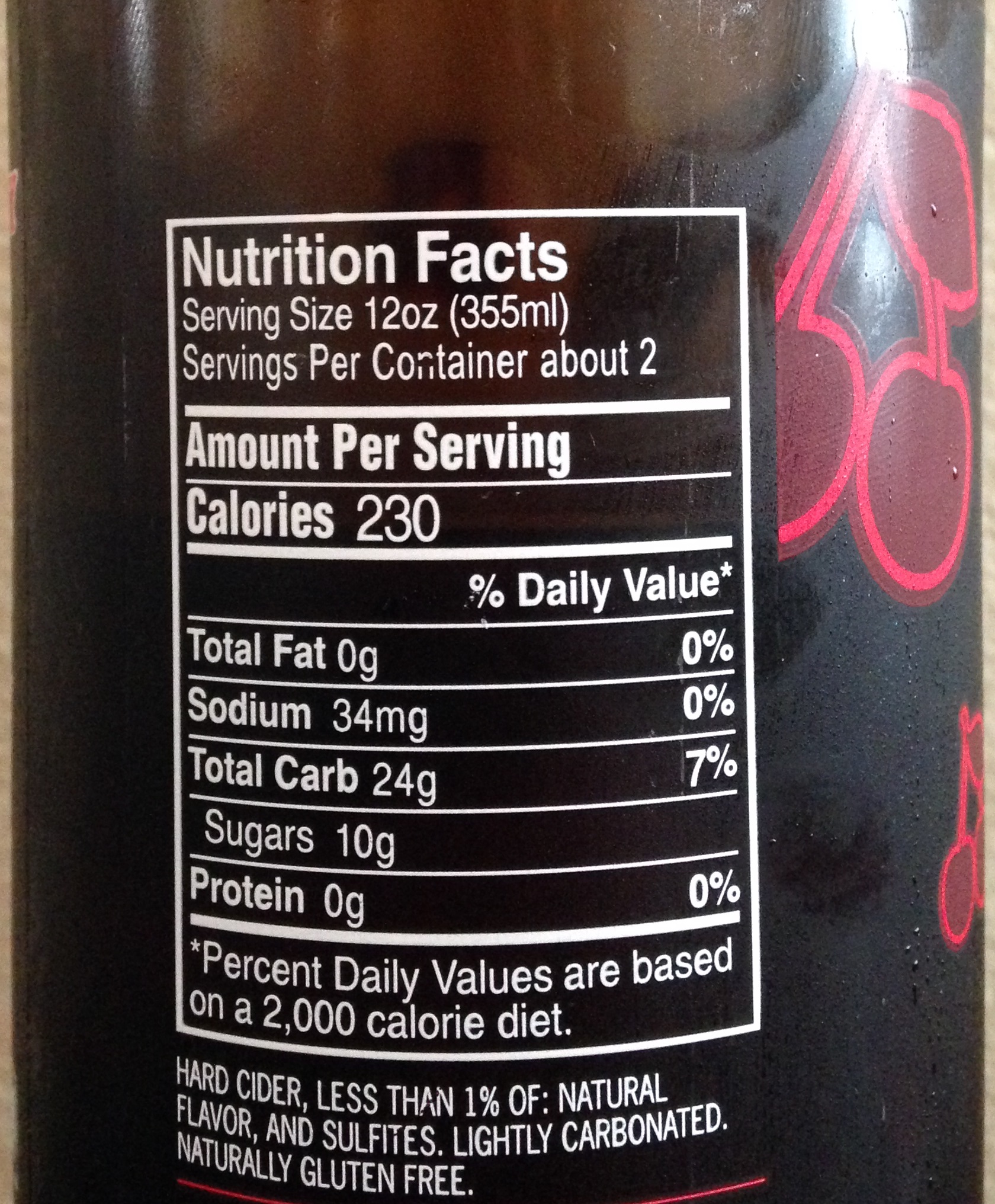
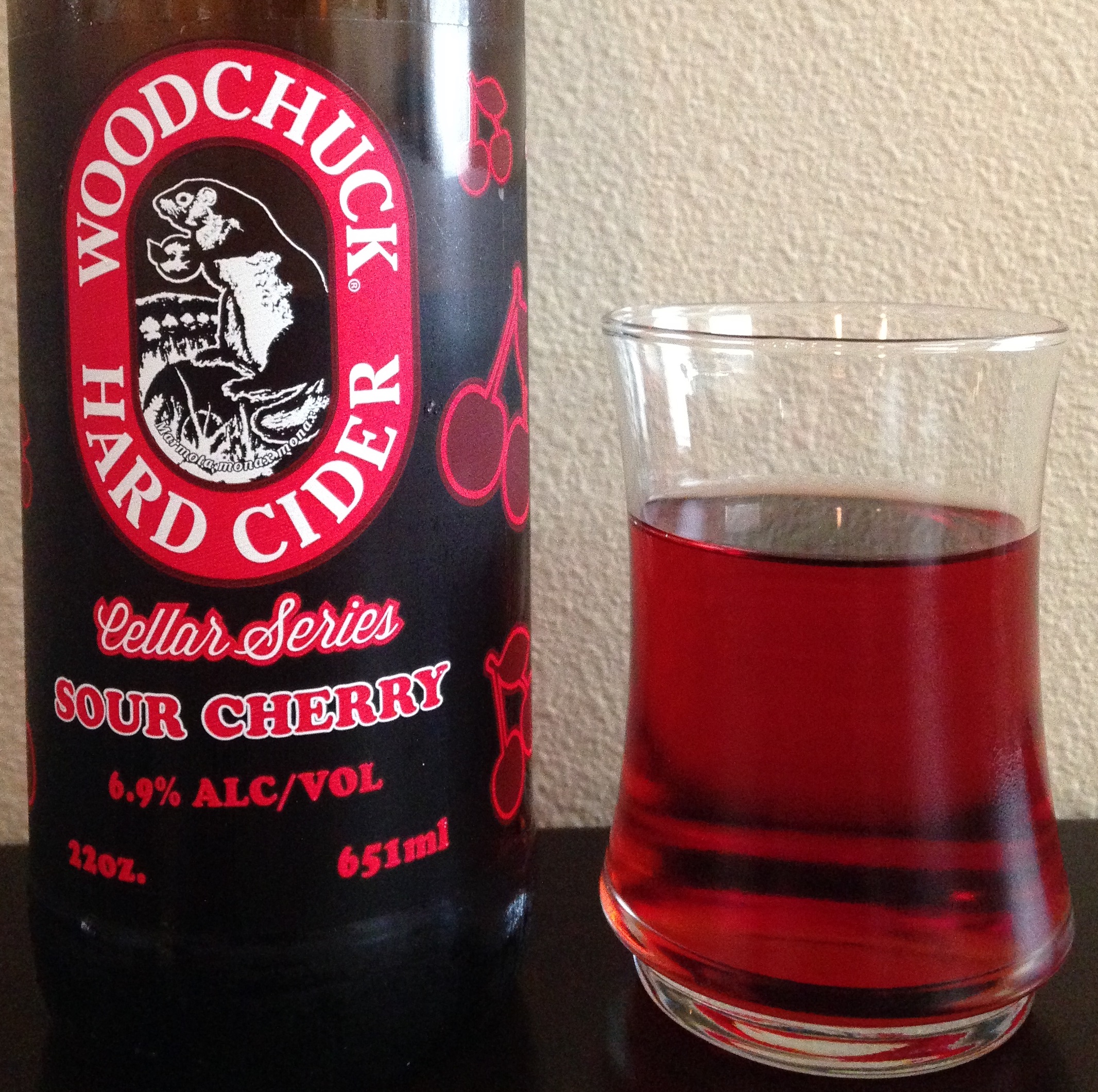
Review of Woodchuck Sour Cherry.  This was a Cellar series release in Spring 2014.  They have since discontinued the Cellar series and now have the Out on a Limb series (six pack where the variety rotates every 45-60 days).  I was told that Sour Cherry is the same as Out on a Limb Cheeky Cherry, except 6.9% ABV instead of 5.5% ABV.

2015-08-23 16.30.29

Cider:  Sour Cherry
Cidery:  Woodchuck
Cidery Location:  Middlebury VT
ABV:  6.9%
How Supplied:  22oz brown glass bottle with a cute cherry motif

2015-08-23 16.30.40 2015-08-23 16.30.52

Availability:  discontinued

Cider Description:  Woodchuck Cellar Series Sour Cherry is crafted in the tradition of age-old Belgian sour beers.  Culinary and bittersweet cider apple varieties make up the fermented cider.  Cherries sourced from Belgium are then added.  The cherries bring a deep red color to the cider and leave behind subtle tat and sour fruit notes.  This is a very delicate cider full of complexity if you are willing to sip slowly and seek it out.  We hope you enjoy our latest from the cellar!  -John Matson, Cider Maker

Price:  $4 or $5 ?
Where Bought:  Total Wine
Where Drank:  home
How Found:  Browsing.  I think I ended up buying 5 or 6 of these bottles at the time!

2015-08-23 16.31.22

First Impression:  Lovely cherry red hue.  Cherry scent.  This was lacking carbonation due to its age (the bottles I drank in Spring 2014 had moderate carbonation).

Opinion:  Semi-sweet to sweet.  Very fruit-forward.  It starts sweet then moves to a moderate tart (quick) finish.  This cider (like most fruity ciders in my opinion) is quite juice-like.  The alcohol is well hidden.  It isn’t complex (I don’t pick up any flavor notes besides cherry), but has a nice flavor.  I’ve never found a fruity cider which truly impressed me like other cider varieties, but this one is probably my favorite fruit-flavored cider along with Finnriver Lavender Black Currant (which does have more complexity).  Other favorite ciders of mine which have a lovely fruit-forward flavor but aren’t “flavored’ are Eaglemount Quince and Reverend Nat’s Revival.

Most Similar to:  Other sweet cherry ciders.  This Woodchuck variety has more cherry flavor than many other cherry ciders though (such as Elemental Cherry, Locust Sweet Dark Cherry, and Original Sin Cherry Tree).

Closing Notes:   What a tasty blast from the past!  Its probably good I finally decided to open this bottle, as it had lost some carbonation, and the flavor was probably next to go.  I think I mostly hung on to it as it was the last Cellar Series release.  I was initially quite disappointed when Woodchuck dropped their Cellar Series and moved to Out on a Limb.  However, it has turned out quite well as it is even less of a commitment; I can get a single 12 oz bottle from the six pack (many stores split them up) instead of a 22 oz bottle.  This was my favorite Cellar Series of Sour Cherry, Mint, and Chocolate (I never tried Smoked Apple, Dry Hop, or Ginger).  They definitely came out with some weird ones!

Have you tried Woodchuck Sour Cherry or Cheeky Cherry?  What did you think?

Cider Summit Seattle 2015 Report

This is part 2/2 on Cider Summit Seattle 2015.  See part 1 for tasting notes on the 32 ciders I tried.  Hopefully for all the folks who don’t live in WA / couldn’t make it, this post will help make you feel you were there!  Cider Summit was awesome, amazing, epic, etc.  There were over 200 ciders from over 50 cideries.  Impossible to try them all, and way too many choices.  So, unfortunately I had to prioritize.  I ended up sticking pretty closely to my list, but not exactly.  Very easy to get distracted once you add in all the people I met up with.  It was actually my first time attending a Cider Summit (even though this was its 6th year in Seattle), as I’ve only really got into cider cider in the last year, although I’ve been enjoying it for a few years.  My husband attended with me, even though he really isn’t into cider; how sweet.  Cider Summit is definitely the biggest cider event in the area of the year!

logo

It was great to see so many old & new cider friends, including a number of folks I met at the Seattle Cider and Burgundian events on Thursday.  Shoutout to the following folks from Cider Summit & WA Cider Week, in no particular order.  It was pretty cool to have folks recognize / say they enjoyed my blog at the event, even though it is still fairly small / new (its been 3 months…time sure flies).

I attended both days of Cider Summit, but didn’t stay too long on Saturday.  On that second day I planned ahead what I still wanted to try the most, and got small tastes of over a dozen ciders in less than two hours so I could get out of there before it got too busy and warm (we were definitely having some warm weather).  The first day I had started a bit strong with a few larger tastes, the heat got to me a bit (ended up going to Whole Foods for awhile for lunch and to cool down actually), and I was in general overwhelmed with the whole event, even with my pre-planning.  So, day 2 went a bit smoother!

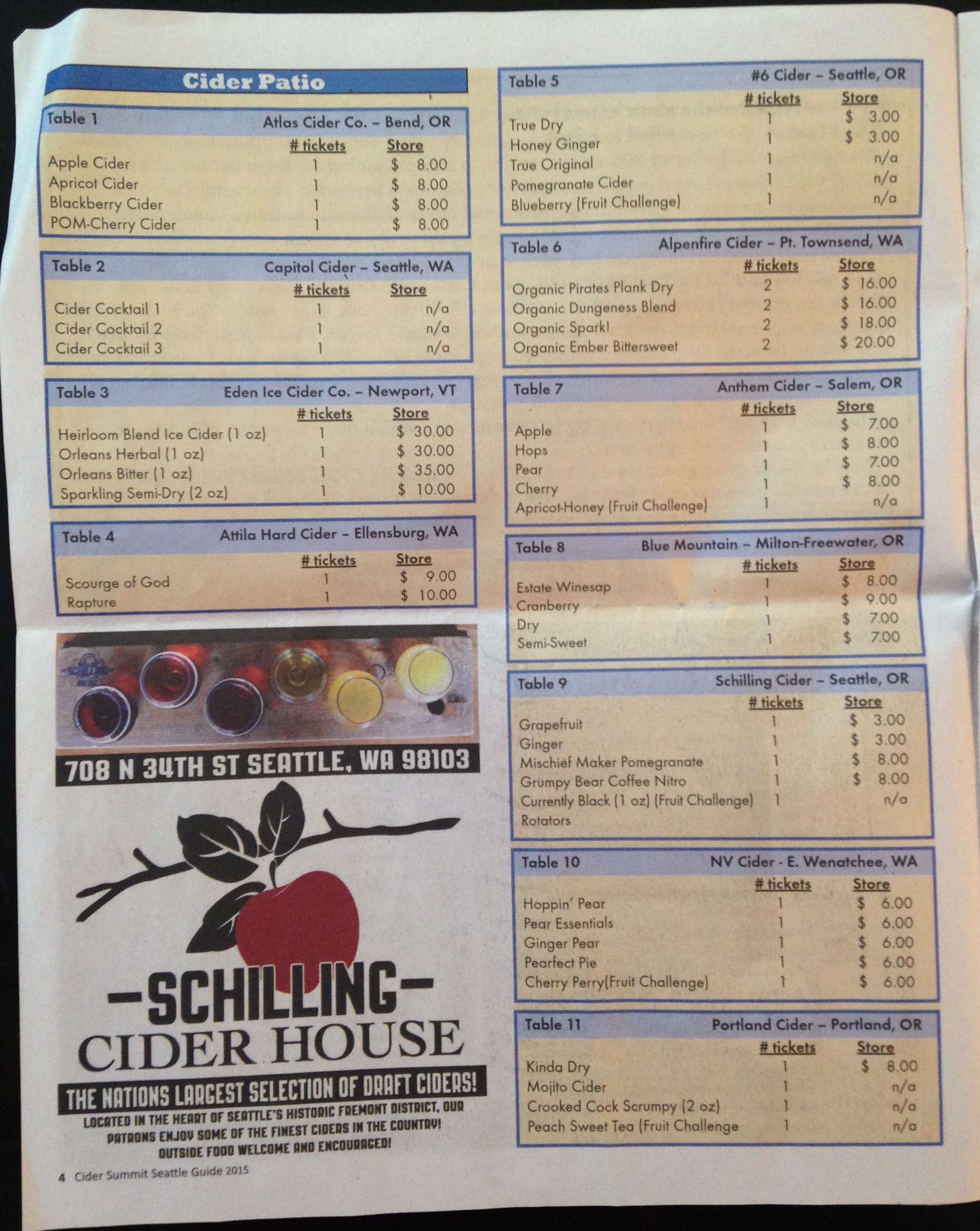
I thought I’d add some information on the event, as its often difficult to find some of these sorts of specifics.  Admission included tickets for tastings (8 for regular and 12 for VIP), a cider glass, and a wristband.  We had in & out privileges with the wristband and glass, including being able to return for the second day.  Apparently some ciders were 2 tickets due to their expense / high ABV, but they would do a smaller pour for 1 ticket.  They were supposed to be 4oz pours, unless it was high ABV.  They also had a booth with some cider cocktails from Capitol Cider.  I asked for small pours from most of them, so between that and the blog thing, I didn’t have an issue with running out of tickets (although they would have only been $2 extra).  The CIDER SAYS t-shirt was definitely a good decision, as were the business cards.

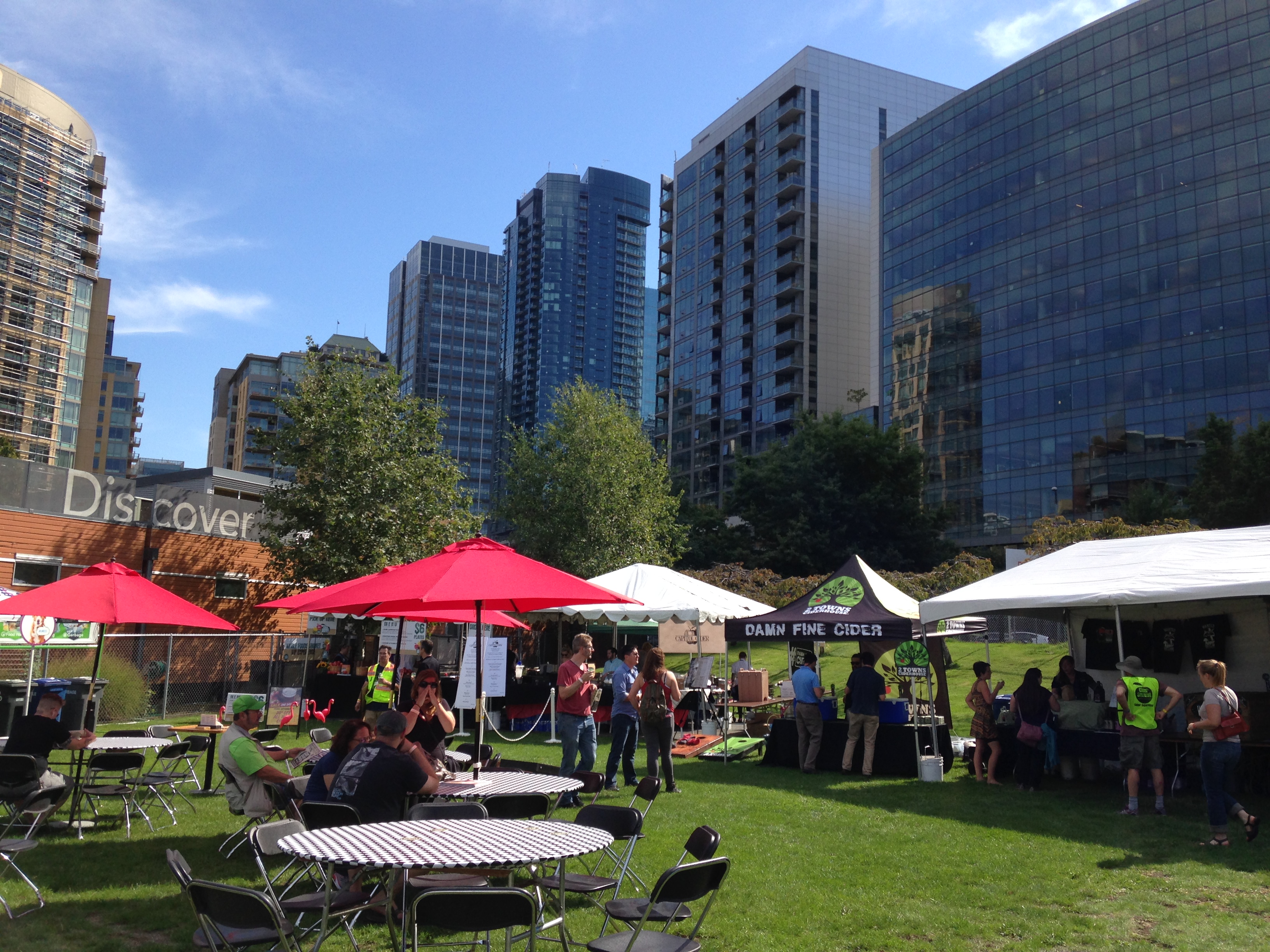
It was an outdoor event, where the cidery booths were under small tents, spread out around the grounds.  That unfortunately meant porta potties, but they weren’t too bad.  What was great is that almost every booth had folks from the cidery (often the cidermakers themselves for the small ones) pouring the cider.  So, when it wasn’t too busy, you could actually get some face time with them.  There were some tents with chairs & tables, plus some standing tables not beneath tents.  Some cideries also had tent alternatives, such as a mini-bus or trailer.  I had no problem bringing food and non-alcoholic beverages in.  However, I figured out I really didn’t need all the bottled water I brought, as they had a water station with cold filtered water that could be used to rinse out tasting glasses or fill a bottle up.  Between several bottles of water and the free Cidercraft and Sip Northwest magazines my husband stuffed in my backpack, it got really heavy!  I also didn’t use the blanket I brought to sit on, although I could have, if I had spent time on the nice grassy knoll hidden behind the food area.  Some of the cideries even brought some lawn and table games.

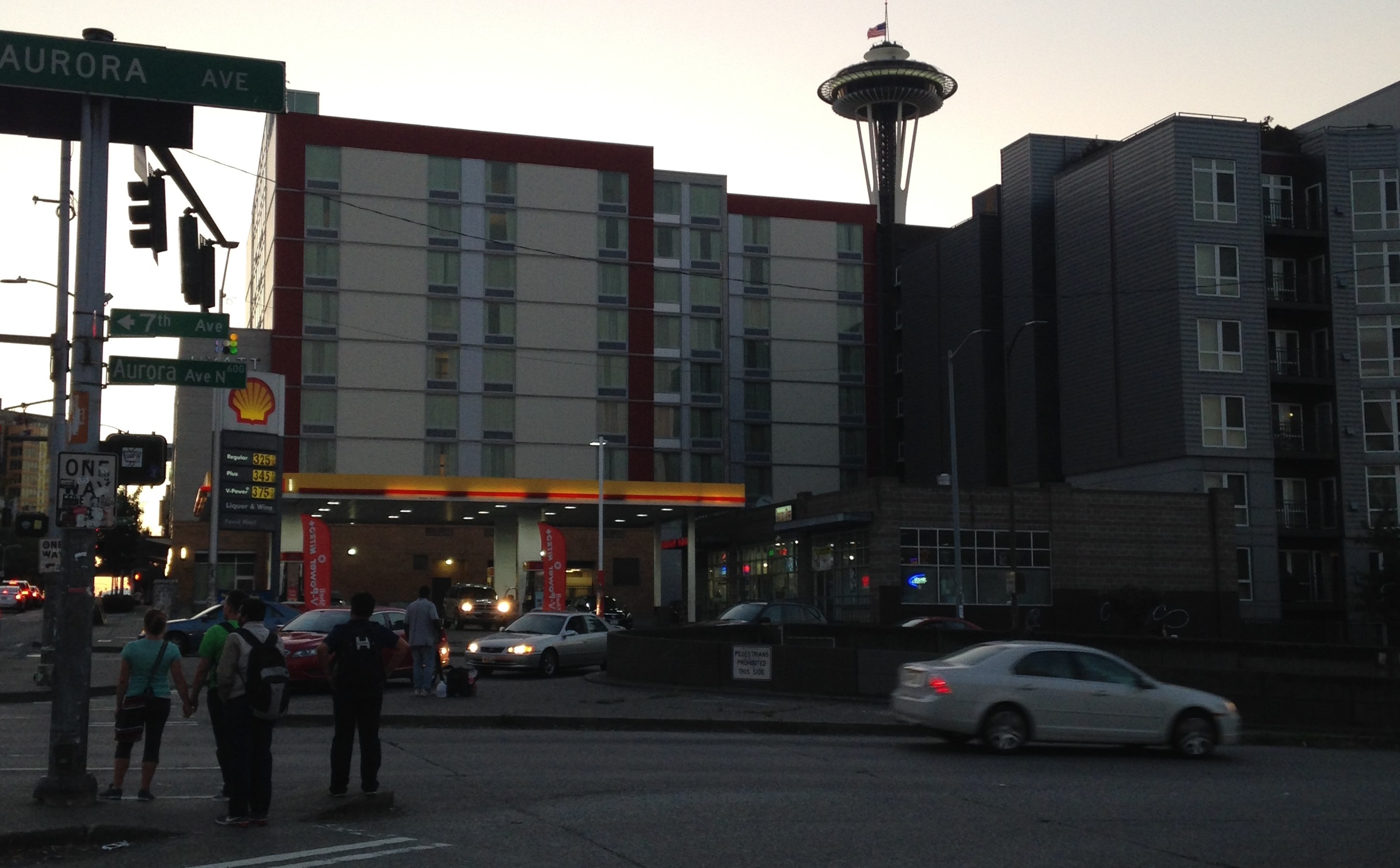
I heard that they will need to switch venues next year however, as the current one at South Lake Union will have a construction project.  We were very happy with our decision to get a hotel within walking distance (even though we don’t live very far away), as we were very tired by the end between the sun, alcohol, and standing around.  The Hyatt Place met our needs.  It was definitely pricey, as everything is in the area, but fairly new & clean.  There was noise as expected (not just traffic, but the silly mini fridge too).  The breakfast in the morning was acceptable.  The hotel worked out well too as we had parking that way, and they didn’t charge extra to stay more than 24 hours, just a flat charge per night hotel stay.  The parking cost was pretty comparable to what we would have paid at an independent garage, and it was more secure too.

Advance tickets are definitely the way to go.  The cheapest was to visit a business selling them (such as Full Throttle Bottles), as online sales added fees & such that negated the $5 advance sale savings.  VIP is also definitely the way to go, as I got entrance an hour early (2pm vs. 3pm); they limited it to 200 VIP tickets.  On Friday it didn’t get too busy until 5pm ish or so (the event went until 8pm).  On Saturday there was a line to get in at noon, but we got to skip it as we already had wristbands!  The crowds quickly picked up, but I was a woman on a mission and went through my tasting list in record time so we could get out of there before it got too hot, and went and grabbed lunch at Mama’s Mexican restaurant (very tasty by the way).

They had food for sale from Whole Foods and Capitol Cider (including cider pairings), but we didn’t try any.  We ended up walking down the street to Whole Foods for a snack/lunch on Friday, returning to the event, then going to a Thai place for dinner.  They also had other misc booths such as Three Twins ice cream, Kind granola bar samples, non-alcoholic cider samples/sales, and dog related booths (as this was a dog-friendly event).  Note that this was a 21+ event.  Another great part of this event was that they sold bottles to take home (all ciders with bottles for sale had the price listed in the program).  However, I may have waited a bit long, as they didn’t have what I wanted (if they had even had it to start, or maybe they couldn’t find it).  They also sold t-shirts, glasses, cider books, etc.  I got a sweet Cider Summit t-shirt.

Check out the other Cider Summit locations in addition to Seattle, which are Portland, San Francisco, and Chicago.

The next big cider tasting event in the Seattle area is NW Ciderfest (October 10 & 11, Pioneer Square, a MDA benefit).  I’m planning to be there!  They will also have bottle sales, plus they are both family and dog friendly.

(Click to biggify any of the following photos)

Event grounds & some booths, some from before it got busy:

2015-09-11 14.30.09  2015-09-11 14.30.11

2015-09-11 14.30.27  2015-09-11 16.28.12

2015-09-11 17.50.19  2015-09-11 17.50.24

2015-09-11 15.12.05 2015-09-11 15.12.21

2015-09-11 15.12.15  2015-09-11 15.15.01  2015-09-11 15.15.08
<Aaron from 2 Towns showing off their Traditions Bourbon Barrel 2012>

2015-09-11 19.03.11  2015-09-12 12.58.54
<Eaglemount and Alpenfire displays>

2015-09-11 14.46.25  2015-09-12 13.02.44

2015-09-11 19.11.22  2015-09-11 19.11.20
<Merce and Si from Cider Log>

2015-09-12 12.03.24  11986603_10100662215417188_7462211408926714561_n
<lovely shadowed photo of the Whitewood Kingston Black information, and me & my hubby Aaron>

Surrounding area:

2015-09-11 16.33.57 2015-09-11 19.30.18

Cider displays at Whole Foods for WA Cider Week:

2015-09-11 16.36.47
<big display of Eden’s apertifs and sparkling cider>

2015-09-11 16.45.08
<first time I’ve seen 3 Worley’s varieties together>

2015-09-11 16.41.02
<Snowdrift Perry sighting!  No Red though; good thing I got mine at another Whole Foods.>

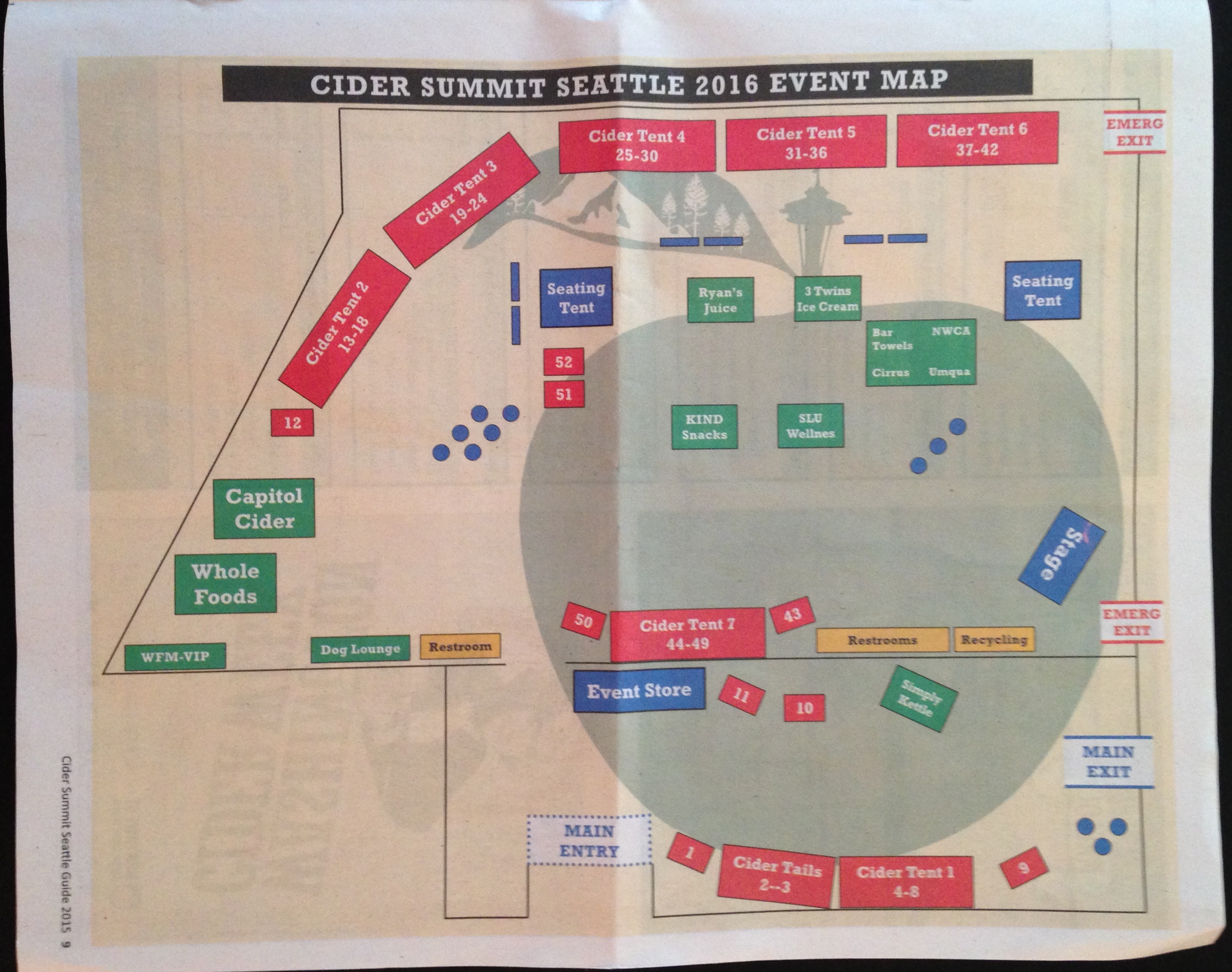
Event program:

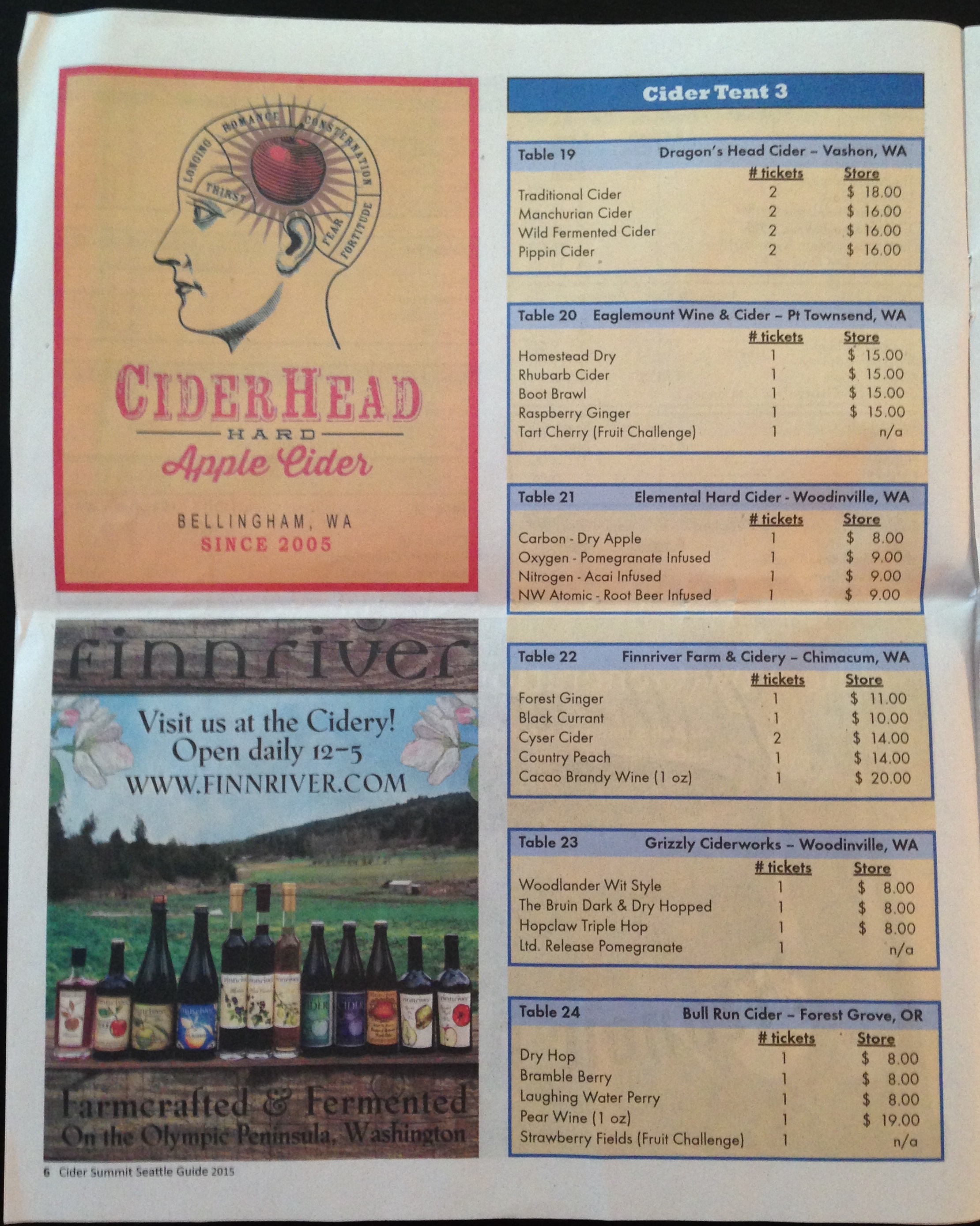
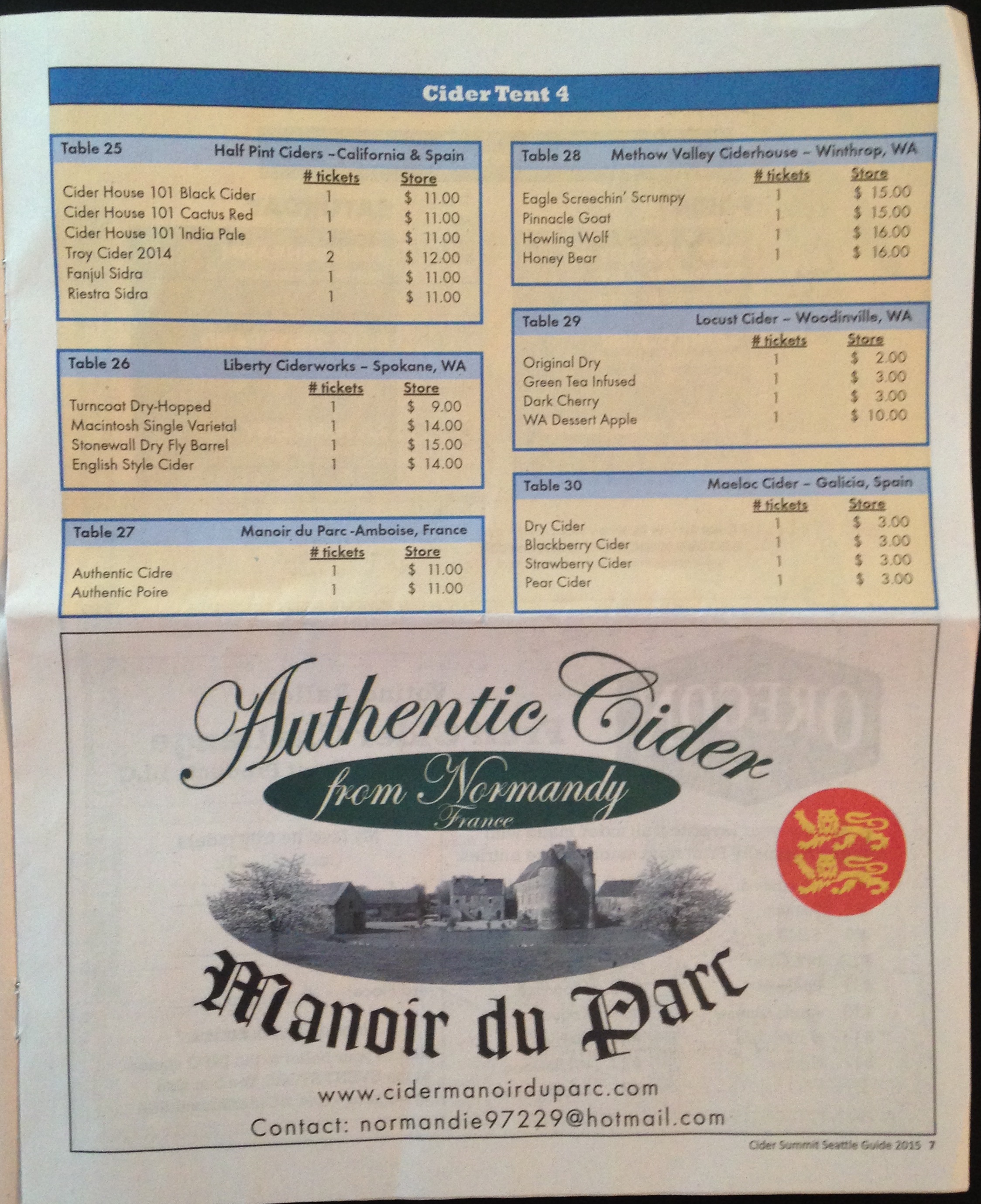
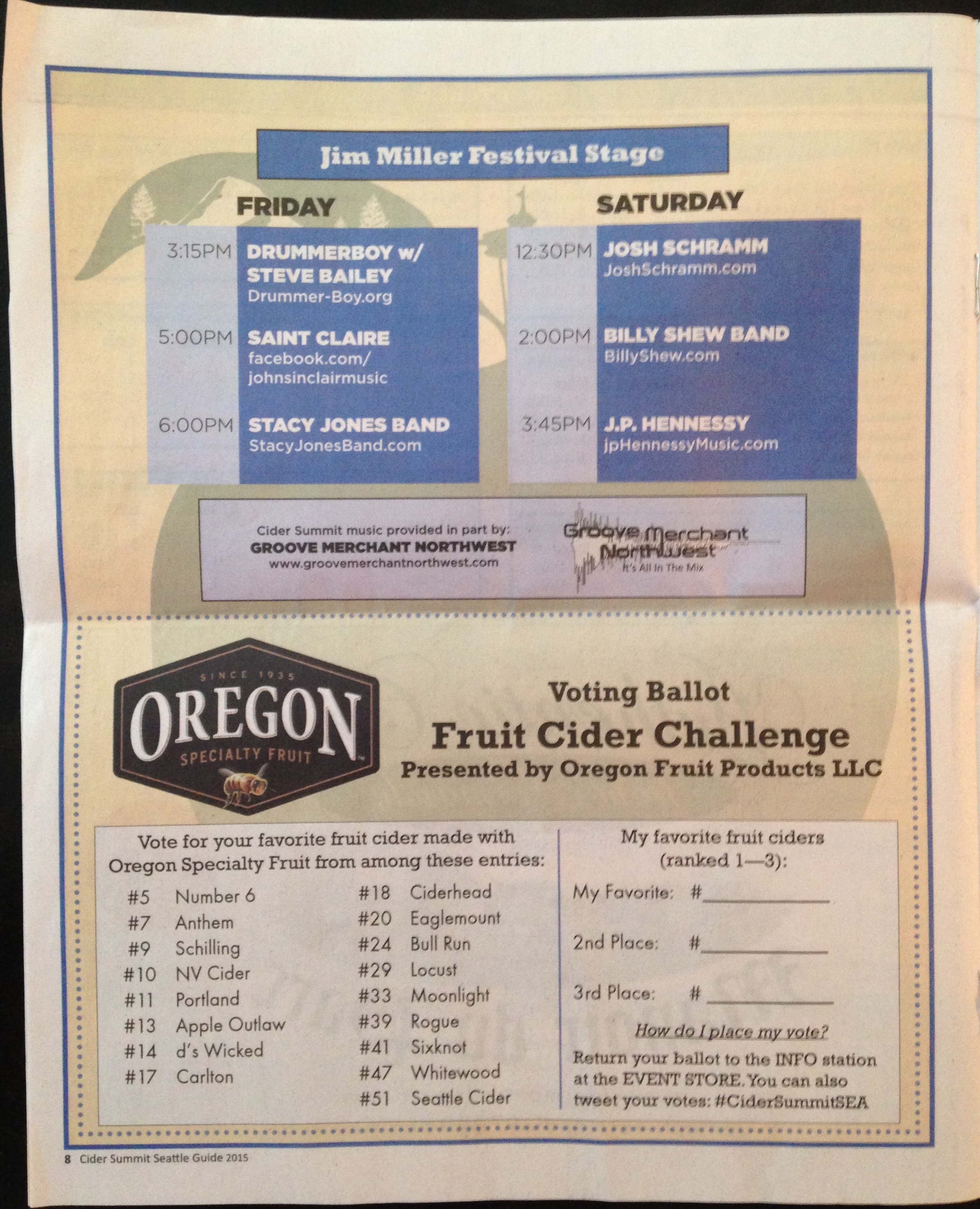
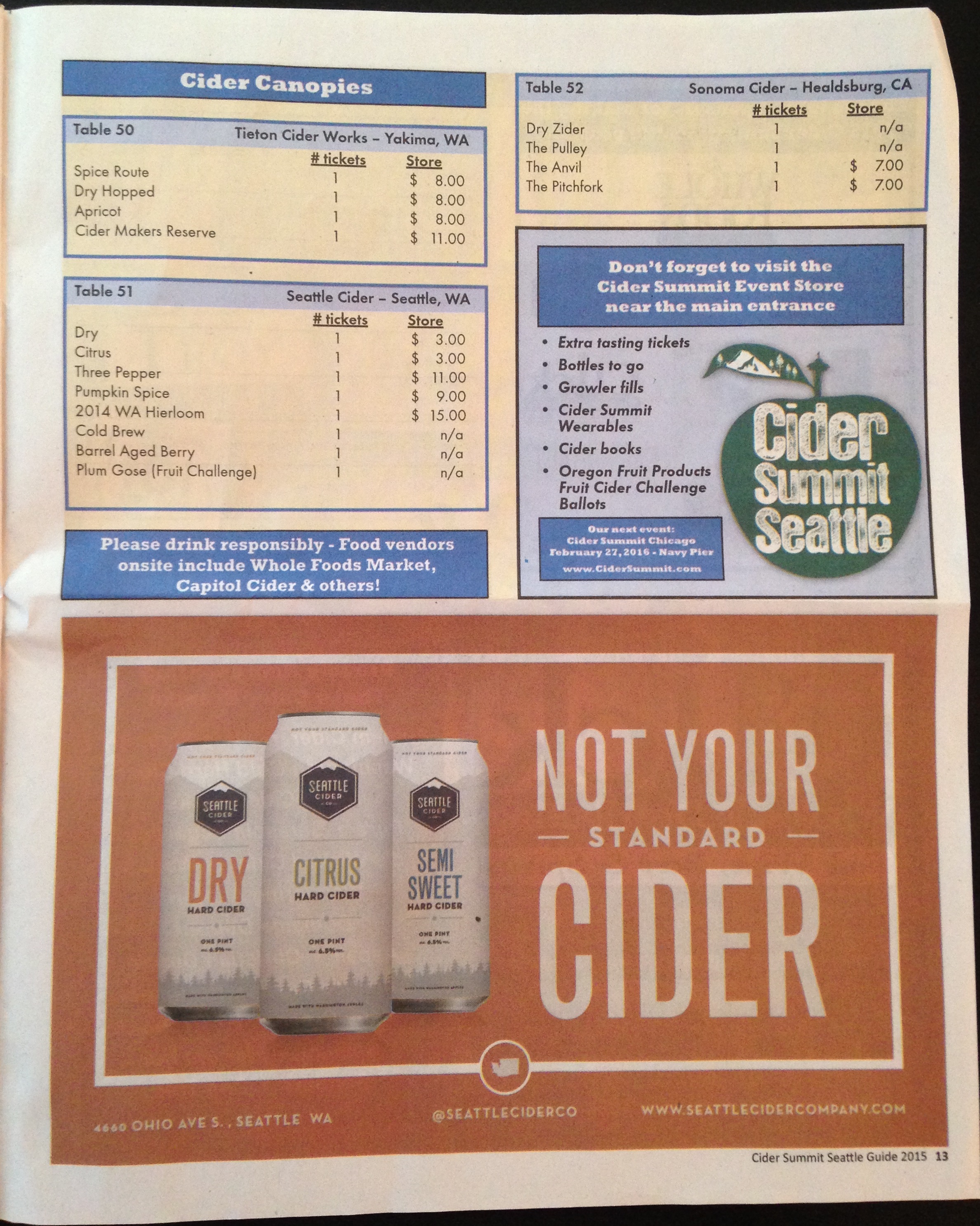
program1  program2

program3 program4

program5 program6

program7 program8

program9 program10

program11 program12

program13 program14

program15 program16

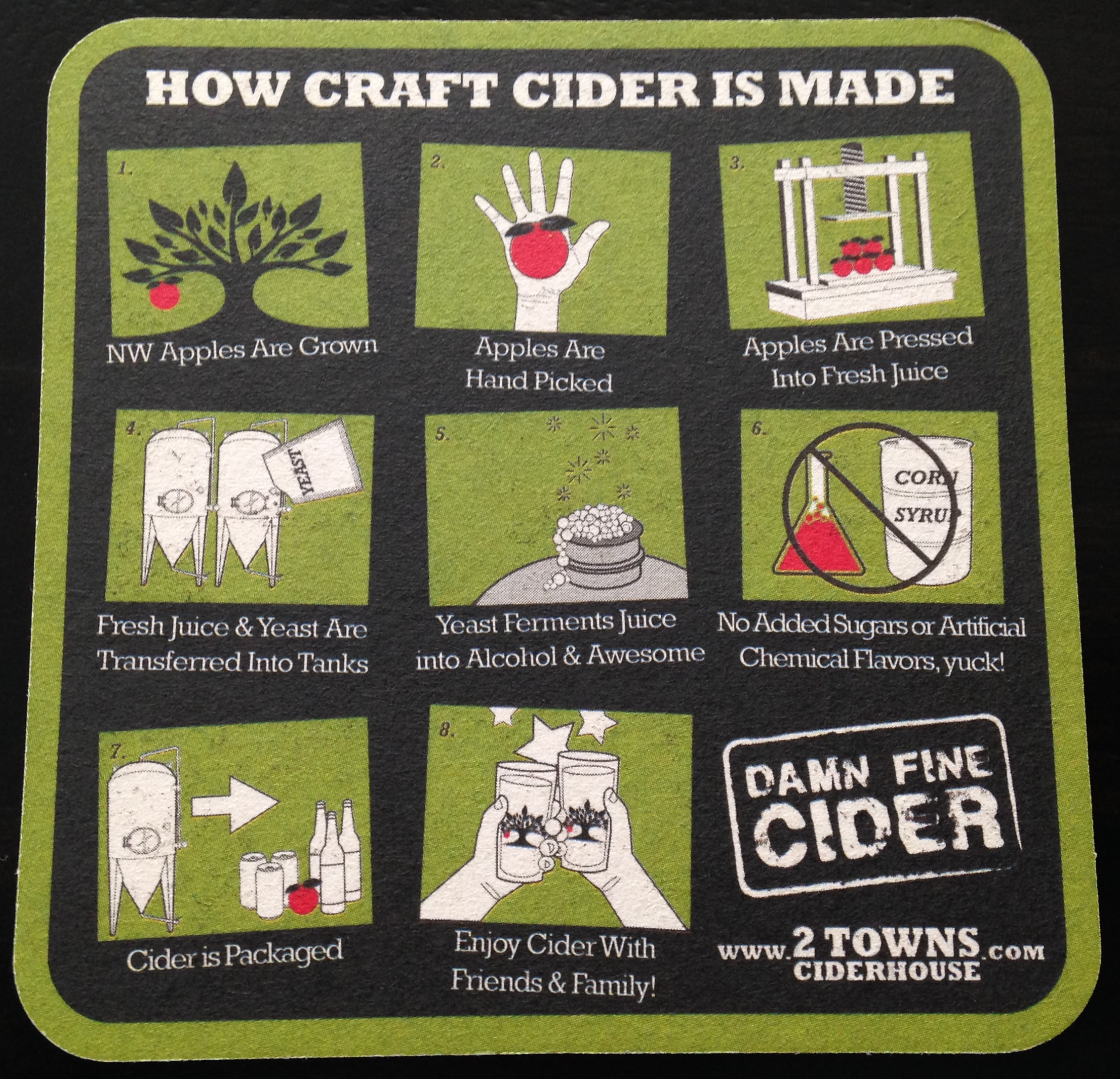
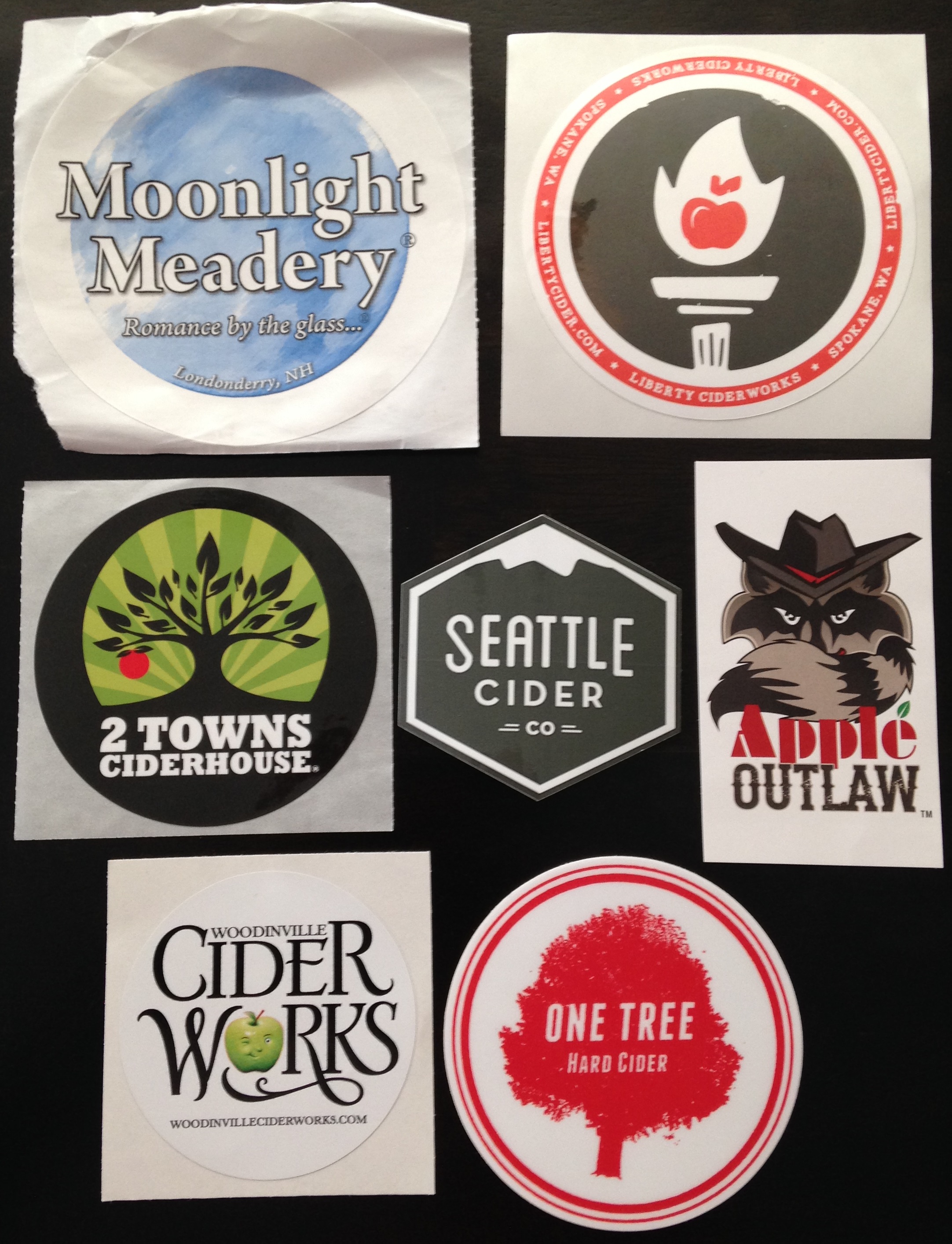
Some of the swag I picked up at Cider Summit Seattle & WA Cider Week events:

2015-09-19 14.04.25 2015-09-12 16.50.33  2015-09-12 16.50.44

2015-09-12 16.50.54 2015-09-12 16.51.01

2015-09-12 16.49.40

2015-09-12 16.52.22  2015-09-12 16.56.35
<stickers and business cards>

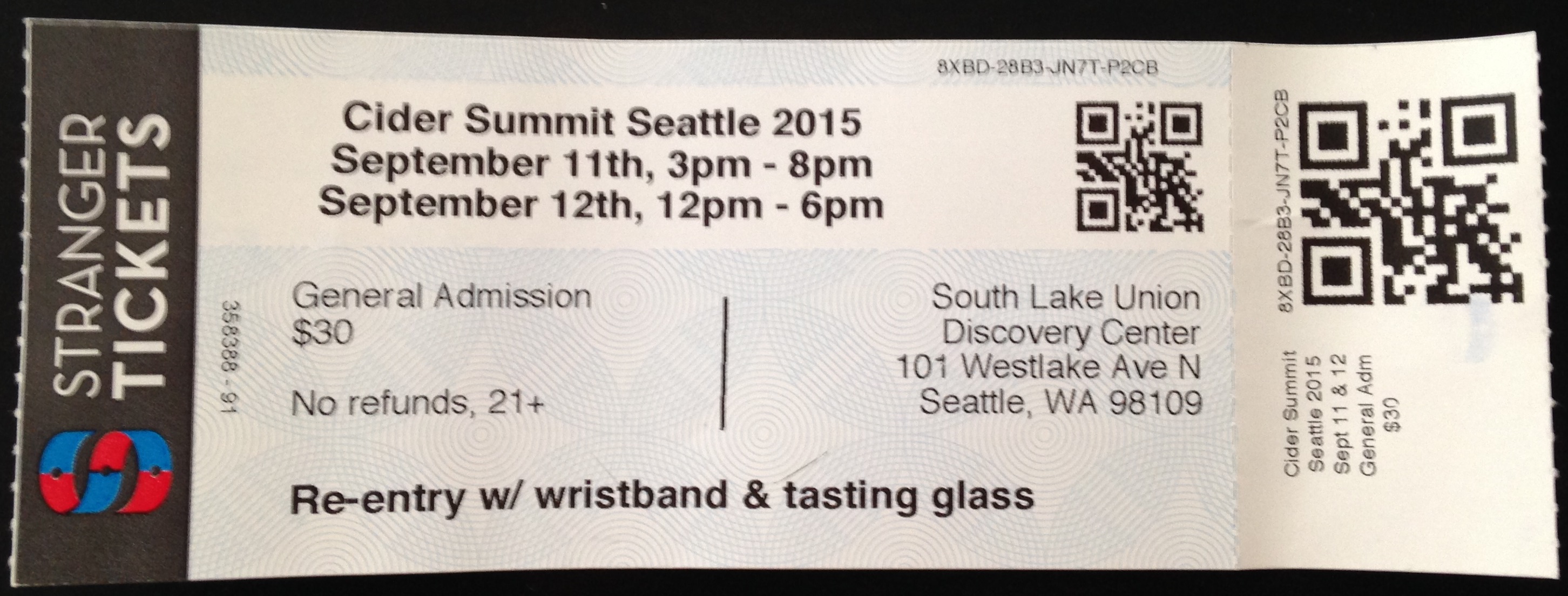
Ticket, handouts, and misc info:

2015-09-12 16.57.00

2015-09-12 16.51.14 2015-09-12 16.51.23

2015-09-12 16.55.13  2015-09-12 16.55.26

farnum  finnriver

eden1 eden2  eden3

eden4  eden5

eden6

2015-09-12 16.49.12 2015-09-12 16.49.40 - Copy

2015-09-08 17.17.58

Stay tuned to Cider Says for two more WA Cider Week 2015 posts, covering the Bill Bradshaw tasting event with 9 cideries at Capitol Cider, and the 2 Towns night at the Schilling Cider House!  Like us on Facebook for the latest info and post notifications.

wa cider week

Cider Summit Seattle 2015 Tasting Notes

What an epic event!  This long-awaited post will cover my tasting notes on the 32 ciders I tried at Cider Summit 2015 (Sept 11 & 12 2015 at South Lake Union).  Another post (post 2/2 now up HERE) will cover information about the event and have lots of photos, including of the swag I picked up and the event program.  I was lucky enough to attend both days, and after a couple tastes I learned to ask for a smaller pour!

When you are going for quantity (vs. many of the folks who were just there to drink some cider and didn’t care so much what type or trying as many as they could), the smaller the taste the better, as long as you can get a couple good gulps in.  Sorry in advance I don’t have too many cider photos (its difficult at an event like this to juggle a glass, notepad, camera phone, etc), but post 2 will have more event & booth photos.  Hopefully someone enjoys these notes, as it took me many hours.

101 Cider House Black Dog Black Cider (Westlake Village CA).  6.9% ABV.  This is a unique “black cider”, which is from adding activated charcoal (apparently a new beverage trend, and is good for the digestion too).  It also includes lemon and agave nectar.  The color turned out a very weird green-blue-black tint (see below).  Fairly dry.  I’d say similar to Spanish Sidra (as it had a lot of sour citrus flavor) with a hint of weird from the charcoal.  I thought of it as more of a novelty, but some of my tasting buddies said they would actually buy a bottle.  This was more drinkable than their Cactus Red (which was crazy tart), but not my thing.

black dog

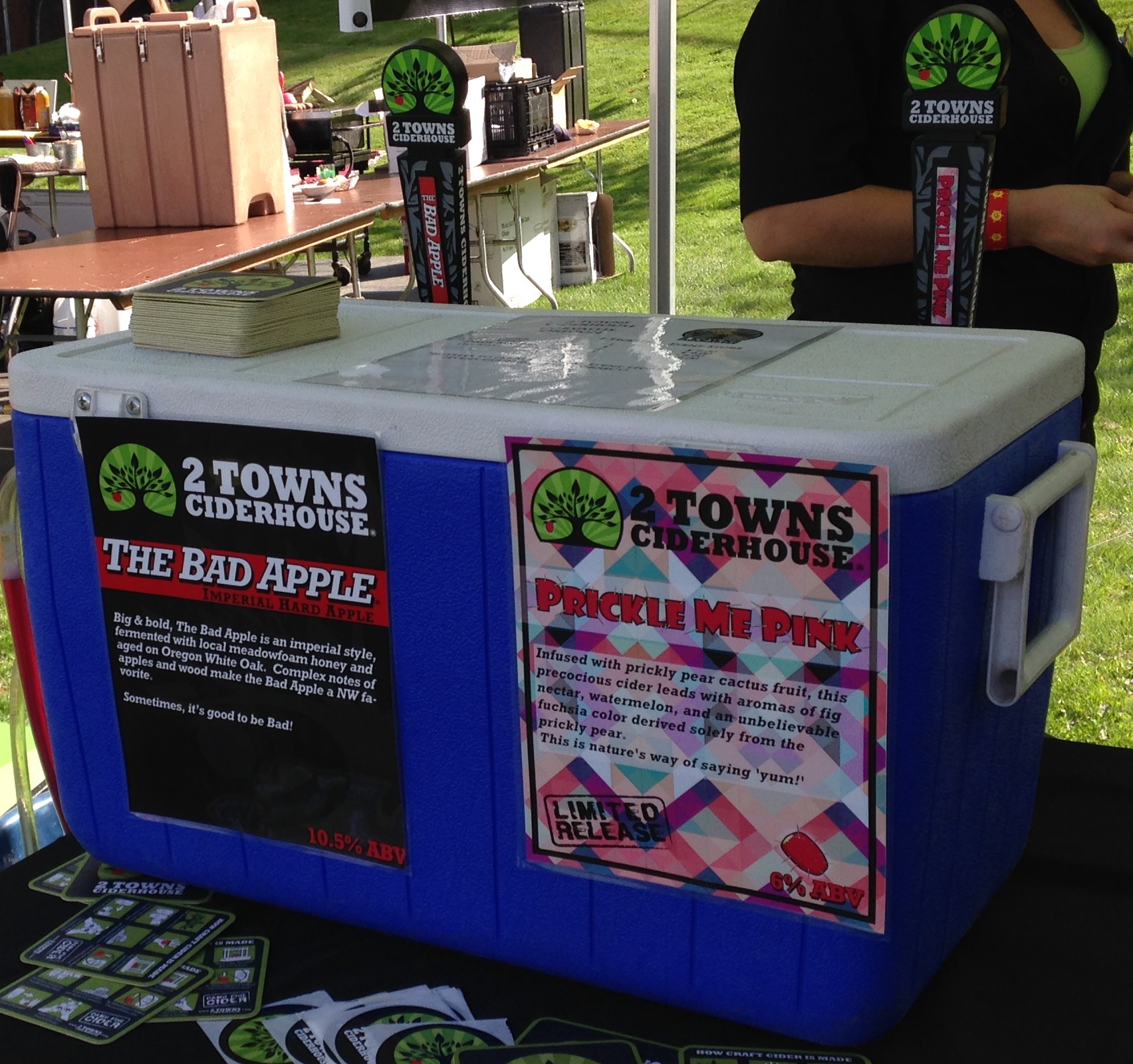
2 Towns Prickle Me Pink (Corvallis OR).  6.0% ABV.  This cider was released just this week, and uses prickly pear cactus fruit juice from California (reminiscent of my time in Arizona).  Semi-dry.  Fluorescent pink color!  Tart.  Nice and flavorful.  Some cactus fruit flavor (yes I’ve actually eaten one before and know what they taste like), but also some berry and watermelon notes.

prickle

Alpenfire Ember (Port Townsend WA).  7.2% ABV.  This one is made from French & English bittersweet apples, organic, wild fermented, and bottle conditioned.  Semi-dry.  Higher carbonation.  Very high tannins and moderate astringency (I’d almost describe the mouthfeel as “chunky” lol).  I wasn’t really a fan, but folks who like a really high tannin ciders probably would.  I really love their Spark! and Apocalypso though, which are their more approachable and sweeter varieties.  Their Smoke was also pretty tasty.

Anthem Ap-Bee-Cot (Salem OR).  6.5% ABV.  Apple-apricot cider fermented with natural yeast from bee pollen.  Draft only.  Semi-dry, unfiltered, and tart, with mild apricot & honey notes.  I’ve not really been a fan of any of Wandering Aengus / Anthem’s ciders.

Apple Outlaw Oaked Sweet Dark Cherry (Applegate OR).  unknown ABV.  Tart with mild cherry notes and the slightest hint of oak barrel flavor.  Not really impressed, but it wasn’t bad at all either.  The first time I’ve tried their ciders.  At this time they also offer Original, Rabid Dry, Ginger Bite, Cranberry Jewel, Hoppin’ Holdup, and Tangerine Twist in bottles.

Dragon’s Head Traditional (Vashon Island WA).  6.8% ABV.  Semi-dry, rather still, smooth, acidic, mild tartness, and moderate tannins.  My first time trying their cider (although I have a bottle of their Wild Fermented at home).  A pretty solid selection.

Eaglemount Homestead Dry (Port Townsend WA).  8.0% ABV.  Hazy.  Dry, tart, and bitter.  Made with heirloom apple varieties including Gravenstein, White Pippin, Stayman’s Winesap, and Tolman Sweet.  Not really my thing.  I love their Quince though!  I mostly tried it as I wanted to try another one of their offerings, and nothing else sounded interesting (Rhubarb, Raspberry Ginger, and Boot Brawl, which is hopped).  A solid choice for those who like this style of cider though.

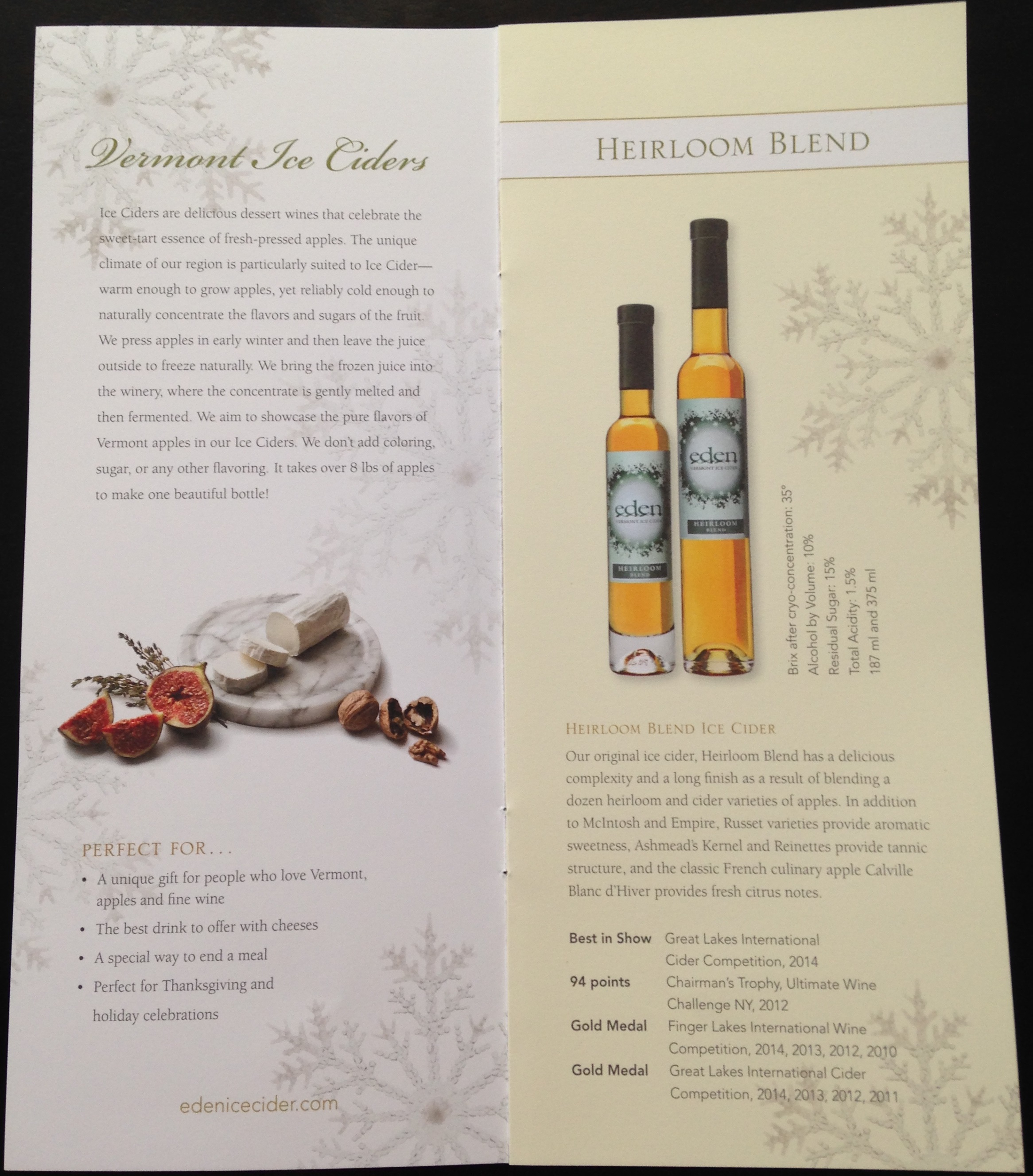
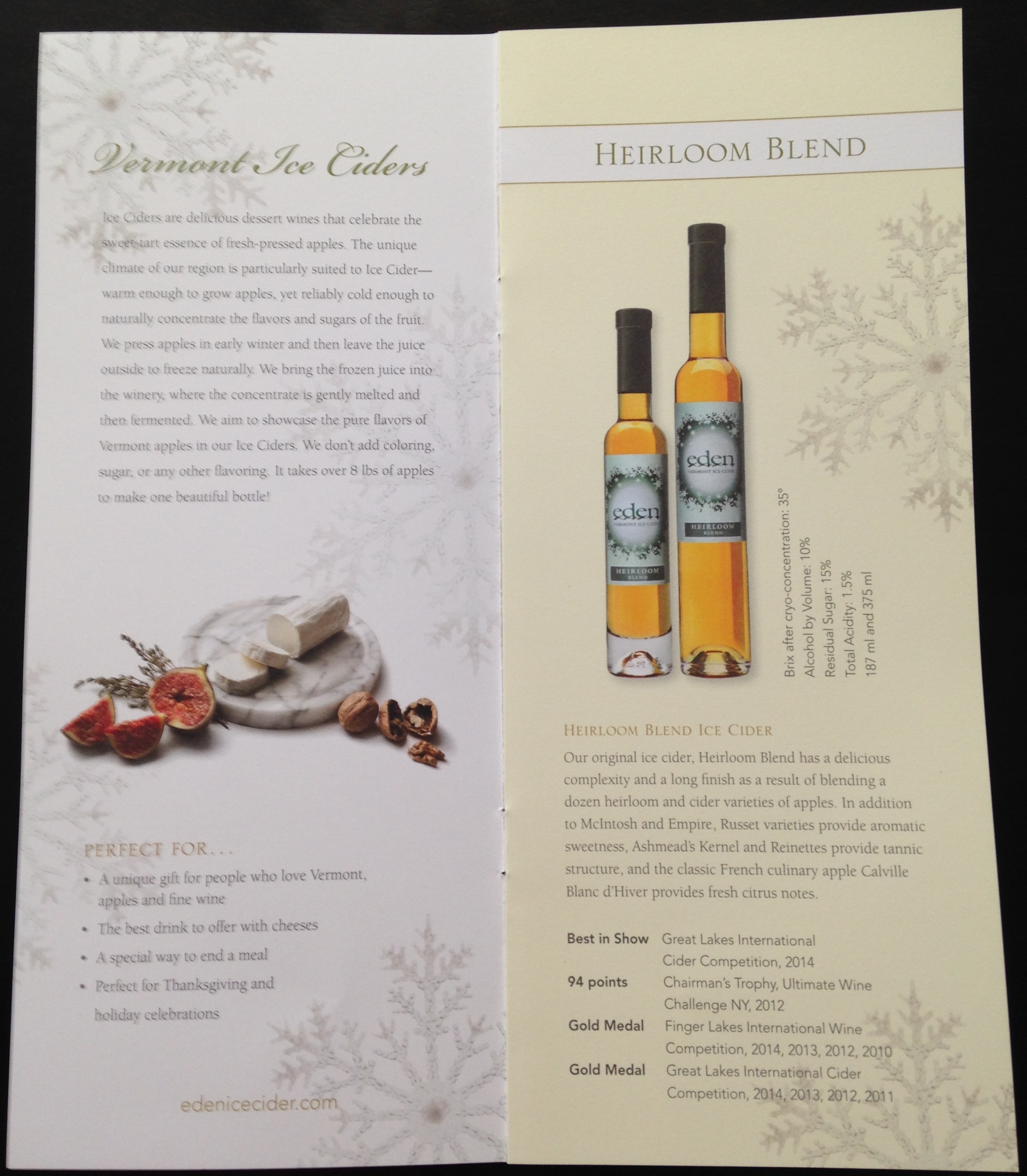
Eden Heirloom Blend Ice Cider (Newport VT).  10% ABV.  Very sweet.  Syrupy but awesome bold full flavor.  Well-hidden ABV.  Vanilla and brown sugar notes.  I look forward to trying more from Eden!  It was awesome to meet Eleanor at the Burgundian event the night before and try two of their other ciders.  I hadn’t tried any of their ciders before this weekend.  My husband surprised me with a bottle of this for our anniversary!  Happy wife.

E.Z. Orchards Semi-Dry (Salem OR).  6.4% ABV.  On the sweeter side of semi-dry.  Uses French bittersweet apples, which have lower acidity and bring in some tannins and tartness.  This was my first time trying their ciders.  Pretty tasty.

Farnum Hill Extra Dry (Lebanon NH).  7.5% ABV.  I’d still call this one dry, not extra dry, as I picked up a hint of residual sugar.  Very tannic and acidic with moderate bitterness.  Significant carbonation.  Not really my cup of tea, but I think this is a great wine-lovers cider.  I had wanted to try their Dooryard, which had been on the tasting list, but they didn’t have it.

Finnriver Country Peach (Chimacum WA).  6.5% ABV.  Hazy slightly pink lemonade color.  Semi-dry.  Sour and tart, but a more approachable sour than some (vs. their Barrel Berry Sour and traditional Sidra and such).  More of a peach skin than peach taste.  Acidic and slightly vinegary.

Finnriver Cyser Cider (Chimacum WA).  6.9% ABV.  Honey cider made with mead yeast.  Semi-dry.  Similar to their Honey Meadow, but without the hint of herbal flavor (I like Honey Meadow better).  Low acidity, tartness, and bitterness.  Earthy.

cyser

Liberty Ciderworks English Style Cider (Spokane WA).  8.0% ABV.  Made with cider apples (including Dabinett, Yarlington Mill and Ashton Bitter) and aged for over a year.  Semi-dry.  Lovely bittersweet flavors with a bit of a “bite”.  Tannic and acidic.  Bright amber.  Very tasty, and definitely English-style.  I’m a big fan of theirs, and looking forward to trying the bottle of their Stonewall Dry Fly Barrel-Aged cider I have at home.

liberty

Manoir du Parc Authentic Cidre (Normandy France).  5% ABV?  A naturally carbonated (bottle conditioned) wild yeast fermented traditional French cider with “no shit added” per the French dude pouring it lol.  Semi-dry.  Funky, tart, high carbonation, and high tannin.  A bit too traditional / funky for my tastes, maybe from the wild fermentation?  So far I’ve been more impressed with Dan Armor and Domaine Pacory Poire Domfront from France.

Millstone Cellars Farmgate Dry (Monkton MD).  8.5% ABV.  I really wanted to give Millstone another chance, as I didn’t care for their Cobbler at all.  I chose this one mostly as the other varieties they were pouring weren’t appealing (hopped, ginger, and strawberry rhubarb).  Barrel aged and made from 40% Stayman Winesap, 30% Northern Spy, 25% Jonathan, and 5% Cameo apples.  Apparently they are known for tart, funky, and astringent ciders which are similar to Sidra, although of course no one told me!  In contrast to Cobbler, I found this drinkable, but I still didn’t care for it.  Definitely dry, tart, sour, funky, and astringent.  To me all those qualities were overpowering such that that the cider couldn’t shine and I couldn’t detect any barrel influence, etc.  A lot of folks really like sour ciders (and beers) though.  Shoutout to Kyle who I e-mailed with, was there pouring cider, and really wanted me to find something from them I liked!  I also saw him at the Burgundian the night before.  They recently re-did their website, and I think it does a much better job of describing their cider style.  The mis-advertisement on the bottle and their website was my main complaint about Cobbler (I get not everyone likes every cider so I never fault a cider because I didn’t like it)…that it wasn’t described as sour, tart, astringent, funky, etc.

Montana Ciderworks Darby Pub Cider (Sula MT).  5% ABV.  Semi-sweet.  Described as “semi-dry new world style”.  Sold in MT, WA, and CO.  English cider flavor with some woody & earthy notes, but its an easy drinking and approachable variety.  Fuller bodied and effervescent.  Mostly Spartan (Montanan) apples, but the earthy notes are from some bittersharp and crab apples.  I wasn’t expecting it to be as sweet as it was (slightly back sweetened), but it was nice.  This was my first time trying their cider, and I’m impressed!

Moonlight Meadery How do you like them Apples Bourbon Barrel Cider (Londonderry NH).  13.5% ABV.  Draft-only cider with honey and brown sugar, aged at least 3 months in Jim Beam bourbon barrels they used for their Last Apple mead.  Very similar to their How do you like them Little Apples I tried at the Schilling Cider House, which was also bourbon barrel aged (this one was slightly sweeter and had more barrel flavor).  Very tasty!  Definitely sweet and syrupy, but it has a lovely rich barrel flavor too.

Moonlight Meadery Kurt’s Apple Pie Mead (Londonderry NH).  16.8% ABV.  Mead bottle pour.  Made from local apple cider, Madagascar-bourbon vanilla, and Vietnamese cinnamon spice.  My husband got a small pour and I tried a sip.  Not really my thing because of the spice, but very smooth.  This is one of their most popular products.

Neigel Vintners (NV) Cider Cherry Perry (Wenatchee WA).  5.1% ABV.  They announced this new variety when I interviewed brothers and co-founders Kevin & Mark Van Reenen, and this weekend was its release.  They left this fairly unfiltered, so there was a nice thicker mouthfeel with both pear and cherry flavors.  Very balanced between the two flavors.  Sweet but not overly.  Yum!  I was surprised to see a couple other local cideries also make a “Cherry Perry”, Wildcraft and Carlton.  They don’t currently plan to bottle it, but if they do, they noted it would have to be slightly more filtered so it would be more stable.

One Tree Caramel Cinnamon (Spokane Valley WA).  6.8% ABV.  Sweet.  Cinnamon with a hint of caramel.  Syrupy.  Spiced cider isn’t really my thing, but I was intrigued.  Their booth was very popular at the event.

One Tree Lemon Basil (Spokane Valley WA).  6.5% ABV.  Semi-sweet.  Nice lemonade-type tartness with a hint of herbal basil flavor.  Very unique.  This was my first time trying ciders from One Tree.  They are fairly new, but seem to quickly be building a following.  At this time they also offer Cranberry, Huckleberry, and Ginger in bottles, and Crisp Apple in cans.

Sea Cider Bramble Bubbly (Saanichton B.C.).  9.9% ABV.  Semi-sweet.  My sample didn’t have much if any carbonation, so I missed out on the “bubbly” part, but it was the end of the bottle.  Lovely berry/rosé color but the blackberry flavor was a bit underwhelming and sorta standard.  Some tartness.  Overall it was disappointing…I had really been looking forward to trying this one (its difficult to find this side of the border and I’d always rather taste something than commit to a bottle, especially when its in that $20 price range for a 750ml).  I will say that it hid the alcohol very well though, and was well-crafted.  I really love their Prohibition, but that is a completely different flavor profile!

bramble bubbly

Snowdrift Cliffbreaks Blend (Wenatchee WA).  7.6% ABV.  Semi-sweet.  I picked up a lot of pear notes with this one for some reason?  Its supposed to be more of an English / bittersweet apple cider with some melon & dried fruit notes.  A bit tart with a hint of citrus too.  I tried it at a different time than the Perry (below) too.  Bold flavor, but I didn’t really get that richness I was expecting.  Very tasty nonetheless.  This is probably the most popular of their regular line.  Their Red & Cornice are probably their most popular overall.  I was happy to hear they are increasing production & distribution of both of those, as they are my favorites…the Red slightly more so, which is odd as barrel aged is usually my favorite.  I was very happy to pick up two bottles of Red for $12 each at Whole Food’s 20% off cider day (Friday of Cider Summit).  Its a good thing I picked them up near home, as they were out at the one near the Summit.

Snowdrift Perry (Wenatchee WA).  10.1% ABV.  Semi-dry.  I was expecting different with this one…I tasted a lot of bitterness & tartness, and only a very mild pear flavor.  I haven’t had too many true perries though, so I probably didn’t know what to really expect.  Its made in the labor-intensive way of Méthode Champenoise (secondary fermentation).  I wasn’t really a fan.  Red is definitely still my favorite from Snowdrift….and it was getting a lot of love at the Summit!

Sonoma Cider Dry Zider (Healdsburg CA).  6.9% ABV.  Cider aged in Red Zinfandel oak barrels for 7 months.  Rosé wine-like cider.  Very dry (0.3 BRIX).  Light berry/salmon color.  A bit tart.  Nice fizz.  Not bad, but not really my sort of cider.  This one is a special release that is available now (has slowly been rolling out for a few months).

Sonoma Cider The Pulley (Healdsburg CA).  unknown ABV.  This is a brand new variety for them, and launched at the event (not even bottled yet)!  They referred to it as absinthe-style, and said the only addition was fennel.  Dry.  Slight herbal flavor.  Very unique.  Not bad, but not my sort of cider.  I got to meet David (one of the cidermakers, with his son Robert).

Traditions Ciderworks (by 2 Towns) Amity Rose 2012 (Corvallis OR).  6.5% ABV.  Made from traditional French and English cider apples grown in Amity OR.  Semi-sweet (but maybe it just came across that way?  I’m guessing it would test drier).  Rather plain, but wine-like with some honey notes.

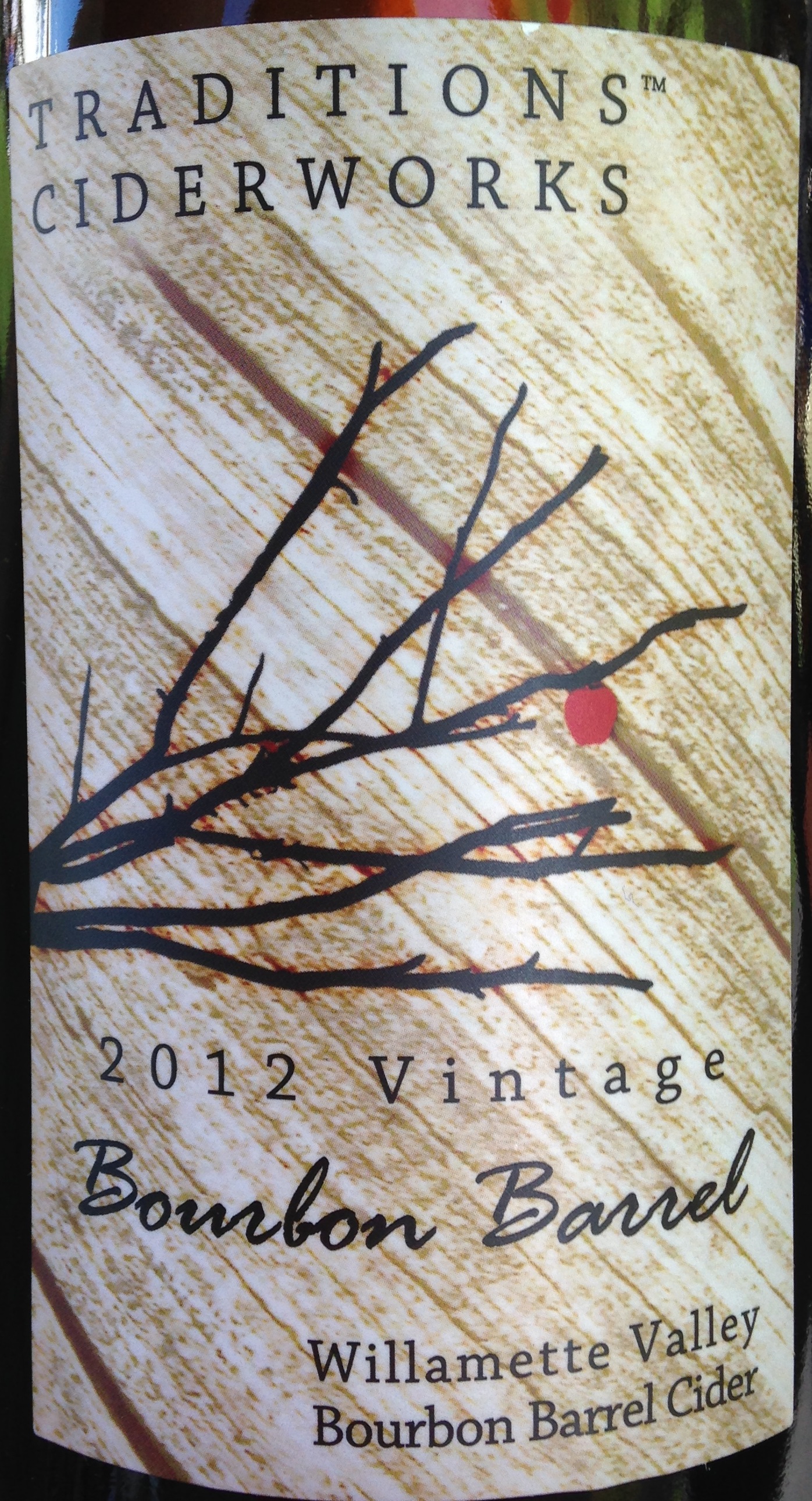
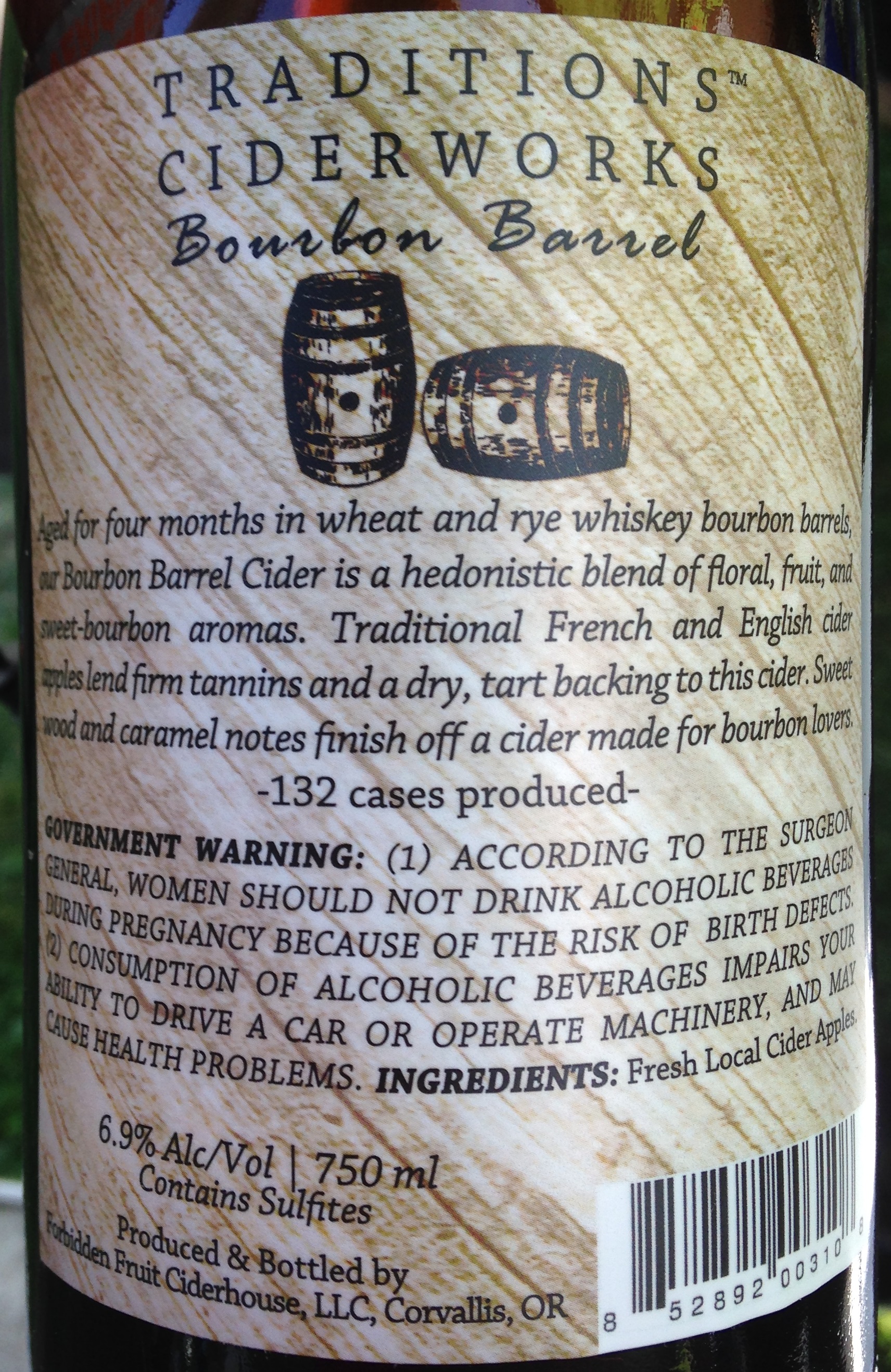
Traditions Ciderworks (by 2 Towns) Bourbon Barrel 2012 (Corvallis OR).  6.9% ABV.  On the sweeter side of dry.  Strong unique bourbon barrel flavor, but not overwhelming.  Very smooth.  Light bodied.  Higher in tannins.  Aged in Buffalo Trace bourbon barrels for 4 months (apparently they got their barrels very wet, so it adds more of the flavor of the spirit).  Made with Dabinett & Kingston Black cider apples and wine yeast.  Awesome!  This was my first time trying their Traditions line, which uses cider apples and is sold in 750 ml bottles (vs. the regular 2 Towns line which uses dessert apples and is sold in 500ml bottles, plus a couple selections in cans).  Definitely try this one if you can find some!  I was very happy to get my hands on a bottle (at Full Throttle Bottles, as they ran out at Cider Summit, or couldn’t find it or whatever).

Traditions Ciderworks (by 2 Towns) Riverwood 2013 (Corvallis OR).  6.9% ABV.  Semi-sweet.  Made with Jonagold apples (a cross between Golden Delicious and Jonathan) and inspired by sparkling brut champagnes.  I found it very similar to their Amity Rose but slightly sweeter, with some floral notes.  I imagine if I sat down with both of them I’d have better tasting notes, but I had just a few sips of each one after the other.

Wandering Aengus Oaked Dry (Salem OR).  6.8% ABV.  Made from English and French bittersweet apples.  Dry.  Mild barrel earthy flavor.  Fairly easy drinking for a barrel aged cider.  Like all of their ciders though, I picked up more bitterness than I prefer, so I’m not a big fan.

Whitewood Whisky Barrel Aged Kingston Black (Olympia WA).  9.7% ABV.  I was really looking forward to this one (mostly as Kingston Black is a famous epitome of a cider apple and I’ve never had a single varietal of it), and it didn’t disappoint!  Apparently this isn’t a true single varietal (ended up 80% Kingston Black and 20% Porter’s Perfection due to some pressing difficulty due to the type of apples), but very close.  Aged almost 2 years in Wishkaw River whiskey barrels!  Dry.  Significant rich barrel flavor.  Higher acidity and tannins with some tartness.  Longer finish.  Very similar to Traditions Bourbon Barrel, but more cider apple than (good) boozy flavor (although this one is higher ABV as Kingston Black has a high sugar content).  Quite different from their Summer Switchel I tried previously.  Definitely try this one if you can find some (very small run)!

Woodinville Ciderworks Tropical (Woodinville WA).  6.3% ABV.  Tap pour.  Cider from dessert apple juice (granny smith, gala, fuji, etc, from Fruit Smart) with mango & passionfruit essence (fresh made concentrate) to backsweeten.  Semi-sweet.  Definitely some nice bold tropical flavor going on.  Mild tartness.  Good fizz.  Definitely a tasty easy drinking cider that I think with the right price and advertising would sell well.  I found it very interesting that the cidermaker/owner Leroy said he made this (added: put the finishing touches on this) Tuesday for the weekend event, comparing to his experience in the wine industry where it takes much longer to get out a product.  (added: the cider was tank aged for 4 months and back sweetened just before the event)  Most craft cidermakers I’ve talked to will at least tank age then bottle age a bit, if not bottle condition, their ciders, so although the product is done quickly, they don’t consider it ready for many months.  This event was their release!  They said bottles should be in stores in about a month.  Overall I think its a solid introductory craft cider, kinda similar to Atlas.  The flavor of their Tropical reminded me a bit of Rev Nat’s Revival, although Rev Nat didn’t add any tropical flavor to the cider (it was all from the yeast, which must have been difficult).  I’m very intrigued to see what they will price their bottles at.

Worley’s Special Reserve (Shepton Mallet England).  5.4% ABV.  A keeved bottle conditioned cider made from cider apple varieties.  Semi-sweet.  Slightly hazy, moderate tartness, and high tannins.  This was my first time trying their cider, although I have a bottle of their “Premium Vintage” at home.  It was a solid selection, but nothing too remarkable.  Maybe as it wasn’t all that cold and had lost some fizz, which is a drawback of bottle pours from events like this.

So, what were my favorite ciders you may ask?  Traditions Bourbon Barrel followed by Whitewood Kingston Black.  Both were fairly similar bold barrel aged ciders, which is my typical favorite cider type.  I was disappointed I couldn’t get a bottle of either at the event (they were out or couldn’t find them or whatever).  However, I was able to try the Whitewood Kingston Black again at the Bill Bradshaw tasting event with 9 local cideries at Capitol Cider the Tuesday after Cider Summit, and found a bottle of the Traditions Bourbon Barrel at Full Throttle Bottles.

Other favorites included Liberty’s English Style, Eden Heirloom Blend, Moonlight Meadery How do you like them apples bourbon barrel, and Montana Ciderworks Darby Pub Cider.  Definitely impressed.  I didn’t really have a single bad cider (there aren’t too many out there), although there were some I didn’t care for.  Stay tuned for Cider Summit 2015 post 2/2, and posts on the remaining two Washington Cider Week events I went to!

Let me know what you think!  Comments please.

Like Cider Says on Facebook for the latest info, shared links, post notifications, etc.

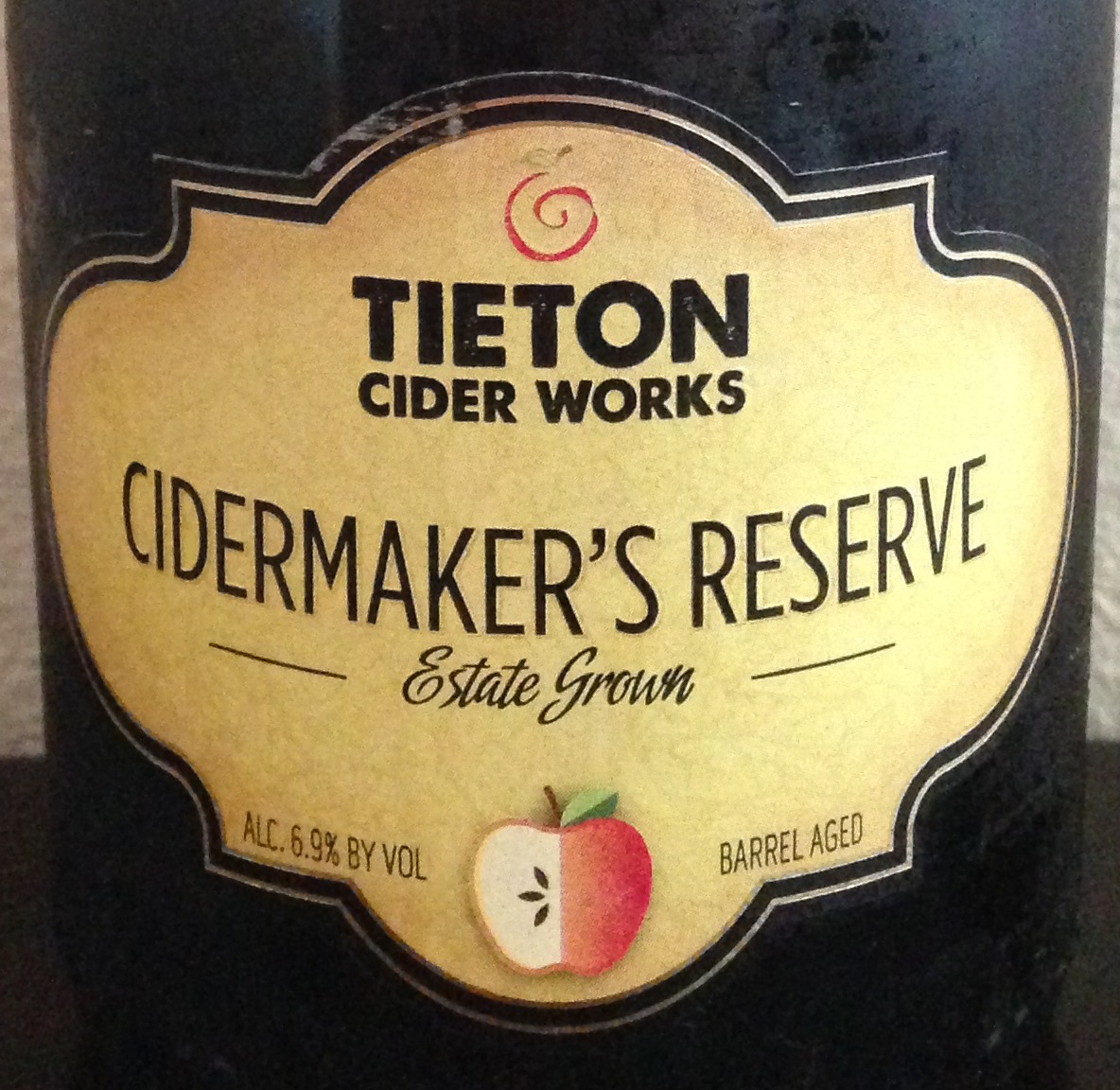
Tieton Cidermaker’s Reserve

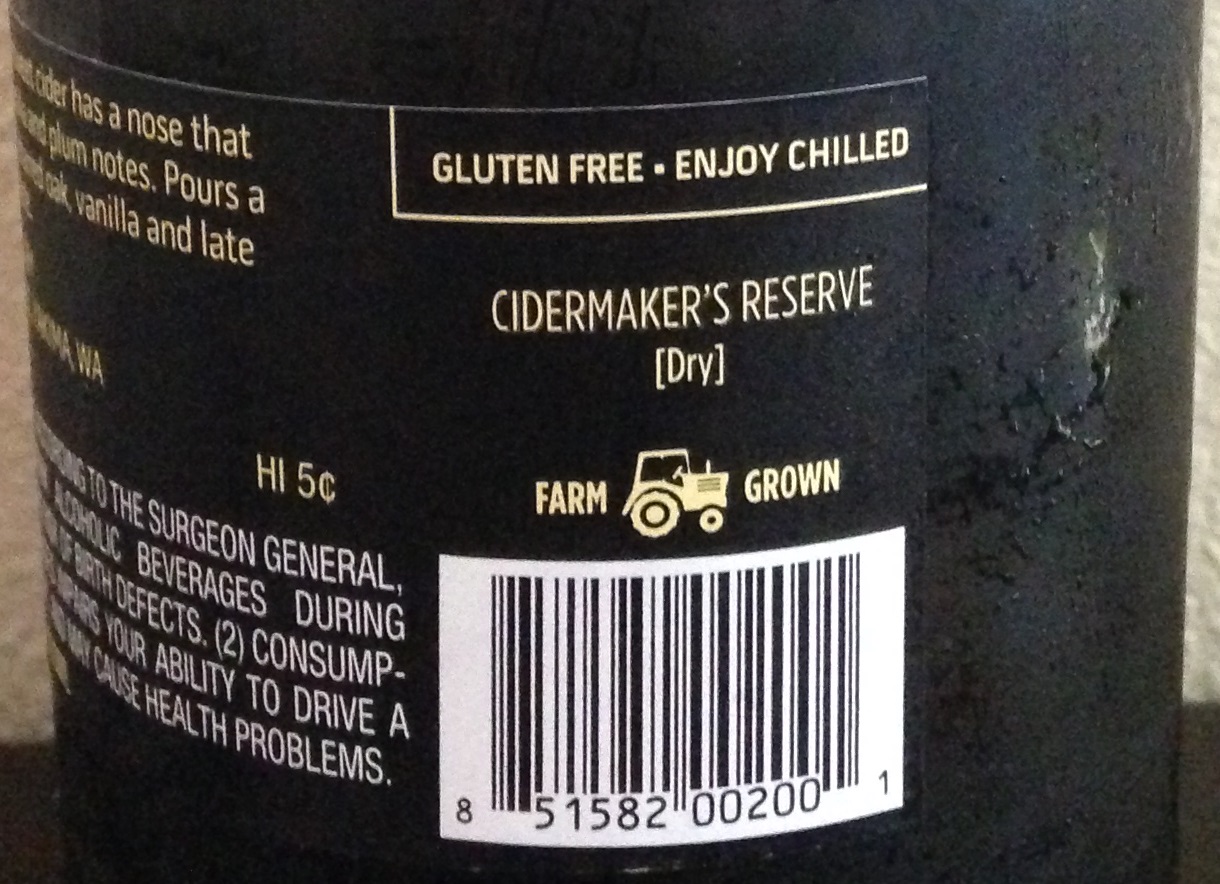
Review of Cidermaker’s Reserve from Tieton Cider Works.

2015-08-22 17.07.18

Cider:  Cidermaker’s Reserve
Cidery:  Tieton Cider Works
Cidery Location:  Yakima WA
ABV:  6.9%
How Supplied:  500ml mini champagne bottle, corked & caged

2015-08-22 17.09.38 2015-08-22 17.10.00

2015-08-22 17.10.49 2015-08-22 17.10.38

Availability:  Year round.  Tieton ciders are available in WA, OR, AK, HI, B.C., ID, CA, NV, MT, WY, UT, CO, AZ, NM, TX, FL, MI, IL, and OH (per their website).  They also take orders by phone to be shipped in WA (info here) and have a tasting room (info here).

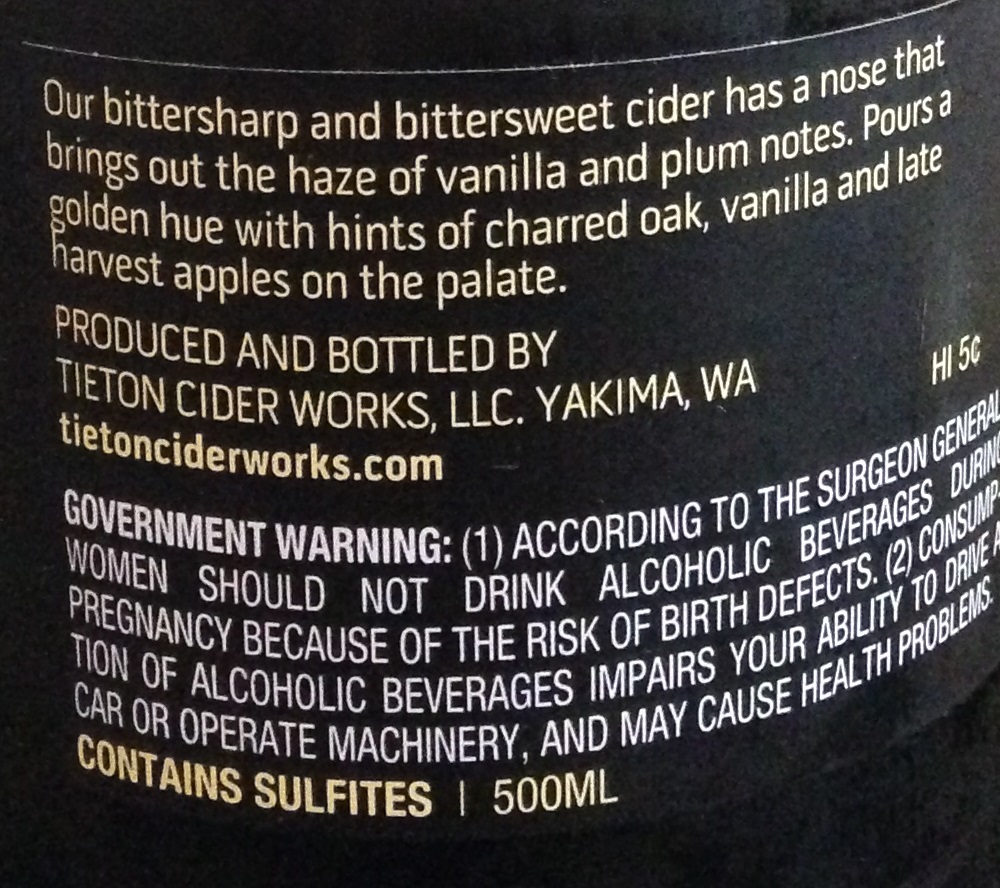
Cider Description:  This two-year-old bourbon barrel-aged bittersweet cider has a nose that brings out the haze of vanilla, plum, and slight bourbon notes. Pours a golden hue with hints of charred oak, vanilla, and late harvest apples on the palate.

Cidery Description:  We are continually asked: how did you get into the cider business?  The answer is easy: we were in the apple growing business. Period. If we had not been a farming family, cider would not have held an interest.  The fruit that is used in Tieton Cider Works cider comes from Craig and Sharon Campbell’s Harmony Orchards. This land has been in our family since the 1920’s when our grandfather planted his first trees in Tieton, Washington. We take our stewardship of the land seriously and have been farming organically for the last 25 years.  As a third generation Yakima Valley farmer with a degree in horticulture from Washington State University and over thirty five years’ experience in marketing produce, Craig has always been curious about the back-story: the history, production, science, and industry of food. Growing different varieties of trees is truly what makes Craig happy and he is always looking for new varieties to plant and nurture.  In 2008 he was introduced to cider apple varieties, those gnarly, inedible wild apple varieties needed to make great cider.  He planted twenty five varieties in a test block of two acres to study the growing patterns: did each fit into the existing bloom and harvest schedule of the farm, what were the flavor profiles of the fruit and how did that variety add to the cider that we wanted to make.  From that original twenty five, Craig has narrowed it down to the eight most suitable for commercial production, never closing the door on annual experimentation when he learns of a new variety. We now have the largest acreage of cider apples and Perry pears in the state of Washington with 55 acres.  The Yakima Valley is the largest apple producing region in Washington and there is an infrastructure existing in our valley that provides many advantages when you are making cider.  Whether we are storing our apples in controlled atmosphere, sending our apricots and cherries to be processed, or selecting the complementary hops and pumpkin for our seasonal ciders – it all exists in the valley we call home. A love of land, food and drink has inspired us to make cider with the fruit we are growing at our ranch, Harmony Orchards.  We know the ciders we make are an expression of the harvest and reflective of the fruit and the place that it is grown. We are thrilled to be involved in re:interpreting the tradition of cider making.

Price:  $9.99
Where Bought:  Total Wine
Where Drank:  home
How Found:  I’ve seen this cider at Total Wine, and even tried it awhile back (can’t remember if it was a tasting or an entire bottle).  However, I wanted to give it another go as I didn’t really remember it, and am now more into drier ciders than I was a year or two ago.

2015-08-22 17.09.12

First Impression:  Medium carbonation upon pouring.  Light champagne yellow.  Smells of ripe acidic apples and oak.

Opinion:  Dry to semi-dry.  I definitely pick up the oak barrel influence, but it isn’t overpowering in the least.  I also pick up some vanilla and bourbon notes.  Moderate acidity, tartness, and bitterness.  Medium bodied.  Some astringency.  Moderate length finish with some lingering acidity, tartness, and bitterness.  Clean refreshing taste.  Its awesome they are a Washington cidery and have such a large cider apple orchard.  Overall a solid well-balanced and well-composed cider, but isn’t one of my favorites.  It is tending towards the bold & unique category that I like, but not quite there yet.

Most Similar to:  Other local craft oak aged ciders I’ve tried such as Schilling Oak Aged, Finnriver Oak & Apple, and Snowdrift Cornice, although slightly more dry & acidic.

Closing Notes:   I look forward to trying more Tieton ciders!  I’ve tried a good deal (Cidermaker’s Reserve, Apricot, Smoked Pumpkin, Wind, Wild Washington, Cherry, and Blossom Nectar), but this is the first I’ve reviewed here at Cider Says.  I’d especially like to try their Sparkling Perry and Frost (ice cider) varieties.

Have you tried Tieton Cidermaker’s Reserve?  What did you think?

Locust Washington Dessert Apple Aged Hard Cider

Review of Washington Dessert Apple Aged Hard Cider from Locust Cider.  This is their first limited release offering, and also the first to be packaged in a large bottle (instead of a multi pack of cans or bottles, or on tap only).

There is a bit of a funny story with this bottle of cider:  Upon arriving home from the bottle shop with this cider I found it on its side in my car in my bottle tote in a small puddle of cider.  Thank goodness for waterproof floor mats…  The bottle was hissing slightly.  I guess the cap hit something in my car when it rolled around a bit and the edge got lifted slightly.  It definitely could have been worse though.  After cleaning up the mess I decided I needed to finish opening the cap and put on the attached flip-top cap before putting it in the fridge.  I hadn’t been planning to drink it that night, and it wasn’t cold anyways.  The following night I opened the bottle and it proceeded to violently foam over!  So, I had cleaned up after this cider twice before even drinking any…  I definitely got a foamy bottle which went a bit overboard in bottle conditioning!  Thankfully only a few ounces of cider was lost in those messes.

2015-08-27 17.38.53

Cider:  Washington Dessert Apple Aged Hard Cider
Cidery:  Locust Cider
Cidery Location:  Woodinville WA (Northeast of Seattle)
ABV:  6.9%
How Supplied:  750ml clear flip-top bottle

2015-08-27 17.39.422015-08-27 17.39.562015-08-27 17.39.16

Availability:  Locust Cider is currently available in WA and ID.  This is a limited release however so it may not be available everywhere that Locust Cider is sold.

Thanks to Jason Spears, co-founder of Locust Cider, for extra info on this cider!

Cider Description:  Made from Golden Delicious, Fuji, Gala, Red Delicious, and Granny Smith dessert apples.  Fermented with wild yeast (the yeast on the fruit itself, in contrast to most ciders which add new yeast). The outcome of a wild yeast fermentation is more unpredictable, and Locust described losing several batches of cider that didn’t turn out well.  The cider is then tank aged for 6 months, where they allow a small amount of oxygen into the system to initiate malolactic fermentation.  This is from secondary bacteria, as opposed to yeast, and changes the cider, reducing acidity and adding body & mouthfeel.  This technique is not always desirable, but is what they were going for with this cider variety.  Then the fermented cider is blended with fresh pressed juice and bottled ulfiltered, to allow for bottle conditioning.

Cidery Description:  Real people making a cider for real people.  They aim to make extremely drinkable ciders, with balanced flavors, not overly sweet or sour.  All ciders are made from Pacific Northwest apples and fruit, with no artificial sweeteners, only apples and yeast.  Founded by two brothers, Jason & Patrick Spears, from Texas, in early 2015.  Their name is a reminder to embrace life without compromise, after Jason was calmed by a gentle orchestra of locusts in a field after a near death experience.

Their tap room is open Thursday thru Sunday in the Woodinville WA warehouse district.

Locust Cider currently offers Original Dry, Green Tea Infused, Sweet Dark Cherry (had been tap only but bottles are on their way to stores now), Summer Berry (tap only), Thai Ginger (tap room only), and Washington Dessert Apple Cider.

Price:  ~$10
Where Bought:  Full Throttle Bottles in Georgetown area of Seattle WA, where they were having a tasting of Locust Cider (Original Dry and Green Tea Infused) and Argus Fermentables (Ciderkin and Ginger Perry).  Of those I only liked the Ciderkin, which I reviewed here previously.
Where Drank:  home
How Found:  Browsing.  I hadn’t heard of this one before.

2015-08-27 17.46.15

First Impression:  Foam!  Hazy/unfiltered honey hue.  Smells of sweet unfiltered cider, honey, and a slight earthiness.

Opinion:  Sweet but not very sweet.  Taste is similar to unfermented sweet cider, except with that hard cider kick.  High acidity.  Moderate carbonation, high foam/fizz, and a bit of tang.  No noticeable funk, but a bit of earthiness.  Moderate finish length.  No significant bitterness or astringency.  Mild tartness.  Medium bodied.  Notes of honey and cooked apples.  Moderate complexity.  This cider is slightly booze-forward, and I probably would have guessed it to have an even higher ABV.

Most Similar to:  Farmhouse style unfiltered ciders such as J.K.’s Scrumpy (from whom I’ve tried Orchard Gate and Northern Neighbor, which are a bit sweeter than this cider).

Closing Notes:   Overall this cider is a solid unique selection.  However, I’m curious how the taste was affected by the apparently aggressive bottle conditioning.  I opened this cider on a Wednesday, had a small glass Thursday, a small glass Friday, and the rest on a Saturday, and even on Saturday it had plenty of fizz left and tried to overflow the glass upon pouring!

I’ve tried most of Locust Cider’s other offerings:  their Sweet Dark Cherry on tap at Schilling Cider House and their Original Dry (canned) and Green Tea Infused (bottled) at the tasting at Full Throttle Bottles when I picked up this cider, all of which I found to be a bit lacking in flavor.  The Washington Dessert Apple however is much different and much more full-flavored than the other three.  I’ll definitely try any other limited release and/or full-flavored cider from Locust Cider, even though their current regular offerings don’t appeal to me.

Have you tried Locust Washington Dessert Apple Aged Hard Cider?  What did you think?

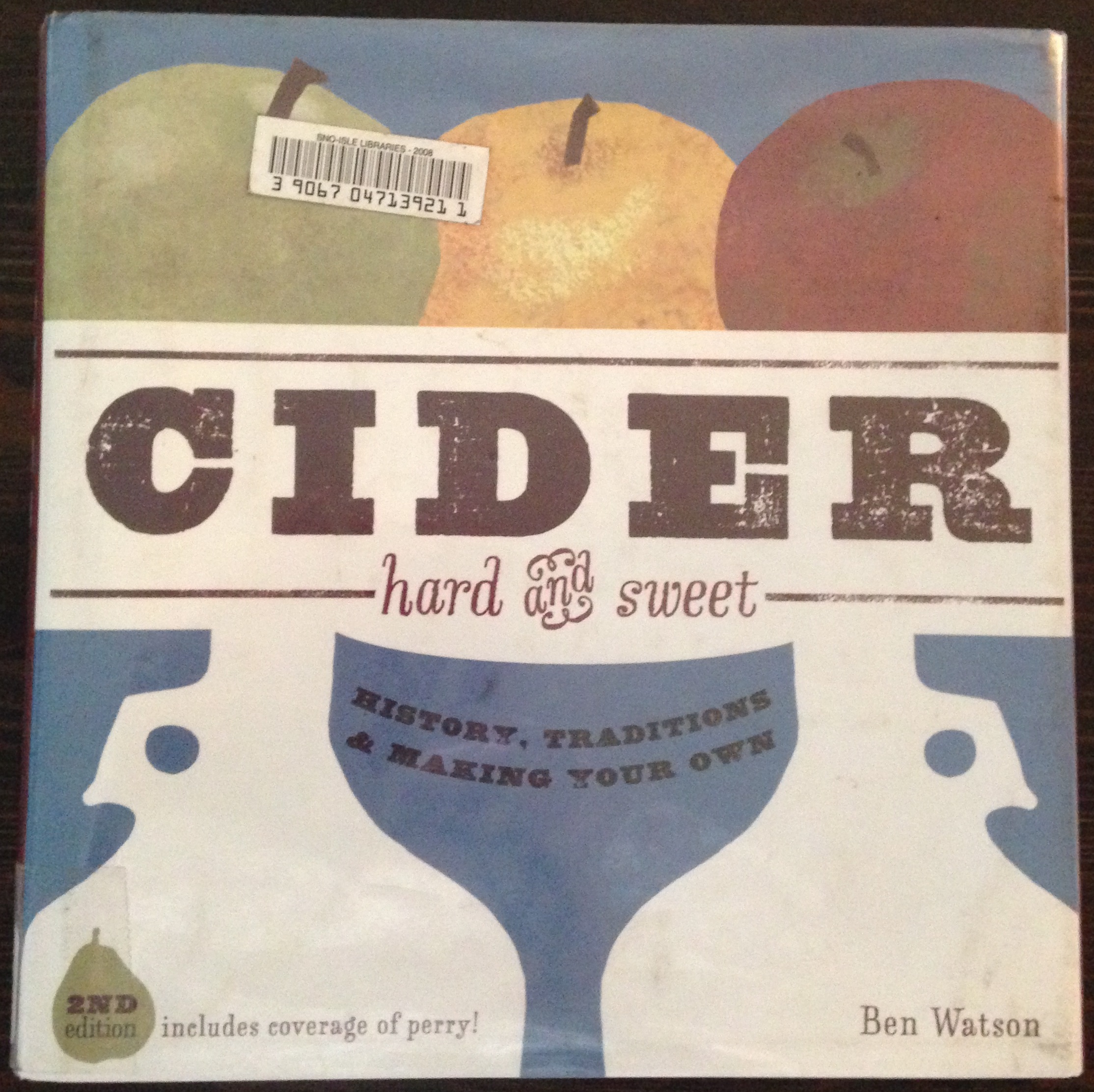
Book Review #4, World’s Best Ciders – Taste, Tradition, and Terroir

Part four of four of reviews of cider-related books I obtained from my local library.  Here are links to part 1part 2, and part 3.  This time the book is World’s Best Ciders – Taste, Tradition, and Terroir (Pete Brown & Bill Bradshaw, hardcover, published 2013).  Its is available on Amazon for $17.56 (a great deal compared to the $30 list price on the book).  The pair is also coming out with a film about cider (The Cider Hunters)!  Check out the trailer here and follow the page on Facebook here.

This book is much more cider enthusiast (vs. cidermaking) friendly than the previous three books.  I enjoyed it so much that I bought a copy, which says a lot as I haven’t bought a book in years!  Its a great coffee table book about cider with lovely photos & graphics.  There are lots of cider recommendations and information indexed by region.  This is truly a world guide in cider!  It also has a very well-written introduction with some basic information about cider, its history, styles, flavors, tasting, etc.

I was even lucky enough to attend Capitol Cider’s meet & greet, book signing, and tasting with co-author Bill Bradshaw last night!  We’re lucky to have him in Seattle for Cider Summit as he resides in the UK.  (a post on that event is in work)

world's best ciders

Chapters:

Introduction

Cider Basics
History of Cider
Apples, Orchards, and the Cider Year
How CIder is Made
Cider Flavors
Commercial Brands
Profile: Peter Mitchell
Perry
Tasting Cider
Tasting Symbols

Planet Cider
A World of Cider
(each of these subchapters has an introduction, profiles, styles, cider suggestions, etc)

Europe
Spain
France
Germany
Austria
United Kingdom
Ireland
Rest of Europe

The Americas
United States
Canada
Argentina and Chile

Australia and New Zealand

Rest of World
South Africa

Cider and Food

Some Great Excerpts:

  • First sentence of the book:  Cider is the world’s most misunderstood drink.
  • Cider takes us back to an earlier, simpler time.  It reconnects us with the land and the cycle of the seasons.  And maybe, in an increasingly virtual, synthetic, and prepackaged age, that’s why cider’s popularity is blooming around the world.
  • We do not claim that the 244 ciders in this book are definitely the best 244 in the world, but that they are 244 of the best.  Every cider in this book is one that we’ve enjoyed and one we think worth trying.  Still, everyone’s palate is different.
  • It is one of the fastest growing drinks in the world, sweeter than beer, less potent than wine, simple and yet capable of complex greatness.  Welcome to the cider revolution.
  • Those who don’t know cider can have a snide attitude if the word terroir is used in conjunction with it.  Social conditioning tells us that this is a concept exclusive to the sophistication and subtlety of wine.  But if we accept that climate (or microclimate), temperature, and soil can have a profound effect on one particular fruit–which we do, because it is true–then logically it would be bizarre to suggest it has no such effect on other fruit.
  • When we began writing this book, a leading drinks writer said to us, “Interesting, but what can you write about cider?  It tastes like apples.  What else is there to say?”
  • Some of us have far higher concentrations of taste buds than others, which creates dramatically different perceptions of flavor.  There’s also an emerging body of research that seems to prove that taste cannot be separated from other stimuli and that context, environment, mood, and memory all make something “taste” different.
  • Drink straight from the bottle and you’re cutting your nose–and about 80 percent of the flavor compounds–out of the equation.

In closing, this book comes highly recommended!  Its a great addition to our living room and a conversation starter.  For me this isn’t so much a book that you read cover to cover, but one that you pick up from time to time and leaf through a section, such as when a particular cider region strikes your fancy.  Its also a great introduction to cider to share with our houseguests before/during/after we have a cider tasting (as always happens in our house as few folks are familiar with good craft cider).

East Meets West: An Evening with Eden and Alpenfire Ciders at Burgundian Bar

Stop 2 on Thursday night brought me to the Burgundian bar in Seattle.  Cidermakers from Eden Ice Cider (Newport VT) and Alpenfire Organic Hard Cider (Port Townsend WA) were on hand to chat, they were pouring ciders from each, and there were even specialty cocktails using their ciders.  It started off very slow at 5pm, but that worked very well for me as I got some awesome conversations in while there were more industry folks than customers.  I met Kyle from Millstone Cellars (Monkton MD); I had e-mailed with him about their Cobbler cider and he remembered me.  I also met Dan from Orcas Distributing, which is one of the main cider distributors in the Seattle area.  I got to see both again the next day at Cider Summit.

The special event menu is below (click to biggify).  They also had a number of bottle pour ciders from Eden, Alpenfire, and more.  There was unfortunately only one draft cider as they apparently had some logistical issues.

2015-09-10 17.23.09

I started with a glass of Alpenfire Apocalypso, a double rum barrel aged blackberry cider.  This is their Calypso cider but rum barrel aged for four instead of two months.  This draft-only cider was $6 for 6oz (Calypso runs about $13 for a 500ml bottle).  6.9% ABV.  Middle of the road sweetness.  Berry with a touch of wood scent.  Lovely berry hue.  Fruity, moderately tart, with a hint of barrel influence.  Very tasty!  It had more complexity than your average fruity cider, which I really enjoyed.  There haven’t been too many fruity ciders I’ve been impressed with, but this is one.  Apocalypso is probably a tie with Spark! for my favorite Alpenfire cider so far.

2015-09-10 17.22.37

I chatted with Eleanor Leger from Eden Ice Cider for quite awhile.  it was awesome to learn more about Eden’s ciders, as I had seen them and was very interested, but hadn’t tried any yet.  Eden’s ciders are made by husband & wife team Eleanor & Albert Leger.  They specialize in and started with ice ciders, but have also branched out into aperitif and traditional ciders.  In addition to offering their customers more variety, both of these products are a way for them to use the same juice as their ice ciders, from a second and third pressing (the sugar content decreases).  They may actually be the only company selling cider apertifs at this time.  It was interesting to hear they are even trying to find uses for the “apple water” which is left after making the cider, such as selling it to a gin distillery which would use it in place of water for added flavor.

They were the first ice cider company in the U.S. and also have their own orchard of cider apples.  Ice cider by the way is a dessert wine variety which was developed in Canada, and is made from apples which have been concentrated by natural winter cold.  The apples are harvested at peak ripeness then kept in cold storage.  After pressing, the juice is set outdoors to freeze for 6-8 weeks, which results in a residual concentrate which is high in sugar and flavor.  The concentrate is then fermented, cold stabilized, filtered, and bottled, leaving a high alcohol and high residual sugar cider.  The final amount of cider is typically less than 1/4 of the original amount of juice pressed.  Eleanor told me approximately 20% of their juice is used for ice cider, 7% for apertif, 8% for cider, and the remaining 65% is “apple water”.

I then tried Eden’s Oak Aged Sparkling Dry Cider, 8.5% ABV, $9 for a 6oz bottle pour (runs around $10 for a 375ml bottle).  This is Eden’s first traditional cider (also available in Semi-Dry), released in 2013, and distribution was expanded outside of VT in 2014.  It is naturally sparkling from bottle conditioning using juice, not sugar (Methode Champenoise, which is VERY labor intensive; here is a great explaination).  This cider is crafted from traditional and heirloom apples (50% Kingston Black) grown within 200 miles of their cidery, aged in French oak puncheons (twice the size of typical barrels) for one year, then bottle conditioned for six months..  The purpose of the barrel aging in this case is to impart a more mature flavor, and it can actually increase the amount of tannins as well (vs. when a barrel from spirits is used it would also impart the flavor of the spirit, such as bourbon).

2015-09-11 12.36.32  2015-09-11 12.36.40
<disclaimer: these bottle label photos were taken at Whole Foods the following
day as I didn’t get a chance to ask the bartender to see the bottle>

Using such a large amount of Kingston Black apples is expensive, and Eleanor discussed the cost difference between using juice pressed from dessert apples ($2.50-4.00 / gallon) and juice pressed from cider apples ($8.00-10.00 / gallon) to make cider.  The high cost is primarily due to their rarity.  Hopefully in the coming years the cost will go down as availability increases, which will also increase the quality of ciders as more cidermakers use cider instead of dessert variety apples.  In addition to apples from Eden’s own orchard (which has about 1,000 trees and took approximately 5 years to go from planting to first harvest), they use a lot of apples from the nearby Scott Farm on Kipling’s estate, which is an old Macintosh orchard which was top grafted with many heirloom and cider apple varieties.  I also learned about Eden’s newest product addition, Imperial 11 Rose, which is an off-dry lightly sparkling 11% ABV cider made from heirloom apples and red currant.  Perfect for the wine-loving cider drinker.

On to the Eden Sparkling Dry cider tasting notes:  Lovely brilliant amber with tiny bubbles and a light foam ring.  Definitely dry, but there was a touch of residual sweetness.  Ripe apple scent and taste.  Moderate amounts of acidity, tannins, and bitterness.  Mild tartness.  Medium bodied.  High carbonation.  Hints of earthiness and funk.  Very well crafted and balanced.  I could really taste the difference from using cider apples (vs. dessert apples) and bottle conditioning (vs. force carbonating).  A perfect cider alternative to champagne.  Yum!

It was a special treat to enjoy it while sitting and chatting with the cidermaker.  I typically have trouble tolerating both dryness and bitterness in a cider, but both were so well balanced with the acidity, tannins, and carbonation that I found the cider enjoyable.  I may have to pick up a bottle of this to have on hand; the small bottle size and reasonable cost (moreso per bottle not per ounce) are nice.

2015-09-10 17.54.29

I also met Nancy Bishop and her son Philippe from Alpenfire.  Ron from DrinkingCider.com and crew also showed up later!

Eleanor from Eden even brought some specialty ciders with her all the way from VT that aren’t available here in WA.  I had to leave before the event was over as I had work at 6am the next day (Friday) so I was unfortunately only able to taste one, dubbed “Cinderella’s Slipper”.  It was a very special variety that hasn’t been released.  It was their first cider made only from (35 varieties of) apples from Eden’s own orchard.  It had literally been forgotten about, sitting in a tank at Eden’s old facility for a year.  I found it to be dry, still, slightly tart, highly acidic, and high in tannins.  Very unique!

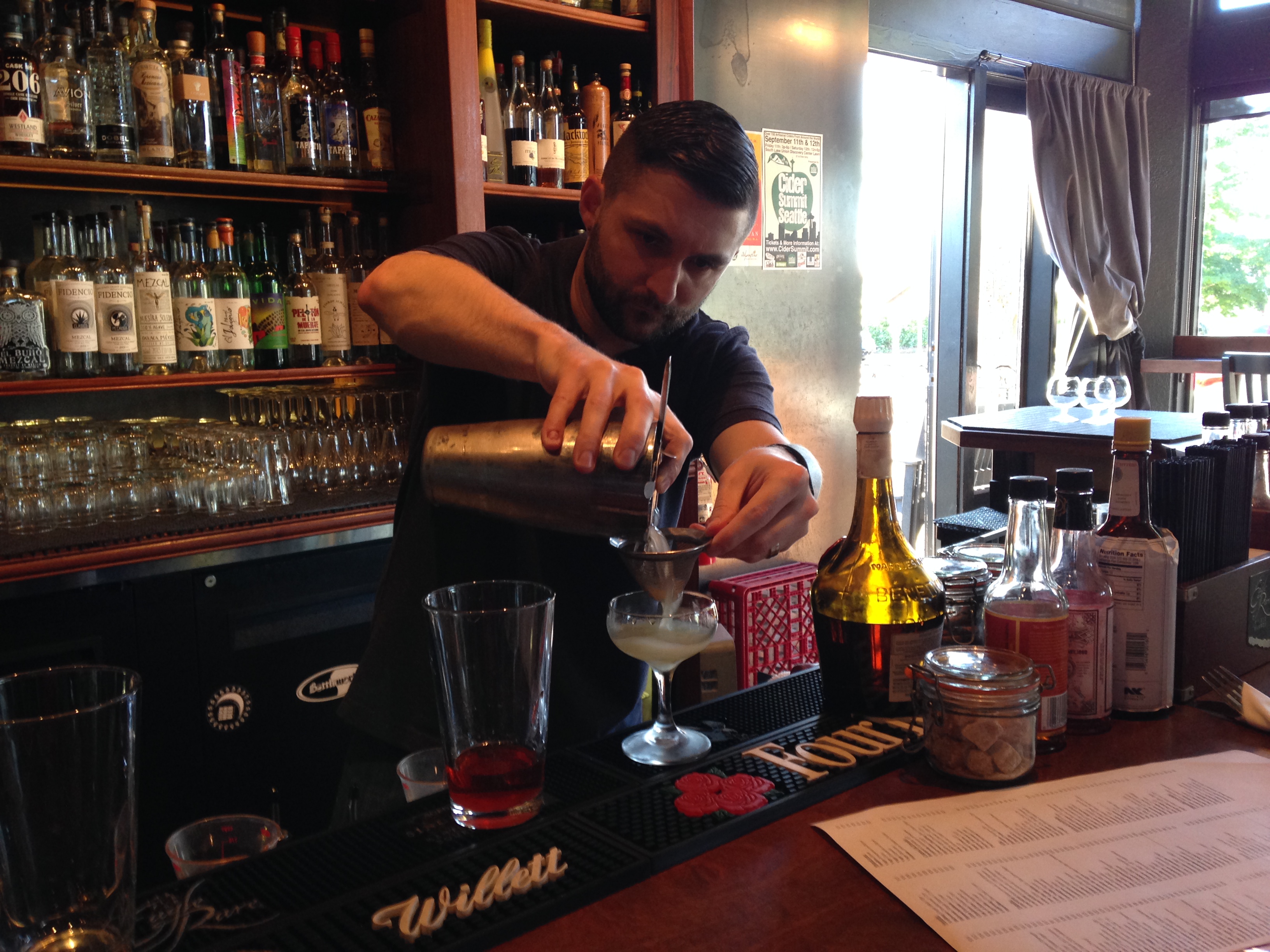
Here is a photo of the bartender at the Burgundian making one of the specialty cocktails by the way.  They were all very pretty and involved many interesting ingredients (time consuming for the bartender when Eleanor decided to try all four lol).  See the photo of the menu at the top of this post.

2015-09-10 17.33.36

However, I didn’t try any, as I am pretty picky when it comes to food & drink, especially cocktails (I don’t like gin or any aged spirits for example), and none of them sounded good to me.  Plus, I don’t really get the point of mixing high end cider into a cocktail; to me it would be like mixing expensive vodka with orange juice or whatever.  I’d rather drink the cider on its own and get the full experience of it!  I will admit I haven’t tried a cider cocktail though, and its something I want to do.

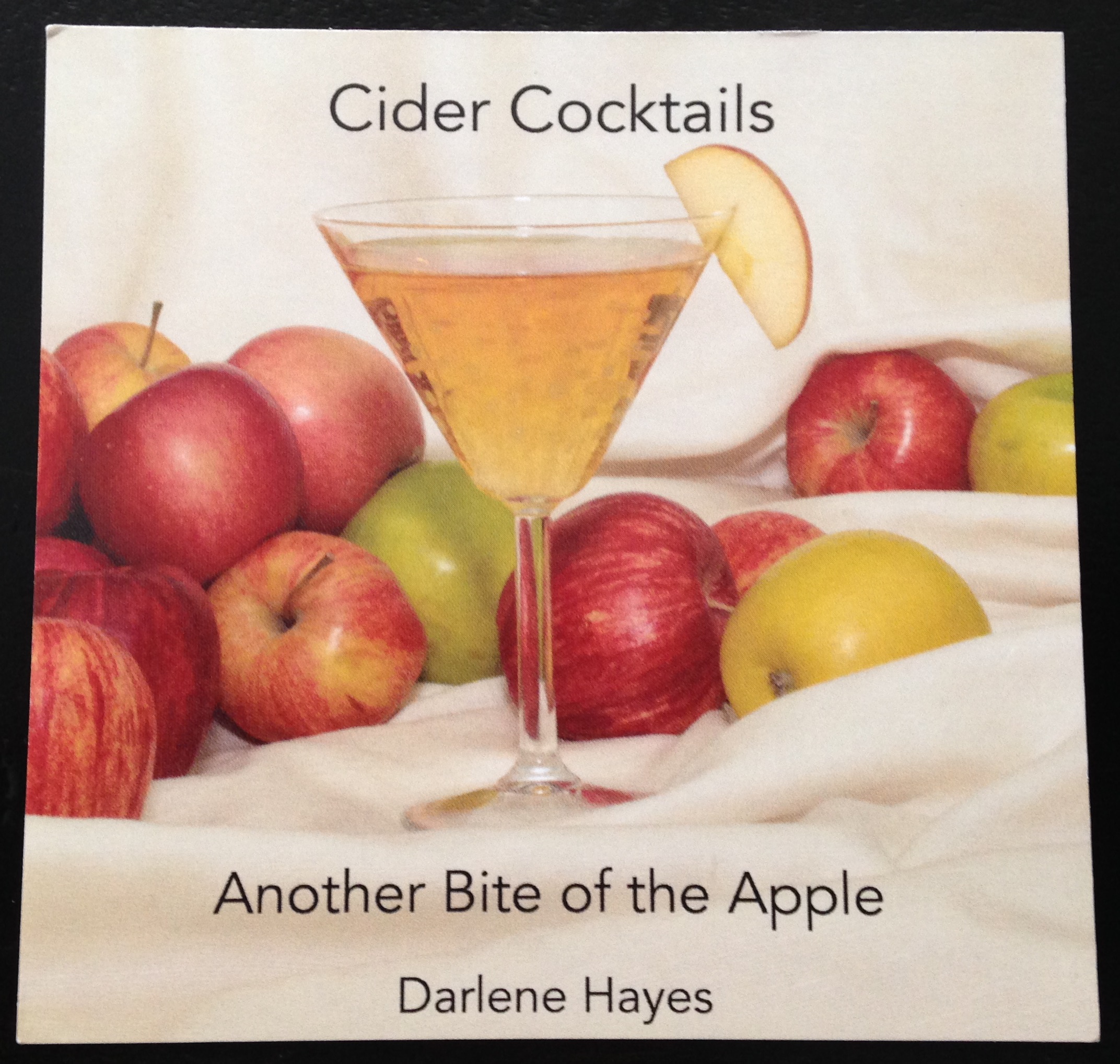
Cider cocktails seem all the rage lately around here, with Capitol Cider pouring them at Cider Summit, and Darlene Hayes even wrote a book all about them!  I was lucky enough to meet Darlene Hayes at Cider Summit and chat with her for a bit (she likes my blog by the way–very cool).  Check out her blog as well, All Into Cider, which has some great stories and information about cider.

Stay tuned for more Washington Cider Week posts at Cider Says.  Up next are posts about Cider Summit itself (including more tasting notes on Eden and Alpenfire ciders), then the Bill Bradshaw tasting event at Capitol Cider, and Schilling Cider House (2 Towns night but also hoping for some barrel aged ciders left from the night before).  I have quite a lot of photos and tasting notes to go through from Cider Summit though, so I apologize if there is a delay in the Cider Summit post/s.  To give a hint, I believe the final count is 33 ciders that I tried!  However, I have some other cider review posts to cue up in the meantime.  Cheers!

Washington Cider Week Kickoff at Seattle Cider

Thursday night was a great kickoff to Washington Cider Week!  I started the evening at Seattle Cider (opening ceremonies, although I left before that), then moved on to the Burgundian Bar (East Meets West, An Evening with Eden and Alpenfire Ciders).  This post will cover Seattle Cider and another will cover the Burgundian (plus many posts to come on Cider Summit and other Washington Cider Week events!).  I mostly chose to stop by Seattle Cider as it was a Washington Cider Week event to fill the time between when I got off work and the event at the Burgundian started at 5pm, as the events were located between work and home.  Plus I hadn’t ever been to their tasting room, The Woods (which they share with their sister brewery, 2 Beers Brewing Company).

seattle cider

Seattle Cider ended up a bit disappointing of a stop as they only opened at 3pm, and nothing was actually going on for the Washington Cider Week kickoff yet.  There were plenty of folks there though, lots of growler fills, etc.  They were only setting up while I was there, but they did however have 16 ciders on tap (6 of their own and 10 from 10 other cideries), some free cider swag, and a hot dog cart.  Also, I got to meet fellow cider blogger Ron from DrinkingCider.com!  He had reached out that he would be in town for Cider Summit, and I let him know my schedule.  We ended up meeting up at Seattle Cider, the Burgundian, and Cider Summit, which was pretty awesome.  He even brought me some cider from Tod Creek in Victoria BC which I look forward to trying; very cool.  Too bad he couldn’t take cider back to CT.

We even got a mini tour from their tasting room manager.  They were in production so we couldn’t walk through the cidermaking area (although they have an opening you can look through to see it), but we got to see a few areas.  I learned that Seattle Cider currently only uses apples from Washington (all dessert varieties except their Harvest series).  It was also interesting to hear about and see their current construction project, a kitchen!  Probably a very welcome addition…more tasting room need to offer food, even if its only chips, crackers, pretzels, whatever.

2015-09-10 15.26.48
<view of their outside seating area from inside>

2015-09-10 15.27.07
<malt sack light fixtures>

2015-09-10 15.28.07
<game area>

2015-09-10 15.28.12
<game area and view into barrel storage>

2015-09-10 15.29.34
<view of cidery tanks from the cutout inside the tasting room>
<their current largest is 280 gallons, but they plan to literally raise the roof to fit larger ones>

2015-09-10 15.25.29
<manager at the Woods (left) and Ron from DrinkingCider.com (right) in their storage area>
<yes, those are 2/4 palates I saw of cans of their Dry and Semi-Sweet>

2015-09-10 15.26.40
<taps, bar area, and fridges of canned/bottled beer/cider for purchase>

2015-09-10 15.31.20
<half of their taps>

2015-09-10 15.30.55
<Seattle Cider’s Harvest series:  Perry, Washington Heirloom, and Gravenstein Rose>

2015-09-10 15.51.52
<cider tap list part 1; I don’t care for Ginger and previously had the Green Tea,
but I tried the Valley Red and Woodlander Wit; see below>

2015-09-10 15.52.02
<cider tap list part 2, where 13-18 are from Seattle Cider>
<I’ve had their Semi-Sweet and tried the Olympic Honey & Plum Gose; see below>
<I don’t care for hopped & green apple, previously had the Grapefruit & Black Currant,
and tried the Crabenstein; see below>

I ended up sampling five ciders at The Woods / Seattle Cider.  Unfortunately they didn’t have a sampler, but would pour tastes.  I really think a sampler is the best way to go anywhere which has multiple cider choices on tap.  So, I had a couple tastes, got a glass of one, then had a few more tastes.

Seattle Cider Olympic Honey.  This cider is a special release (August 2015) Seattle Cider did with the Fairmont Olympic Hotel, and only available at Seattle Cider and the restaurant/bar at the Fairmont Olympic Hotel.  This used honey from the rooftop apiary at the hotel.  I had really wanted to try this after seeing a segment they did on King 5 local news on Facebook, so I was pleased they still had some.  Retail is $9 for a 22oz bottle, but I had a 13oz tap pour for $6.  6.9% ABV.  Semi dry.  I picked up only hints of honey, but it was refreshing, and probably my favorite Seattle Cider variety so far (I’m not a huge fan of their ciders, although they have a large local following).  Moderate acidity and and mild tartness.

2015-09-10 15.34.52
<Seattle Cider Olympic Honey>

Seattle Cider Plum Gose.  This is Seattle Cider’s twist on gose (a unique style of German beer which includes coriander and salt).  It includes Jacobsen sea salt (from Portland OR), coriander, and plums, and was made using Chardonnay yeast and added malic acid.  6.9% ABV.  Semi-dry.  Very unique but mild flavor from the ingredient additions.  Lovely light berry hue from the plums, but my taster was too small to get a clear photo of the cider’s color.  Higher carbonation.  A touch of saltiness.  Apparently they previously had a full Gose cider, and would often get requests to mix it with their PNW Berry, so they decided to make something similar with plums.

Liberty Ciderworks Crabenstein.  Made using Dolgo crabapples and Gravenstein apples with wild yeast fermentation.  7.3% ABV.  Dry.  Tart and mouth-puckering with a touch of funk, but the flavor profile is pretty mild.  I like Liberty’s Manchurian Crabapple single varietal better as it is bolder, but they are completely different styles of cider (for example, the Manchurian is 12.5% ABV).

Cockrell Valley Red.  Cider with Puyallip WA raspberries.  This is the first time I’ve tried a cider from Cockrell.  6.2% ABV.  Semi-dry.  Lovely fruity nose and red hue (again, no photo; sorry), acidic, and tart.  I didn’t pick up raspberries (nor did I know that was the fruit they used until I researched this cider), but for me it was more of a general tart berry than a specific flavor.  It reminded me some of Snowdrift Red (which I prefer).

Grizzly Ciderworks Woodlander Wit-Style.  They modeled this cider after Belgian wit-style beer (they used that variety of beer yeast).  I’ve previously tried their Ridge.  6.7% ABV.  Semi-dry.  Smells slightly woody.  I didn’t pick up any of the orange peel or coriander they included in this cider, but again, it was a pretty small taste.  I found it very similar to their Ridge, but slightly more sweet, tart, and complex, and slightly less flavorful.  I prefer the Ridge, which I found to have more of the woody & earthy notes I enjoy.

2015-09-10 15.32.05

This is just the start of my Washington Cider Week posts, so stay tuned for posts on Thursday night part 2 (Burgundian with Eden & Alpenfire ciders), Cider Summit, and events I’ll be attending next week at Capitol Cider and the Schilling Cider House!  Subscribe to Cider Says using the sidebar (on the right or at the bottom of the page on mobile devices) and like us on Facebook to ensure you don’t miss out!

Atlas Blackberry

Review of Atlas Hard Blackberry Cider.  This cider appears to be made from fermented apple juice, then blackberry, elderberry, & black currant juices are added after fermentation.

2015-08-24 16.57.39

Cider:  Hard Blackberry Cider
Cidery:  Atlas Cider Co.
Cidery Location:  Bend OR
ABV:  6.2%
How Supplied:  22oz clear glass bottle

2015-08-24 16.56.38 2015-08-24 16.56.30

2015-08-24 16.56.54 2015-08-24 16.56.02 2015-08-24 16.55.51

Availability:  Year-round in OR, WA, & ID.

Cider Description:  Oregon has a state flag, song, flower, and this my friends is our nomination for a state cider.  A deep hue of purple fills the glass as we took zero short-cuts with this fine blend of blackberries and elderberries.  The tartness of the blackberries is rounded out by the complex characteristics of the elderberries.  Filled with tannins this cider leaves a delightful fry and rich finish.  Cheers to NW berries.

Cidery Description:  ATLAS Cider Co. produces authentic hard cider fermented from 100% fresh pressed fruit from our region. Partnering with Northwest farmers to source our fruit has been a priority of ours from the beginning. Our ciders start with a base of NW varieties that are pressed to achieve a balance of sweetness, tartness, and dryness. We forge our ciders in the heart of the NW in Bend, OR.  Fermented from 100% fresh pressed fruit.  All fruit from our local OR/WA region.  No use of anything artificial or colorings.  Balanced with just a touch of sweetness.  Naturally Gluten free.  22oz bottles and kegs available.

Price:  $5.50 (usually runs $7 though)
Where Bought:  My husband picked this up for me at Albertsons.  Actually, he brought home all three Atlas varieties they had!  Apple, Apricot, and Blackberry.  I did a review of the flagship Apple variety awhile back.  Atlas also makes a fourth variety, Pomegranate-Cherry.
Where Drank:  home
How Found:  It showed up in the fridge lol.

2015-08-24 16.59.24

First Impression:  Deep berry purple red.  Foam rim.  Little carbonation.  Strong berry-grape scent.

Opinion:  Semi-sweet.  Fairly tart, especially to finish.  Dan at Atlas told me the majority of the apples used in their ciders are granny smith, which I find quite interesting (they say it gives their ciders “a nice flavorful punch that are lacking in many”).  I pick up the berry notes (blackberries & elderberries), but the black currant tastes more like grape to me.  I found this cider to be quite simple and juice-like.  Thin bodied and quick finishing.  I think I would have liked more carbonation and acidity.  It was however refreshing and flavorful.

Most Similar to:  Other berry-forward ciders.  Finnriver Lavender Black Currant is a favorite of mine.

Closing Notes:   I look forward to trying their Apricot variety I already have at home; apparently it is their driest offering.  I enjoyed the Apple better than the Blackberry.  I think its awesome that Atlas uses only 100% Northwest juice and no artificial ingredients, and can still be sold at a very reasonable price point.  Plus they are family owned and operated (I give them major kudos on that one especially as family is tough enough to get along with at home sometimes!).  They have a huge almost cult-like following, especially on Facebook.  Overall Atlas Blackberry a solid berry cider but I’m not truly impressed.  However, I’ve discovered I’m not a huge fruity cider fan…I tend to like a richer bold flavor, unique, barrel aged, etc.

Check out their Vimeo site.  It currently includes three videos, including a behind the scenes look at the details to operating a cider company.

Have you tried Atlas Blackberry?  What did you think?

J.K.’s Scrumpy Farmhouse Summer

Review of Farmhouse Summer from J.K.’s Scrumpy.  This is their summer seasonal offering, and like all their cider, is organic, unfiltered, preservative/sulfite free, and made only from fresh pressed juice.

2015-09-05 16.47.13

Cider:  Farmhouse Summer
Cidery:  J.K.’s Scrumpy
Cidery Location:  Flushing MI (Almar Orchard)
ABV:  4.5%
How Supplied:  22oz bottle

2015-09-05 16.47.23  2015-09-05 16.47.50 2015-09-05 16.47.32

Availability:  Summer seasonal, semi wide release, found in approximately 35/50 states, and in parts of Canada

Cider Description:  The Koan family invites you to try their seasonal offering: Grandfather’s Summer Cider.  Served to toiling farm hands for a job well done in the Michigan summer, this refreshing beverage with a zest of orange, the richness of plump raisins, and a hint of coriander, aims to quench your thirst.  Discover our cider, our farm, our history.  -Jim Koan, independent American Farmer.

Additional Information from J.K.’s Scrumpy:  They grow 50 varieties of apples on 500 acres on their farm.  In the 1970s there were 36 orchards in their area, and now, only 2! Approximately 16 of those varieties go into Farmhouse Summer, including Harrison, Spy, and Cortland.  The cider is fermented for 6-16 months, then blended for consistency.  Therefore no two batches are ever alike (as they say, just how Mother Nature intended).

 They sent me these links:
Thanks to Sabrina from J.K.’s Scrumpy for the extra info!

Cidery Description:  This Original Hard-Cider has been made on our family-owned farm in Flushing, Michigan for well over a hundred years. It was first pressed back in the 1850’s. Not much as changed in the process since then. We use the same apples from the same orchards as my great-great grandfather did before the time of the Civil War. We are proud of that. It gives us a sense of history.  The cider has played an important role in the ongoing history of our farm. The sale of cider actually saved our farm during the Great Depression. And, during the Prohibition people came from far and wide for our “Special Farm Cider.”  We grow vegetables and fruits here at Almar, but our cider has kept us in business when times have gotten tough. Regretfully, it seems that history has a habit of repeating itself…These past few years, many of our nation’s orchards have closed their barn doors and orchard gateways as the influx of apple juice made from cheap concentrates arrive in the USA from China and South America. Some call it a “sign of the times,” and others seem to appreciate the “bargain” at the grocery store.  All I can say is that our Orchard Gate Gold is the real thing. It’s not a “made using” or “contains” product. IT IS REAL CIDER. Pure, natural and uniquely flavorful. We grow, harvest, and press the apples right here on the farm. It is time-consuming, labor-intensive and worth every bit of what it takes to make it.  Our cider is not only natural, it is truly organic. It always has been. It’s simply a fact of what we do – and how we do it. We use no insecticides in the farm orchards. Rather, I do what my grandfather did. I have a large flock of guinea fowl that wander about and eat the bugs. Fallen apples that have hit the ground are always a food source for pests, so I let my Berkshire pigs wander the orchard and eat the fallen apples. In a fast-paced, instant gratification society all this may seem a little old fashioned, or not “cost-effective.” But, we have a cider that is not like any other, and the idea of playing around with what makes that happen… well, it just ain’t part of the plan.

Price:  $3.99 (on sale from $6.99)
Where Bought:  Total Wine
Where Drank:  home
How Found:  I had seen this variety, but had been hesitant to try it due to the orange, coriander, and raisins, which just sounded weird.  However, discussion at the Hard Cider Appreciation Society on Facebook indicated these flavors weren’t too prominent, so when I saw it on sale I thought I’d give it a try.

2015-09-05 16.49.40

First Impression:  Hazy light amber.  Still.  Smells like sweet ripe apples, pear, citrus, and cinnamon.

Opinion:  Very sweet.  Orange, citrus, and honey notes.  However, I didn’t taste any of the pear or spice I smelled.  Apparently coriander can taste like citrus (I looked that up as its not something I’m familiar with; I also learned coriander is the seeds of the cilantro plant).  No significant acidity, tartness, or bitterness.  Medium bodied.  Syrupy taste and texture.  Quick finish, but I got an annoying lingering aftertaste/feeling at the back of my throat with this cider, almost minty?  It wasn’t as prominent for my husband, but he noticed it once I mentioned it.

Some notes about this style of cider:

  • Apparently the high degree of sweetness in their ciders is from arrested fermentation.  Allowing the cider to completely ferment makes a drier cider (as the yeast has fermented most/all of the sugar to alcohol).  This is why cidermakers often back sweeten their ciders with unfermented juice (plus that is a way to bring the ABV down to a target level).  By arresting the fermentation process they retain more sweetness.
  • Scrumpy usually refers to cider made from “scrumped” apples (which is either defined as those stolen from the ground or those which are old & shriveled up) in the West Country of England, which can be a potent and rough style of cider.  I’ve had one true Scrumpy cider, Serious Scrump from 2 Towns, and it wasn’t for me.  However, currently this term is instead used to indicate that a cider is a craft / artisan product.
  • Almost all commercial ciders use sulfites (sulphur dioxide) as a preservative.  Avoiding their use is more difficult as sulfites are used to kill the natural yeast on the apples.  The use of sulfites makes a more standardized product and reduces the risk of spoilage.  Pasteurization can instead be used.  Some folks are sensitive to sulfites, so its good to see that folks have the option of cider without them (although a small amount can be naturally occurring from the fermentation process).

Most Similar to:  Other ciders from J.K.’s Scrumpy, which have a  unique sweet farmhouse (unfiltered) taste.

Closing Notes:   I really support all their practices at J.K.’s Scrumpy / Almar Orchards (organic, no preservatives, etc), but I didn’t care for this cider.  Its amazing how low they can keep their price point while maintaining all those practices.  However, I really like their Northern Neighbor cider, which is made from Michigan and Canadian Saskatoon apples.  I’ve also tried their flagship Orchard Gate Gold, but not their Winterruption (winter seasonal) or Pair Perry.  They will have Pair Perry at Cider Summit Seattle, so I look forward to trying that one!  J.K.’s Scrumpy ciders are great for folks who like a sweet cider but want a craft product (affordable and semi widely available too).

Have you tried J.K.’s Scrumpy Farmhouse Summer?  What did you think?

where will I be this week? tasting cider of course! (Washington Cider Week & Cider Summit Seattle)

For all my Seattle peeps, if you see me at any upcoming event, say hello!  I’ll be wearing a pink CIDER SAYS t-shirt.  If you also want to meet up before or after an event, let me know.

cider week CSS_2015_Apple

Here is my schedule so far for the 5th annual Washington Cider Week and Cider Summit Seattle:

Washington Cider Week opening ceremonies at Seattle Cider with 10 cideries on tap and a food truck, Thursday September 10th, 3:00-4:30pm ish (event is 3-9pm)

East Meets West: An Evening with Eden and Alpenfire Ciders at the Burgundian Bar, Thursday September 10th, 5-7pm ish (event is 5-9pm)

Cider Summit Seattle at South Lake Union Discovery Center, Friday September 11, 2-8pm ish (VIP starts at 2pm and regular at 3pm)

Cider Summit Seattle at South Lake Union Discovery Center, Saturday September 12, noon-6pm ish

Meet & Greet, Tasting, & Book Signing with Bill Bradshaw at Capitol Cider, Tuesday September 15, 6-8pm

2 Towns Tap Night at Schilling Cider House, Thursday September 17, 6-8pm ish (event is 6-9pm)

Check out the complete Washington Cider Week event calendar here, as there is a crazy amount of events going on!  And, stay tuned for lots of Cider Summit related posts here at Cider Says.  I know a lot of folks aren’t so lucky to live in Washington, so I’ll try to make it seem like you’re here with me!  Like Cider Says on Facebook for other updates as well.

Book Review #3, CIDER – Hard and Sweet – History, Traditions and Making Your Own

Part three of four of interesting notes from cider-related books I obtained from my local library.  Here are links to part 1 and part 2.  This time around is CIDER – Hard and Sweet – History, Traditions and Making Your Own (Ben Watson, 2nd edition, published in 2009).  The first edition was published in 1999.  There is now however a 3rd edition (published 2013), paperback available for $11.43 on Amazon.  Overall I enjoyed this book more than Cider – Making, Using, & Enjoying Sweet & Hard Cider.  However, my favorite of the four cider books is yet to come!  (but is quite different than these first three)

cider hard and sweet

Chapters:

The History of Cider
Roman history
Western Europe
England
America

Apple Varieties for Cider
Sex and the Single Apple
Basic Types of Apples
Keeping Things in Proportion
Finding Your Cider Apples

Sweet Cider: From Tree to Juice
In Defense of Real Cider
How Safe Is Real Cider?
A Glass a Day Keeps the Doctor Away
Making Your Own Sweet Cider
Harvesting the Fruit
Support Your Local Cidermaker
Sweating the Apples
Milling the Fruit
Pressing the Juice
Maceration
Apple Juice
Traditional Cidermaking Photo Series

Hard Cider: From Juice to Bottle
Cidermaking 101
Basic Equipment (fermentation vessels, other fermentation equipment, measuring tools, racking and bottling equipment, cleaning and sanitizing equipment, miscellaneous items)
The Juice Before Fermentation (Sugars, Specific Gravity, and Potential Alcohol; Acids; Tannins; Yeast Nutrients and Pectic Enzymes; Sulfur Dioxide; Common Cider Disorders)
Fermentation (Yeasts, Wild and Domesticated; Starting a Yeast Culture; Some Commercial Yeast Strains Used for Cidermaking; Primary Fermentation)
Maturation and Bottling

Cider Styles and Traditions
The Influence of Soils and Climate
Regional Ciders (Spain, France, United Kingdom)
Basic Cider Styles (Draft Cider, Farmhouse or Farm Cider, French Cider, Sparkling Cider, Cyser, Apple Wine, New England-Style Cider, Specialty Ciders)
Apple Wine

Tasting and Evaluating Cider
Organizing a Cider Tasting
Collecting Ciders for Your Tasting
Props and Procedures
Evaluating Cider
Sample Cider-Tasting Score Sheet
Sample Cider-Tasting Results
Common Cider-Tasting Terms

Perry, or Pear Cider
A Short History of Perry
Making Your Own Perry
English Perry Pears Grown in North America

Stronger Waters: Cider Vinegar and Spirits
Apple Brandy (Calvados)
Pommeau
Applejack
Ice Cider
Cider Vinegar

Cooking with Cider
Cider in American Cooking (Boiled Cider, Cider Syrup, Cider Jelly)
Using Cider in Recipes
Recipes (Old-Fashioned Apple Butter, Hot Mulled Cider, Cider Wassail Bowl, Pork Chops Braised in Hard Cider, Chicken Breasts Vallée d’Auge, Crème Fraîche, Apple Cider Marinade, Fish Poached in Cider, Onion Cider Relish, Red Cabbage Braised in Cider, Harvest Stuffed Squash, Pears Poached in Cider, Caramel Apple Gelato, Lost Nation Cider Pie, Tarte aux Pommes – Apple Tart, Pâte Brisée, Boiled Cider Apple Crisp, Pears Preserved in Calvados)

Cidermaking: Beyond the Basics
Scaling Up
Measuring Instruments
Winesap
Traditional Sparkling Cider
Fermentation Vessels and Supplies
Fermenting and Aging in Oak Barrels
Kegging, Filtration, and Bottling Equipment
Keeping Things Sweet (Keeving; Cold Shocking, Filtering, and Stabilizing Cider)
In-Bottle Pasteurization
A Final Thought

What I Found Interesting:

History

  • Only a few species of small wild apples are native to North America (crabapples).  The first apples as we know them were brought by colonists from England and Western Europe, as early as 1623.
  • The American folk hero Johnny Appleseed (real name John Chapman) became a symbol of the apple’s spread as it followed Western settlement in the years after the Revolutionary War.  He operated an extensive frontier nursery In Pennsylvania, and traveled planting apple seeds and selling seedling trees to settlers.
  • By 1767 in Massachusetts more than 35 gallons of cider per person per year was consumed.  Cider was even a common unit of exchange.
  • By 1775 one out of every ten farms in New England owned and operated its own cider mill.  Most early settlers preferred not to drink the local water, which could be unpalatable or even polluted.
  • The first apple trees came to Washington state around 1848.  By 2000, Washington produced half of the U.S. apple crop (5% of the world crop).
  • Cider production had already dropped (due to decreased consumption) prior to Prohibition, from 55 million gallons in 1899 to 13 million gallons in 1919.
  • China is the world’s largest apple growing nation.  [which is probably why we hear of some cidermakers unfortunately using cheap Chinese imported apple juice concentrate in cider]

Cider Apple Varieties

  • Most apples benefit from being cross-pollinated by another tree of a separate variety.
  • A good fresh cider requires sweetness and body, sprightliness and aroma, and very few if any single apple varieties possess all of these qualities.
  • True cider apples are mainly bitter-tasting varieties that are used in making the classic hard ciders of Northwest Europe and England.  The bitterness and astringency of those apples come from the tannins that are present in both the skin and flesh of the fruit.
  • Apples vary wildly in sugar content from around 6% to nearly 25% (Wickson, a small high-sugar and high-acid variety from intentionally crossing the Newtown Pippin and Esopus Spitzenburg).
  • Apples of the same variety may vary considerably in sweetness during different growing seasons and regions.
  • Apples vary wildly in acid content, from 0.1% to 1.3%.

Cidermaking

  • Sweet cider naturally contains approximately 15% sucrose, 74% fructose, and 11% glucose.
  • Tannins give a hard cider body and a dry finish, and help clarify (fine) the cider making it less hazy and more brilliant.
  • The complex bouquet of a hard cider is partly due to the aromatic varieties of apples used in the blend, but also partly due to the fragrant compounds produced as a result of yeast fermentation.

Cider Styles and Traditions

  • An important contributor to the character of any cider is something the French call terroir, a term referring to the place where the fruit is grown (soil composition, climate, microclimate, etc).
  • Two relatively unknown types of cider in the U.S. are German Apfelwein (8% of the world’s cider) and cider from South Africa (14% of the world’s cider, second only to the UK).
  • The greatest, oldest, and most highly regarded cidermaking areas of Europe are England’s West Country, Normandy and Brittany in France, and Asturias and the Basque region of Spain.
  • French cider is classified as Cidre Doux (up to 3% ABV), Demi-Sec (3-5% ABV), and Cidre Brut (over 5% ABV), and is 9% of the cider produced worldwide.
  • Draft cider is the most common variety in America, and most often sold in six-packs.  It is usually made of juice from surplus dessert apples, fermented to dryness, filtered, cut with carbonated water and/or apple juice to 5-6% ABV, and sulfited before bottling.  It is sweet to semi-sweet and should be drunk very cold.
  • Farmhouse or farm cider is traditional, “real” cider, or English dry cider.  It is usually still, dry, fully fermented to 5%+ ABV, and may have sweeteners added.
  • French cider of cidre doux relies on a process known as keeving, in which pectins and nitrogenous yeast nutrients are precipitated out of the cider, then clarified juice is siphoned into another container to begin a long slow period of fermentation  It has some residual sweetness and is only 2-4% ABV.
  • Sparkling cider is carbonated in some way, either by natural carbonation (secondary fermentation with a small amount of sugar), the French “closed cuvee” champagne method, or force/artificial carbonation.
  • The main difference between sparkling and effervescent ciders is the clarify and brilliance of the former, from removal of spent yeasts and other residues.
  • Apple wine is produced when sugar is added to raise the specific gravity high enough to obtain a 10-12% ABV product.  Otherwise there is little or no difference from hard cider.

Fox Tail Fuzzy Haven

Review of Fox Tail’s Fuzzy Haven cider, a dry peach cider I tried on tap.  This is the first time I’ve tried a cider from Fox Tail, although I’ve seen their flagship Sir Issac variety in bottles (at Full Throttle Bottles in Seattle).  I believe that is currently their only bottled cider, although they have expansion plans, and they offer a number of varieties on tap.

Cider:  Fuzzy Haven
Cidery:  Fox Tail
Cidery Location:  Hood River OR
ABV:  5.5%
How Supplied:  on tap

fox tail logo

Availability:  regional, only North & Central OR and Western WA

Cider Description:  Named for everyone’s favorite peach variety the Red Haven. It has great notes and flavor of peach mixed with apples. (Dry to Semi-Dry)
[Fox Tail’s website says 6.2% ABV, but this was listed as 5.5% ABV on the menu board.  I imagine it may vary batch to batch, and I’m more likely to believe the menu board as listing what the keg said.]

Cidery Description:  Fox-Tail Cider comes with a long history of family farming in Oregon. It all started in the late 1800’s with a German immigrant who planted apple trees to export apples back to Europe. August Paasch created the Paasch packing label for domestic and export. He continued farming with his sons into the 20th century.  Every fall August would crush up a few barrels of raw squeezed apple cider and let it naturally ferment. He was always a big hit when he’d bring the barrels back out for the New Years Eve party that following winter. Five generations later, his Great Great Grandsons still work the land. Growing not only apples, but pears, cherries, peaches and more. In 2009 Bob and long time friend Justin Cardwell began doing test batches of hard cider. Foreseeing that in the next few years there would be a reemergence of the cider industry. (Cider was America’s drink of choice before prohibition.) In 2013, Fox-Tail opened its doors next to Smiley’s Red Barn in the heart of the fruit growing area of the valley. Now distributing throughout the Pacific Northwest, Fox-Tail Cider has only begun to tell its tale.

They have a taproom open seasonally with 10 hard cider selections (5 of theirs and 5 others),plus non-alcoholic cider.

2015-09-04 16.41.48
<tap list at ‘Round the Table Gamer Pub in Lynnwood WA>

2015-09-04 16.41.41
<my selection>

Price:  $5.50 / pint on tap
Where Drank:  ‘Round the Table Gamer Pub in Lynnwood WA.  I heard about them on Facebook and visited just for the cider, as they have three on tap and a few bottle selections as well.  Their other cider tap selections that day were Finnriver Habanero and Tieton Cider Works Dry Apple.  They even had a mead (Kurt’s Apple Pie from Moonlight Meadery).  It wasn’t really the type of scene my husband and I like on a Friday night though…lots of teenagers, and everyone was very into the games they were playing, but apparently their typical scene is more family-like.  It wasn’t so much a place to hang out and just have a drink (no bar, and it was library type tables & chairs to accommodate game play).

However, I wasn’t really expecting a bar type atmosphere (for that sort of vibe in the same area, my vote is definitely Special Brews, which has a larger tap list but less cider, and a huge bottle selection).  I imagine ‘Round the Table is a really good family place though, which is what they cater to (vs. a 21+ bar).  They sell all types of games, have a selection of games which you can test play for free, and a community puzzle.  The prices were reasonable, they had a small food selection (toaster oven type stuff), and about a dozen varieties of Full Tilt ice cream.  There were also specialty sodas, including on tap.  They even do growler fills (32oz).  Check out this article about their opening last year.  The co-owner even got in touch with me and mentioned they really want to do a cider event, so I look forward to coming back for anything cider-related!

2015-09-04 16.24.34

First Impression:  Yellow hue.  Light foam ring.  No visible bubbles/carbonation.  Mild apple-peach slightly earthy scent.

Opinion:  Dry to semi-dry.  Hints of peach and citrus, but I found Fuzzy Haven to be a very mild flavored cider.  Crisp tasting and fairly easy to drink.  Moderate acidity.  Mild bitterness,  Mild to moderate tartness.  Light bodied.  Very little carbonation.  Quick finishing.  Slightly earthy but not funky.  I looked it up before ordering a pint, so I was expecting it to be dry, but I’d thought there would be more peach flavor.

Most Similar to:  Other mild fruity ciders.  I’ve tasted this most often with cherry (of which I’ve had at least 8 types), but I’ve also had one peach cider, which I found to be mild, from Blue Mountain.

Closing Notes:   I’d recommend Fox Tail Fuzzy Haven for someone who likes drier fruity but mild ciders.  Although it was a very solid cider, I didn’t especially enjoy it…I usually go for ciders which are more boldly flavored.  However, I’d be interested to try other varieties from them.

Have you tried any ciders from Fox Tail?  What did you think?

Finnriver Honey Meadow

Review of Honey Meadow from Finnriver, their Spring seasonal botanical release.  I’ve tried a number of other Finnriver ciders (Oak & Apple, Habanero, Black Currant, Lavender Black Currant, & Fire Barrel), but this is the first full Finnriver review at Cider Says!  Finnriver has gorgeous bottles, an awesomely informative website, and of course, tasty ciders!  They also make fruit wine (brandy and port-style).  Here is a great illustrated Finnriver product guide.

2015-08-21 16.03.17

Cider:  Honey Meadow
Cidery:  Finnriver
Cidery Location:  Chimacum WA
ABV:  6.5%
How Supplied:  500ml bottle

2015-08-21 16.03.30 2015-08-21 16.04.09 2015-08-21 16.04.21

Availability:  Spring time in WA, OR, CA, AZ, NV, TX, IL, CO, and Alberta & BC Canada (detailed info here).  They also have an online store (which can ship to WA, OR, CA, AK, CO, MN, FL, & WA D.C.)

Cider Description:  Finnriver’s ‘Elijah K. Swan’ Infused Botanical Hard Ciders are named after the good folks who sold us the farm (Lige & Kay Christian) and who first planted apple trees here, as well as for the trumpeter swans that overwinter in the valley.  This cider is a tribute to our neighbors and to those big white birds who remind us that earth is still wild.  Each season the ‘Elijah K. Swan’ release seeks to capture the wild and garden-grown taste of life on the Olympic Peninsula.

The Honey Meadow cider is our SPRING release, featuring Finnriver’s bright base of fermented organic apples, backsweetened with Olympic Peninsula honey and infused with local lemon balm and chamomile.  With thanks to Denise at Mountain Spirit Herbal Company and Tinker Cavallero, local gardener extraordinaire, for finding us just the right herbs for this blend.  Drinking this might make you feel like a happy honeybee after a great green day among the blossoms…

Cidery Description:  At Finnriver we gather and ferment the flavors of the land to offer you farmcrafted hard ciders and spirited fruit wines. We are inspired by the allure of the fruit, the ancient history of the craft of fermentation and the lively traditions we now seek to revive.  Our mission is to inspire a deeper connection to the land that sustains us….Some of these ciders are small-batch, seasonal and labor-intensive. Others are produced with contemporary methods and more readily available year-round…Finnriver grows over twenty varieties of traditional and heirloom apples in our organic orchard, to feature in our traditional and specialty ciders.  (they have a tasting room open seven days a week, noon to 5pm)

Price:  $7.99 (on sale from $9.99)
Where Bought:  Total Wine
Where Drank:  home
How Found:  Browsing, but I had heard of this cider before.

2015-08-21 16.06.48

First Impression:  Honey yellow hue.  Medium carbonation upon pouring, and tiny bubbles remain.  Smells of ripe apples, honey, and chamomile.

Opinion:  Semi-sweet.  Tastes of the honey and chamomile it smells like.  I think I pick up the lemon balm more with the moderate tartness (I wouldn’t have identified it without the description).  Carbonated mouthfeel and medium bodied.  Mild sourness and bitterness.  Mild earthy funk, and a flavor that makes me think of honeycomb?  Very unique and semi-complex.  I like the herbal qualities and don’t think it is overdone at all (which I was afraid of, but was unfounded).  Great for spring & summer time!  I picked this cider up a couple weeks ago and knew I wanted to drink it before the seasons changed (where has the summer gone?).

Most Similar to:  Woodchuck Out on a Limb Oopsy Daisy, which although it is a significantly sweeter and commercially-made cider, has some similar honey & chamomile flavors.  i think the Finnriver cider is much better done, with a more complex crafted balanced flavor.  I’ve had one other honey cider as well, Angry Orchard Summer Honey, but wasn’t a fan (tasted syrupy to me).

Closing Notes:   Tasty!  This makes me want to try more of their seasonal botanical line, as I liked both Honey Meadow and Lavender Black Currant.  I also really want to try some of Finnriver’s special releases (Artisan Sparkling, Apple Blueberry, Golden Russet, and Apple Abbey), but don’t remember seeing any of them near me.  Maybe now that I start looking I will though.

Have you tried Finnriver Honey Meadow?  What did you think?

Red Tank Happy Cider

Review of Red Tank Happy Cider.  This is currently Red Tank’s only cider available outside of kegs.  However, they have numerous varieties available on tap, and plan to have their Roughneck Cider available in cans in November.  What vibrant packaging!

2015-08-16 16.28.51  2015-08-16 16.28.40

Cider:  Happy Cider
Cidery:  Red Tank
Cidery Location:  Bend OR
ABV:  5.5%
How Supplied:  16oz cans (four pack, although I bought this one individually)

2015-08-16 16.28.19
There is a lack of information on the can, although unfortunately that is quite common.  Actually, I couldn’t even find much information online on this cider.  So, I e-mailed the cidery.

Availability:  Limited to OR and WA (ID and Northern CA soon)

Information from Drew Wilson at Red Tank Cider Company:

Cider Description:  An authentic, powerful apple profile with a crisp, clean acid background. Balanced with just enough sweetness to bring it all together. We wanted a cider that made us Happy, so we made one. We’re not making any health claims, it’s just really good.  Made only from 100% fresh-pressed NW apples.
Happy Cider is currently our only packaged product because we thought it a very approachable cider.  It is fruit forward and clean. Fresh pressed apple juice and yeast are our only ingredients in Happy Cider. Our juice is made up of a blend of table apple juice (Red and Golden Delicious, Granny Smith, etc.)

Cidery Description:  Northwest craft cider.  Born from years of industry experience, Red Tank Cider creates real North West hard cider. We make cider because we have a serious, uncontrollable passion for it. We won’t stop. It’s not supposed to be easy. That’s why it tastes so good. We practice sustainable techniques in our cider house. We use only apples, yeast, and natural sulfites to make our cider. We do not put in any chemical additives and present our craft in its natural form.

Red Tank Cider is the first cider company in Bend Oregon.  We started this company with knowledge and sweat.  We have not taken out any loans or taken on any investors in our effort to bring the people cider.  From the people for the people.  We currently produce around 700 barrels a year with our eye on expanding that to over 2,000 within the next 18 months.

Additional Notes:  Bend OR has two cideries, Red Tank and Atlas.  Red Tank has a tasting room open Friday 4-6pm and by appointment.  Atlas has a tasting room open Wed-Sat 11am-11pm and Sun-Tues 11am-7:30pm.  I reviewed Atlas’ flagship cider awhile back.  Atlas has an especially large following online for their size.

Price:  $3.79 / can (runs about $14 for a full four pack)
Where Bought:  Total Wine
Where Drank:  home
How Found:  Browsing.  I’d seen this variety for awhile but skipped buying it due to the price.  However, I saw some talk online that it was good, and I was curious.

2015-08-16 16.29.31

First Impression:  Medium amber.  Moderate carbonation upon pouring.  Sweet cooked apple scent.

Opinion:  Between semi-dry and semi-sweet.  Clean, smooth, crisp, and refreshing.  Moderate tartness, bitterness, and acidity levels.  This cider seemed to go almost flat quite quickly.  Medium length finish with some lingering bitterness (although I’ll admit I’m sensitive to bitterness).  Some caramel and vanilla notes.  However, I found the flavor overall to be quite mild, almost watered down tasting.  Also, it was on the boring side for my tastes.  I tend to like bold & unique ciders though, and this is more of a plain flagship type cider.  Additionally, it seemed to have a lot of apple “juice” flavor for not being made from concentrate.  Overall I think its commendable that Red Tank is making a cider with 100% fresh pressed local juice without additives and without too much sweetness.  It just didn’t wow me, especially for the cost.

Most Similar to:  Other local flagship ciders I’ve tried.  The one that especially comes to mind is from HUB, which I have also reviewed here, probably due to the sweetness level and the lingering bitterness.  Another one is 2 Towns Bright Cider.

Closing Notes:   Although it didn’t impress me, Happy Cider is however a solid choice and I’d be very interested to try some of their other ciders in the future.

Have you tried Red Tank Happy Cider?  What did you think?

Book Review #2, Cider – Making, Using, & Enjoying Sweet & Hard Cider

Part two of four of interesting notes from cider-related books I obtained from my local library (Part 1 is available here).  This time around is Cider – Making, Using, & Enjoying Sweet & Hard Cider (Annie Proulx & Lew Nichols, 3rd edition, published in 2003).  Similarly to The New Cider Maker’s Handbook, the majority of this book has a cidermaking focus.  Paperback priced at $10.75 on Amazon.  From my perusal, The New Cider Maker’s Handbook seems to be a better choice over this one, mostly as it is more thorough and has an easier to read layout.  Additionally, hard cider has really evolved in the U.S. since 2003!

making using enjoying cider

Chapters:

Cidermaking: What You Need and How to Do It
Cidermaking, Step by Step
Equipment and Materials: How to Use Them
Cider Disorders

Making Different Cider Varieties
Basic Still Blended Cider from North American Varieties
Naturally Sparkling and Champagne Ciders
Old-Fashioned New England Cider
French Cider
Cider in a Hurry!

Apples for Cider
The Apple – Body and Soul
Good Cider Apples
European Cider Apples
Canadian Apples
North American Astringents
North American Cultivars Used in Making Cider

The Home Cider Orchard
The Orchard – from Dream to Reality
Climate and Weather
Sizing up the Site
Soil
Staking Out Your Orchard’s Claim
Planting
Orchard Care
Diseases, Insects, and Wildlife
The Harvest
Developing Your Own Cider Apple Trees

Beyond Cider:  Vinegars, Brandy, Tasting, and Cooking
How to Make Vinegar
Aromatic and Herb Vinegars
Applejack and Apple Brandy
Apple Brandy
Cider for Tasting, Drinking, and Cooking
Cider to Drink and in the Kitchen

Cider and the Law
U.S. and Federal Law and Regulations
Canada

Appendix: Making Your Own Equipment
Plans
Materials
Ingenuity
Kits
Websites

What I Found Interesting:

  • Twelve steps of cidermaking:  harvest, “sweating”, washing, grinding, pressing, blending, testing, fermentation, racking off, filtering or fining, bottling, and storage.
  • Popular proportions for juices are neutral base (30-60%), tart (10-20%), aromatic (10-20%), and astringent (5-20%).
  • Tannins are complex phenolics which add a slight bitter tang and astringency to cider, and give the finest ciders their flavor and personality.  They do not add acidity to the juice, as does malic, tartaric, or citric acids.  Dessert apples have about one-fifth the tannins of European cider apples.
  • The single most important step in cidermaking is acquiring fine-flavored, well-ripened apples with good levels of acid and tannin.
  • A standard apple tree will produce about ten bushels of apples and has a lifespan of around a hundred years.  (there are also semidwarf and dwarf trees)
    • One bushel of apples weighs about 45 pounds, and will yield 2-3 gallons of cider.
  • Tulip-shaped clear wine glasses are recommended to hold the cider bouquet at the lip of the glass.
  • The sweeter the cider the colder it should be served.  Drier cider may be served at room temperature.
  • Describing scents, flavors, and tastes is a difficult job, since they are perceived differently by people, linked to obscure personal memories, and to different culturally acquired food habits.
  • Cider color varies based on both the apple varieties and the way it was made.
  • For a cider tasting, go from dry to sweet, young to old, and lighter to heavier alcohol content.

Washington Cider Week Events Surrounding Cider Summit Seattle

For my Seattle peeps…what Washington Cider Week events are you going to?  I’m thinking of the following:

East Meets West: An Evening with Eden and Alpenfire Ciders (Thurs Sept 10, 5-9pm, Burgundian Bar)

Tasting and book signing with Bill Bradshaw (Tues Sept 15, 6-8pm, Capitol Cider, $30)

One or more events at the Schilling Cider House, such as the wood aged, Finnriver, Portland Cider Co, 2 Towns, and/or Schilling nights (they have something every night 09/10-09/18, then 09/20, each from 6-9pm).

There is also a cool sounding one the day after Cider Summit, Cider Fete (Sun Sept 13, 3-7pm, Bottlehouse), but I’m guessing my liver may need a break by then…

Keep an eye on the calendar at http://www.nwcider.com/cider-events/, although some of these aren’t even on there yet.

cider week